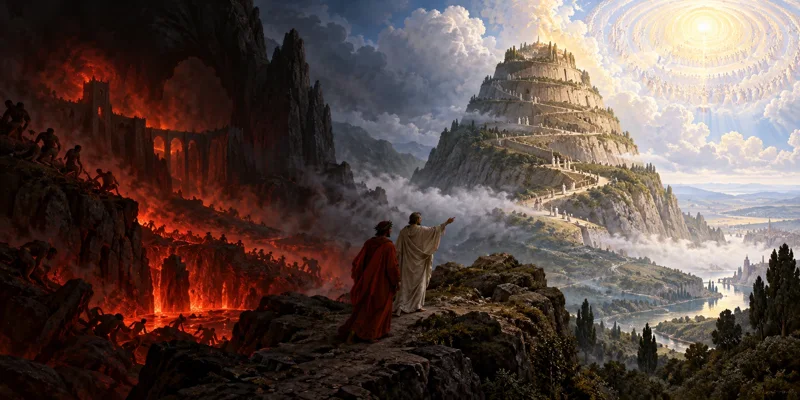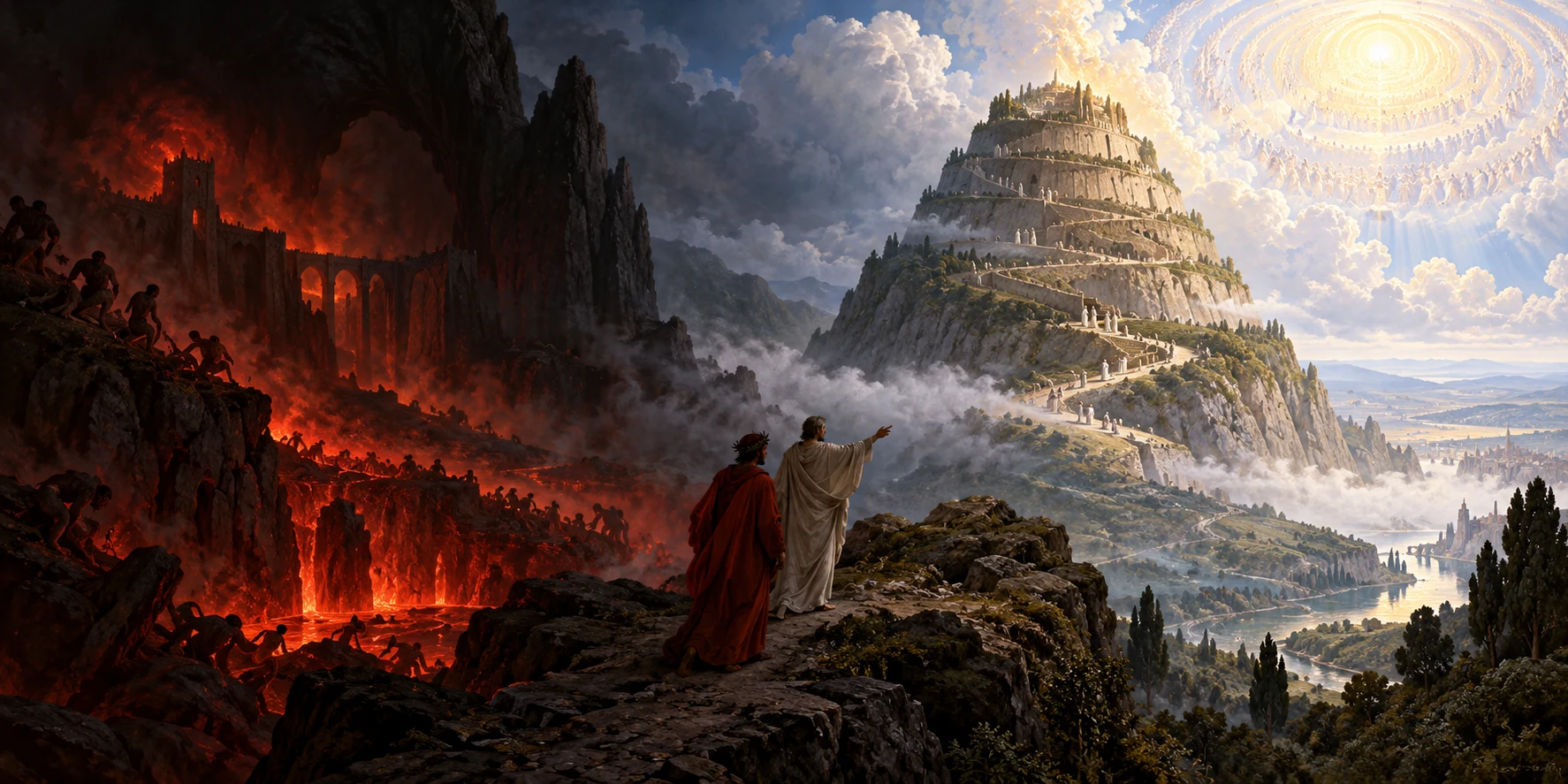
Why is it called the Divine Comedy? Because in Dante’s time, a comedy was not necessarily funny. It was a story that begins in trouble and ends in happiness, told in an ordinary, everyday language rather than the lofty style of tragedy. Dante’s poem begins with a man lost in a dark wood and ends in the presence of God, and it is written in Italian rather than Latin. By the rules of his day, that made it a comedy.
And the “Divine”? Dante never used it. He called his poem simply the Commedia. The word that now seems inseparable from it was added by admirers after his death.
What did “comedy” mean to Dante?
Medieval writers inherited the ancient categories of tragedy and comedy, but mostly as ideas rather than as plays they had seen. Tragedy meant a story that starts in prosperity and ends in disaster, told in a high, elevated style. Comedy meant the reverse: a story that starts badly and ends well, in a humbler style.
Dante’s poem fits both halves of that definition. The plot runs from despair to joy, through Hell, up the mountain of Purgatory and into Paradise. And it is written in the Florentine vernacular — the language people actually spoke — at a time when serious poetry on great subjects was expected to be in Latin. Choosing Italian was a bold decision, and it helped make Tuscan the basis of the Italian language.
A letter addressed to Dante’s patron Cangrande della Scala, which presents itself as Dante’s own explanation of the poem, sets out exactly this reasoning about beginnings, endings and humble language. Scholars still argue about whether Dante really wrote it, but it shows how early readers understood the title.
Who added the word “Divine”?
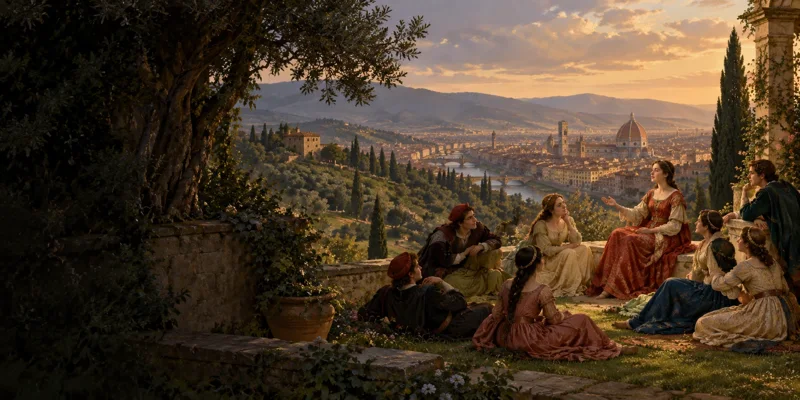
Giovanni Boccaccio, author of The Decameron, was one of Dante’s greatest admirers. He wrote a life of Dante, lectured on the poem in Florence, and described it as divine. Over the following two centuries the epithet stuck, and a Venetian edition of 1555 printed it in the title: La Divina Comedia, in the spelling of the day. The name has stuck ever since.
So the full title is a kind of collaboration: Dante’s modest, technical label, and his readers’ verdict on it.
The Divine Comedy
Begun in exile around 1308 and finished shortly before Dante’s death in 1321. One hundred cantos, from the dark wood to the vision of God.
The Aeneid
Dante’s guide through Hell is the poet Virgil, and this is the epic that made him Dante’s master — Aeneas’s own journey to the underworld included.
The Decameron
Boccaccio, the man who called Dante’s poem divine, wrote this very different masterpiece: a hundred tales told by young Florentines escaping the plague.


How is the Divine Comedy structured?
Dante built his poem with an architect’s love of pattern. There are three parts — Inferno, Purgatorio and Paradiso — of thirty-three cantos each, plus an opening canto, making one hundred. It is written in terza rima, a chain of interlocking three-line stanzas that Dante invented, and each of the three parts ends on the same word: stelle, “stars”.
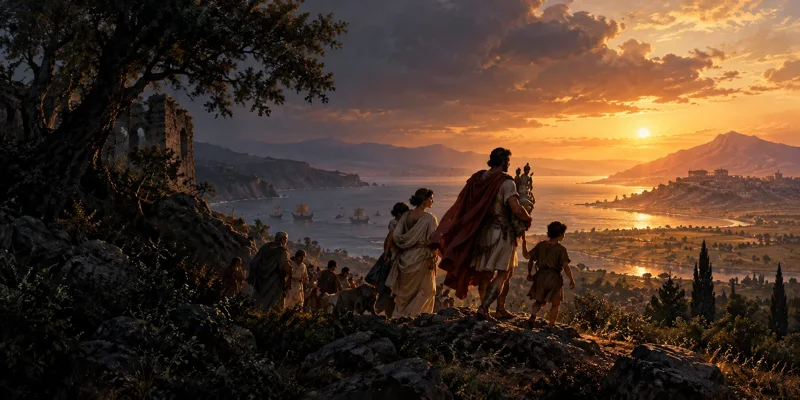
The story is simple to follow. In the year 1300, Dante, aged thirty-five, finds himself lost in a dark wood. The Roman poet Virgil appears and leads him down through the circles of Hell and up the mountain of Purgatory. Then Beatrice, the woman Dante loved in his youth and who died young, takes him up through the heavens.
Is the Divine Comedy hard to read?
It is demanding, but less than its reputation. The difficulty lies mostly in the hundreds of real people Dante meets — popes, politicians, poets and the Florentine neighbours he settled scores with — rather than in the story itself. Notes help, but you do not need to catch every reference. The Inferno in particular is vivid, dramatic and often horribly memorable, which is why most readers start there.
Read a canto at a time, ideally aloud. Each is a self-contained episode of a few pages. Our step-by-step guide, how to read the Divine Comedy, offers more help, and the great epic poems places Dante beside Homer, Virgil and Milton. For the English poet who took on the same vast subject, see Did you know Milton dictated Paradise Lost after he went blind?
Then begin in the middle of the journey of life, in the dark wood where Dante begins. The Divine Comedy promises a happy ending — that is what the title means — but it makes you earn every step of the way.
Questions readers ask
Why is it called the Divine Comedy if it is not funny?
In Dante’s time a comedy meant a story that begins in misfortune and ends happily, written in everyday language. Dante’s poem moves from Hell to Paradise and is written in Italian, so it qualified.
Who named it the Divine Comedy?
Dante called it simply the Commedia. Boccaccio praised it as divine, and the full title first appeared on a Venetian edition in 1555.
Should I read only the Inferno?
Many readers start with Inferno, the most dramatic part, but the poem is designed as one journey. Purgatorio and Paradiso complete the story and give the title its meaning.
What language was the Divine Comedy written in?
It was written in the Tuscan dialect of Italian, not Latin. Its success helped make Tuscan the foundation of modern standard Italian.