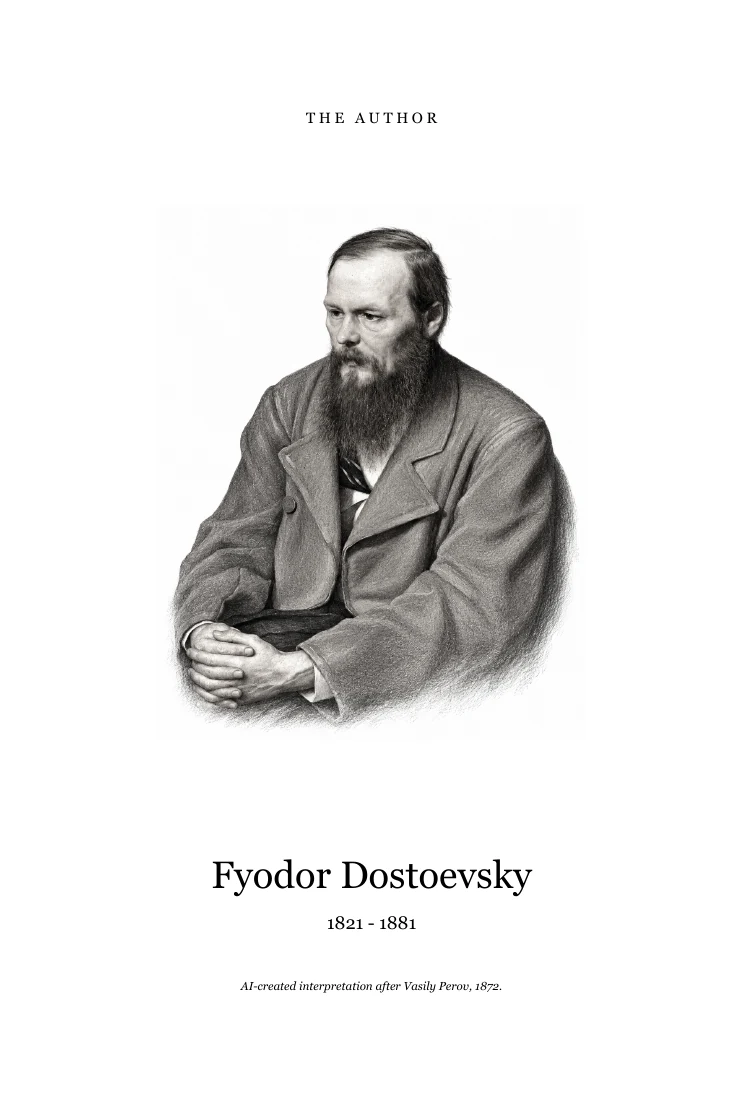
Dostoevsky thought The Brothers Karamazov was only the beginning. He planned a second novel following the youngest brother, Alyosha, into later life, but he died in early 1881, a few months after the last instalment appeared, and the sequel was never written. What we have is the first half of his design, and it is already enormous.
In our edition, The Brothers Karamazov runs to 778 pages, which the book card estimates at about sixteen hours. In Constance Garnett’s 1912 translation, the one we publish, it comes to about 350,000 words by our count of the Project Gutenberg text. At an average reading pace that is around twenty-two hours, and most readers will take somewhere between sixteen and twenty-nine.
How long does it take to read The Brothers Karamazov?
Reading speed is personal, so treat these as rough guides. Our card’s figure divides the 778 pages by fifty an hour. Research gathered by the psychologist Marc Brysbaert in 2019 suggests that adults read fiction at around 260 words a minute on average, with most between 200 and 320. Applied to Garnett’s text, that gives about 18 hours for a fast reader, 22 for an average one and 29 for a slow one.
Dostoevsky’s novel tends to push people towards the slower end. Long stretches are argument, confession and debate, and the best of them, such as Ivan’s prose poem “The Grand Inquisitor”, are worth reading twice. Allow for that, and an hour a day will see you through in about a month.
How long is each book?
The novel is divided into four parts containing twelve “books”, plus an epilogue, and they make natural stopping points. By our word count of Garnett’s translation, with the time each takes at an average pace:
- Part I. Book I, The History of a Family: 12,000 words, under an hour. Book II, An Unfortunate Gathering: 26,000 words, 1¾ hours. Book III, The Sensualists: 31,000 words, 2 hours.
- Part II. Book IV, Lacerations: 22,500 words, 1½ hours. Book V, Pro and Contra: 33,000 words, 2 hours, including “The Grand Inquisitor”. Book VI, The Russian Monk: 22,000 words, 1⅓ hours.
- Part III. Book VII, Alyosha: 17,500 words, just over an hour. Book VIII, Mitya: 36,000 words, 2¼ hours. Book IX, The Preliminary Investigation: 30,000 words, 2 hours.
- Part IV. Book X, The Boys: 21,000 words, 1⅓ hours. Book XI, Ivan: 43,000 words, 2¾ hours. Book XII, A Judicial Error: 46,000 words, 3 hours.
- Epilogue: 9,500 words, about 35 minutes.
Two things stand out. The opening book is short and brisk, a family history that introduces the father and his three sons; it is the easiest part of the novel to get through. And the fourth part is much the heaviest, at more than 110,000 words across its three books. Plan for the novel to slow down, in pages if not in tension, as it approaches its end.
Above all, don’t lie to yourself. The man who lies to himself and listens to his own lie comes to such a pass that he cannot distinguish the truth within him, or around him
Fyodor Dostoevsky, The Brothers Karamazov, Book II, translated by Constance Garnett (1912)
Why is it so long?
Partly because it was written for a magazine. It ran as a serial in The Russian Messenger from January 1879 to November 1880, and Dostoevsky spent nearly two years writing it, delivering instalments as he went. Partly because it is several novels in one: a family drama, a crime story, a courtroom drama and a long argument about faith, freedom and responsibility, each given room to breathe.
And partly because Dostoevsky lets his characters talk. Whole chapters are speeches, stories within the story or arguments carried on late into the night. Those are the chapters people remember, so it pays to read them unhurried rather than skim them to get to the plot.
The Brothers Karamazov
778 pages in Constance Garnett’s translation. A father, three very different sons and a crime that tests all of them. Twelve books and an epilogue, each a natural stopping point.
Crime and Punishment
At 496 pages, the shorter Dostoevsky. If you want to try his voice before committing to Karamazov, start with Raskolnikov.


Planning your reading
A book a week takes you through in a little over three months, comfortably, with the short epilogue as a bonus. A faster plan of a book every three days finishes it in about five weeks. If you are deciding between this and Tolstoy, How long is Anna Karenina? shows that the two are almost exactly the same length in our editions, and How long is Crime and Punishment? covers the shorter option.
For where this novel sits in Dostoevsky’s work, see Where to start with Dostoevsky; for the translation question, How to choose a translation of a classic. Then begin with Book I, the family history, which you can finish in a single evening. Open The Brothers Karamazov and meet Fyodor Pavlovitch and his sons.
Questions readers ask
How many pages is The Brothers Karamazov?
Our edition runs to 778 pages. Because translations differ in length, other editions can vary noticeably.
How many words are in The Brothers Karamazov?
Constance Garnett’s translation runs to about 350,000 words by our count of the Project Gutenberg text. Other translations differ somewhat.
How long does it take to read The Brothers Karamazov?
Most readers need between about 16 and 29 hours. At an average fiction reading speed of 260 words a minute, Garnett’s translation takes around 22 hours, or about a month at an hour a day.
Is The Brothers Karamazov longer than Crime and Punishment?
Yes, much longer. In our editions The Brothers Karamazov runs to 778 pages and Crime and Punishment to 496.
 White Nights64 pages · $9.99
 Notes from Underground112 pages · $11.99
 The Idiot576 pages · $24.99