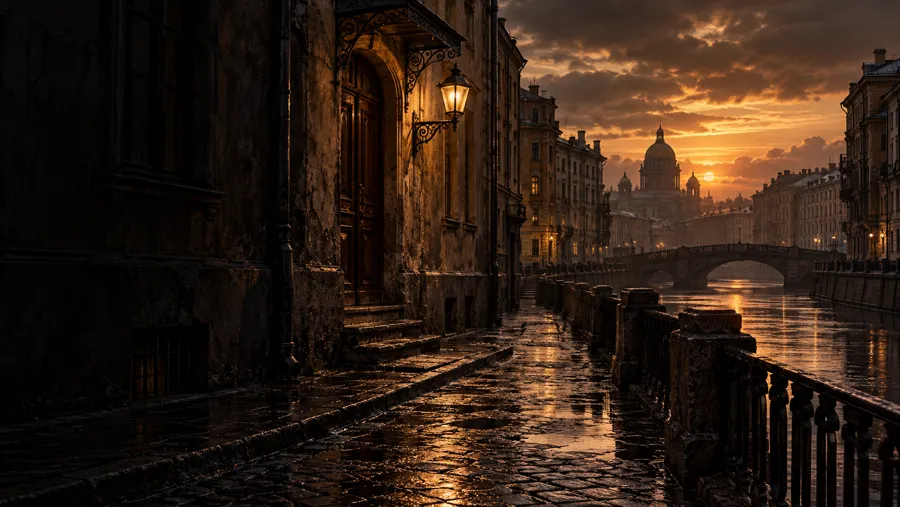
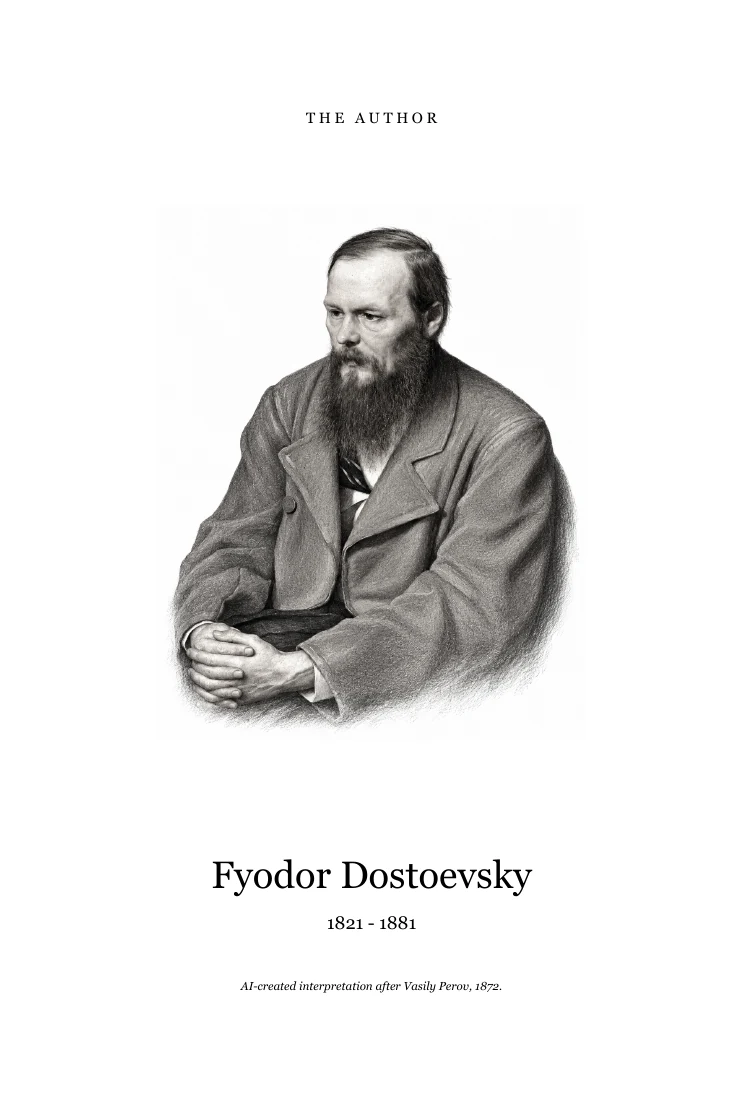
In January 1866, subscribers to the Moscow monthly The Russian Messenger found the opening of a new novel by Fyodor Dostoevsky: a poor former student slipping past his landlady on an exceptionally hot evening in Saint Petersburg. The same magazine was also printing, in those years, the early chapters of a book Leo Tolstoy was then calling 1805, which would become War and Peace. It was a remarkable time to be a Russian magazine reader.
Crime and Punishment ran in twelve monthly instalments, the last in December 1866. You need not take a year. Our edition of Crime and Punishment is 496 pages long. Allow an hour for every fifty pages, the yardstick behind our book cards, and that is close to ten hours. Dostoevsky’s feverish pace carries some readers faster than that; the long arguments in its second half slow others down.
How is Crime and Punishment divided?
Into six parts of broadly similar length, followed by a short epilogue. Each part runs to between five and eight chapters, and each makes a substantial sitting of ninety minutes to two hours. Part Two is the longest; the epilogue is by far the shortest, a coda you can read in well under an hour.
The divisions are not arbitrary. Part One, seven chapters long, builds towards the crime itself, and it is the only part in which the deed lies ahead rather than behind. Everything after it is about what the act does to the man who committed it: the fever, the visits from friends and family, the conversations with an investigator who seems to know more than he says. Critics have long pointed out how symmetrical the book is, with key scenes in its first half mirrored in its second.
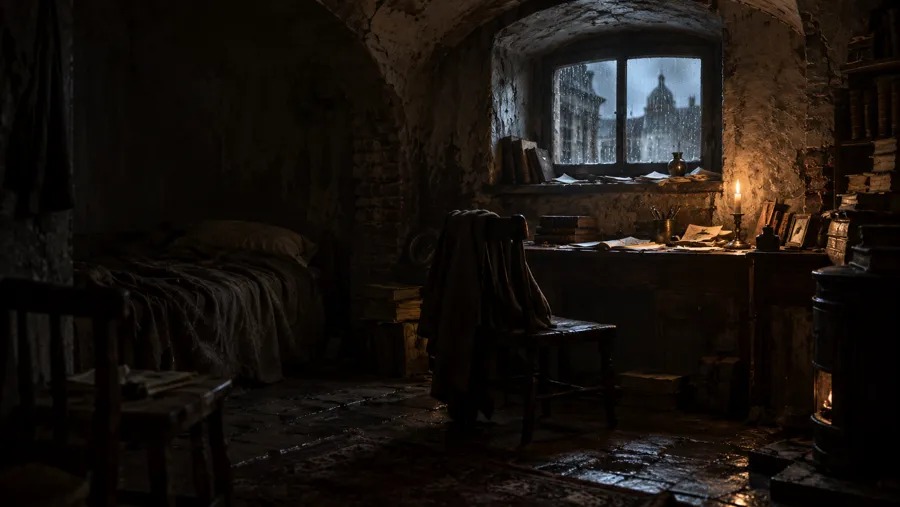
A six-week plan for Crime and Punishment
If ten hours feels like a lot, try one part a week. It keeps a little of the serial rhythm of 1866, and gives each part time to settle before the next begins.
- Week one: Part One. Raskolnikov, the pawnbroker, the drunken clerk Marmeladov in a tavern, and a letter from home that changes everything.
- Week two: Part Two, the longest. Fever, police offices and the loyal, talkative friend Razumihin.
- Week three: Part Three. Raskolnikov with his newly arrived mother and sister, and a first meeting with the investigator Porfiry.
- Week four: Part Four. Sonia, and one of the most famous scenes in Russian fiction.
- Week five: Part Five. A funeral meal that goes badly wrong.
- Week six: Part Six and the epilogue, read together.
Why does Crime and Punishment feel longer than it is?
Usually because of the names. Russian characters are addressed in several ways, and Garnett keeps them all. Raskolnikov is also Rodion Romanovitch and, to his family, Rodya; his sister Dounia is Avdotya Romanovna; Sonia is Sofya Semyonovna. Once you know that each person carries a formal name, a patronymic and a pet name, the cast shrinks to its real size and the pages speed up. A note of the main names on a bookmark saves a surprising amount of time.
The other reason is intensity. Dostoevsky wrote much of the novel close to Raskolnikov’s own mind, and the book can be tiring in the way that a long, heated conversation is tiring. Short, regular sittings suit it better than one heroic weekend.
It began as a much smaller idea. When Dostoevsky first offered it to the magazine’s editor, Mikhail Katkov, in 1865, he described a story about a young man in the grip of half-formed ideas; only by November of that year was he calling it a novel. His notebooks show that he also tried telling it in the first person, as a confession or a diary, before settling on the close third-person voice that makes the finished book so claustrophobic.
Crime and Punishment
1866. A murder in the first part and five more parts of conscience, argument and pursuit through the summer streets of Saint Petersburg. In Garnett’s translation.
Notes from Underground
1864. A short, bitter monologue from a man underground. Read it in an evening and you meet a voice Raskolnikov would recognise.
White Nights
1848. A dreamer’s four nights in Petersburg. Dostoevsky’s gentlest story and a good warm-up for the city he returns to in Crime and Punishment.


For a longer view of the novels, see where to start with Dostoevsky, and if you want to know what you are taking on next, how long is The Brothers Karamazov. But Part One is only seven chapters. Clear one evening this week and begin Crime and Punishment on that hot July night by the bridge.
Questions readers ask
How long does it take to read Crime and Punishment?
Close to ten hours for our 496-page edition, at an hour per fifty pages. Most people spread it over a few weeks of evenings.
How many parts and chapters are in Crime and Punishment?
Six parts and an epilogue. The six parts contain 39 chapters between them, and the epilogue has two more.
Was Crime and Punishment published in instalments?
Yes. It appeared in twelve monthly instalments in The Russian Messenger during 1866, before being published as a separate book.
 The Brothers Karamazov778 pages · $29.99
 The Idiot576 pages · $24.99