
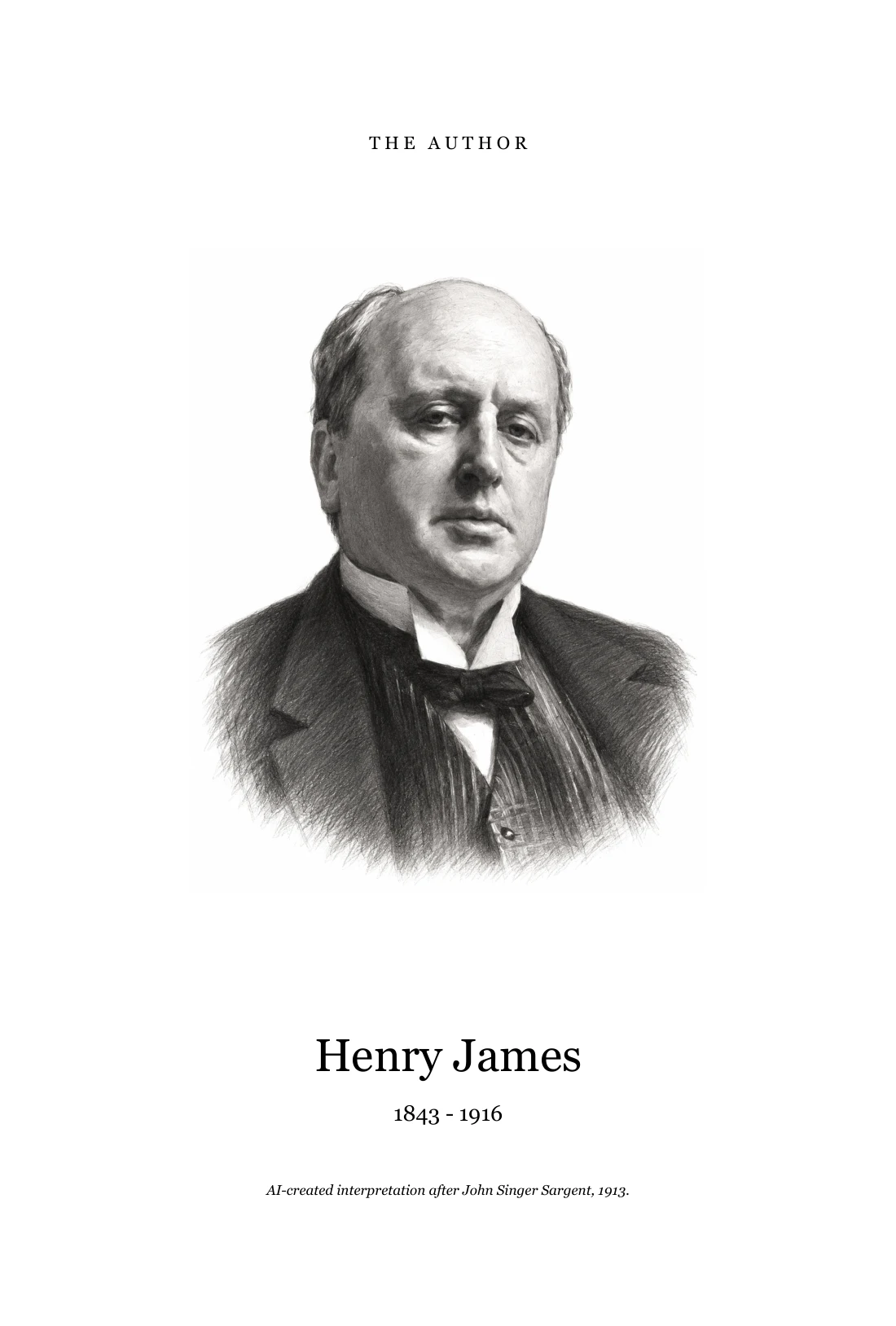
Most people who give up on Henry James give up on the wrong book. They begin with The Portrait of a Lady, or even The Golden Bowl, meet a sentence that unspools for half a page, and decide he is not for them. The cure is to start short.
Henry James wrote short novels and long tales all his life, many of them for magazines with strict limits on length, and they show everything that makes him great — the comedy, the moral pressure, people talking all around the one thing that matters — without asking for a fortnight of your evenings. Here are six Henry James short novels, from the quickest read to the longest, written between 1878 and 1897.
Henry James’s short novels, shortest first
- $10.99
Daisy Miller
1878. Winterbourne meets the girl from Schenectady in a hotel garden at Vevey, and spends the rest of the story failing to understand her. The easiest James of all.
- $11.99
The Aspern Papers
1888. A literary man takes rooms in a crumbling Venetian palace to get at a dead poet’s letters, guarded by the poet’s aged former lover and her plain niece. Suspense, from a writer not known for it.
- $12.99
The Reverberator
1888. A pretty, artless American girl in Paris tells a gossip columnist far too much about her fiancé’s Frenchified family, and it all ends up in his scandal sheet. A light comedy about the press.
- $13.99
The Europeans
1878. Two worldly siblings raised in Europe descend on their Puritan cousins near Boston, and it turns out the New Englanders are the harder people to read. An afternoon’s comedy that holds his whole international theme in miniature.
- $13.99
The Spoils of Poynton
1897. A widow with perfect taste wages war on her son over the treasures of their country house, and a penniless young woman with finer scruples than either is caught between them.
- $15.99
What Maisie Knew
1897. A child handed back and forth by divorcing parents who care only for their quarrel watches the grown-ups and understands more than any of them guess. Funny, appalling and the bridge to his late style.


If you want only one, take The Aspern Papers. If you want to laugh, take The Reverberator. And if you have already read Daisy Miller and The Europeans, our guide to Henry James’s early novels in order sets them beside the longer books of the same years.

Why are the short ones easier?
Length forced James to choose. In a short novel there is one situation, a handful of people and a single point of view, so the famous Jamesian ambiguity has room to work without swamping the story. He also wrote most of these for magazines: The Aspern Papers ran in The Atlantic Monthly from March to May 1888, The Reverberator in Macmillan’s Magazine the same year, and The Spoils of Poynton in the Atlantic in 1896 under the plainer title The Old Things. Each instalment had to hold a reader to the next.
The dates matter too. Daisy Miller and The Europeans are early James, written with a light, quick hand. The Spoils of Poynton and What Maisie Knew come from the late 1890s, after the humiliating failure of his play Guy Domville in 1895 sent him back to fiction. In them you can watch the late style arriving, still on a scale you can manage.
The Aspern Papers and The Reverberator: suspense and gossip
The Aspern Papers is built on a real story: the letters Percy Bysshe Shelley wrote to Claire Clairmont, Mary Shelley’s stepsister, who kept them until her death. James moved it to Venice and turned the poet into an American, Jeffrey Aspern. His narrator will flatter, lie and court a lonely woman to get his hands on the papers, and the book’s tension comes from watching how far he will go.
The Reverberator is its comic twin. George Flack, the Paris correspondent of an American society paper, is the villain, and James clearly enjoyed loathing him, observing that for the convenience of society he “ought always to have worn something conspicuous—a green hat or a yellow necktie.” The heroine, Francie Dosson, is too honest to understand why her chatter is a catastrophe, and the comedy lies in the collision between her candour and her fiancé’s family.

The Spoils of Poynton and What Maisie Knew
These two arrived in the same year, 1897, and they are the richest books on the list. The Spoils of Poynton is a war over furniture, nearly all of it seen through the eyes of Fleda Vetch, a poor young woman with exquisite taste and an exacting conscience. Her refusal to grab what she wants is either the noblest or the most maddening thing in the novel, and readers still argue about which.
What Maisie Knew, serialised in The Chap-Book and The New Review, opens with a custody battle and one of the coldest jokes in James:
She was divided in two and the portions tossed impartially to the disputants.
Henry James, What Maisie Knew (1897)
Maisie is passed between parents who use her as a weapon, and James tells the story through her growing understanding, so that the reader always knows a little more than she does and a little less than she will. Critics have never agreed about it. Edmund Wilson admired it and urged it on Vladimir Nabokov, who thought it terrible; F. R. Leavis called it “perfection”. A film version directed by Scott McGehee and David Siegel was released in 2012.
Where to go next
From here, the natural step is The Turn of the Screw, another short novel of 1898, with two children at its centre. Then try a long early book, and when you are ready, the late masterpieces; our guide to how to read late Henry James explains how to tackle them. For a general map of his career, see Where to start with Henry James, and for other great short books by other hands, the best classic novellas.
But start in Venice, in a dusty garden behind a decaying palace, with a narrator who has decided that flowers will be his way in. The Aspern Papers is James at his most gripping, and it will take you an evening.
Questions readers ask
What are Henry James’s short novels?
His shorter novels and novellas include Daisy Miller (1878), The Europeans (1878), The Aspern Papers (1888), The Reverberator (1888), The Spoils of Poynton (1897), What Maisie Knew (1897) and The Turn of the Screw (1898).
Which Henry James book should a beginner read first?
Daisy Miller or The Aspern Papers. Both are short, clear and gripping, and they show his central subjects without the long, winding sentences of his late novels.
Is What Maisie Knew hard to read?
It is harder than Daisy Miller but much easier than the late novels. The prose is more elaborate, but the story, a child caught between divorced parents, is easy to follow and often very funny.
 The Turn of the Screw114 pages · $11.99
 Washington Square190 pages · $13.99
 The Ambassadors406 pages · $19.99
 The Golden Bowl504 pages · $22.99