
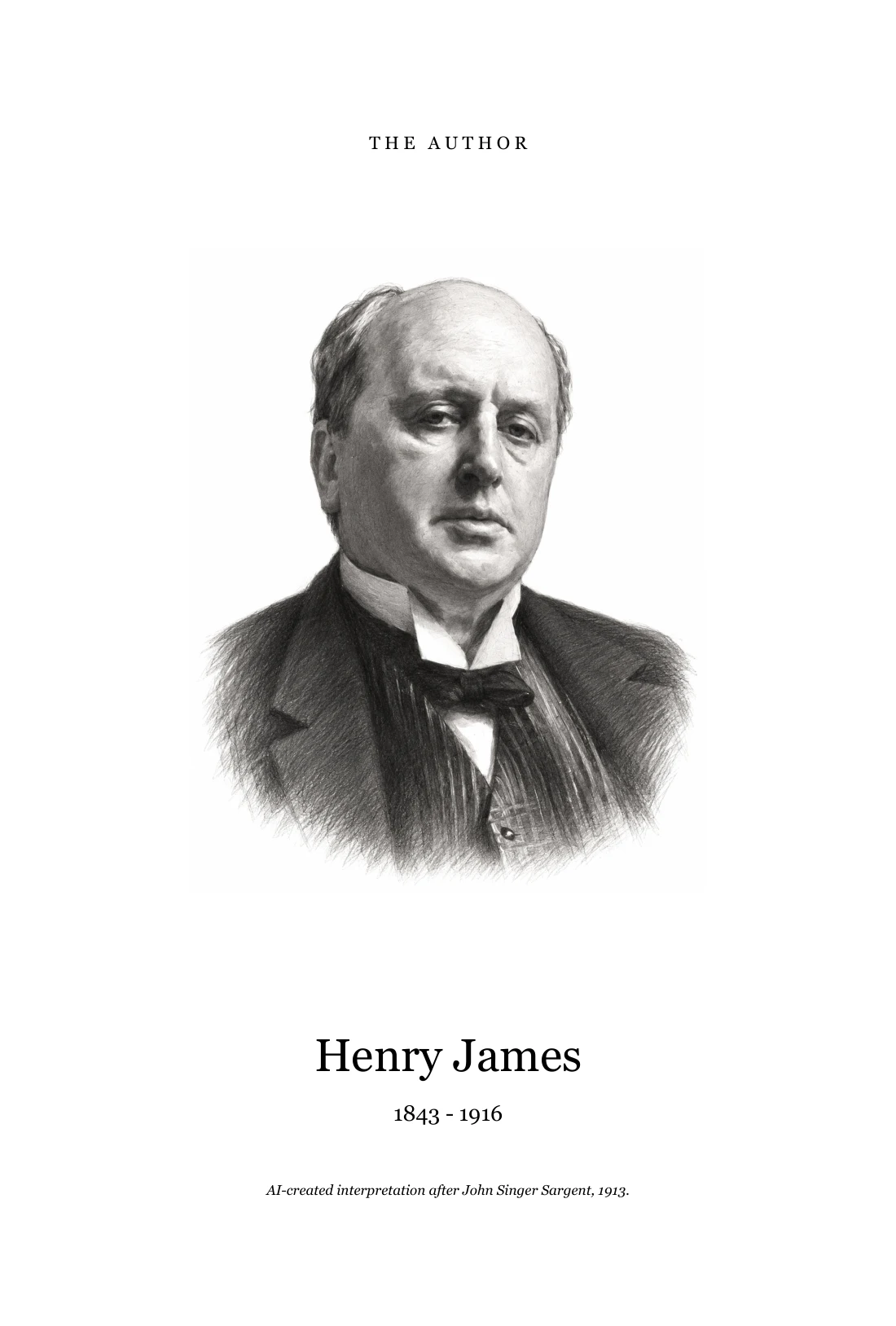
The historian Philip Guedalla once divided Henry James’s career into three reigns: “James I, James II, and The Old Pretender.” The joke has stuck because readers recognise it. The early James of Daisy Miller and Washington Square is clear and quick. The late James of The Ambassadors and The Golden Bowl is something else: sentences that circle, qualify and double back, conversations conducted almost entirely in hints, and a narrator who seems to know everything and say only half of it.
This is a guide to reading that last James. The short version: start with The Ambassadors, read slowly and partly aloud, follow one mind at a time, and don’t expect to catch every implication on the first pass. Nobody does.
Why does Henry James write like that?
Part of the answer is that he stopped writing. From the 1890s James dictated his novels to a typist, pacing the room while the machine clattered. Theodora Bosanquet, who took his dictation from 1907, said the habit was easy to recognise in his style, “which became more and more like free, involved, unanswered talk.” James knew it, and did not mind:
“I know,” he once said to me, “that I’m too diffuse when I’m dictating.” … “It all seems,” he once explained, “to be so much more effectively and unceasingly pulled out of me in speech than in writing.”
Theodora Bosanquet, Henry James at Work (1924)
The other part is that the late novels are about perception. Their drama is the slow discovery of what other people know, want and have done, and James makes you share the difficulty. When a sentence seems to be holding something back, it usually is, and so is the character thinking it.

Which late Henry James novel should you read first?
The Ambassadors. It was the first of the three late masterpieces he wrote, between 1900 and 1901, though it reached print after The Wings of the Dove; it ran as a serial in the North American Review through 1903, with passages cut to fit. James himself, in the preface he later wrote for the New York Edition, called it “frankly, quite the best, ‘all round,’ of all my productions.”
It also has the friendliest premise. Lambert Strether, a widowed American editor in his fifties, is sent to Paris by his formidable fiancée to bring her son home to run the family business. Paris has other ideas. The whole novel is told through Strether’s eyes, so you are never in more than one head at a time, and its very first sentence shows the late manner in miniature, a simple fact turned slowly to catch the light:
Strether’s first question, when he reached the hotel, was about his friend; yet on his learning that Waymarsh was apparently not to arrive till evening he was not wholly disconcerted.
Henry James, The Ambassadors (1903)
The Ambassadors
1903. An American of fifty-five discovers Paris, and himself, while failing at his errand. Twelve books, one point of view and the warmest of the late novels. Start here.
The Golden Bowl
1904. A father, a daughter, and the two people they marry, who already know each other rather well. The last and most intense of James’s major novels. Read it second.


Warm up with the transitional novels
If you want to ease in, two books from the late 1890s show the late manner arriving. What Maisie Knew (1897) tells the story of a small girl shuttled between divorced parents, and lets you watch adults behave badly through a child who understands more than they realise. The Awkward Age (1899) goes further: it is cast almost entirely in dialogue, in ten books each named after a character, so you learn to read a James conversation for what people are not saying.
- $15.99
What Maisie Knew
1897. Maisie, passed between warring parents and their new partners, sees everything and is told nothing. The best training for reading late James.
- $20.99
The Awkward Age
1899. A London drawing room and an eighteen-year-old daughter who knows too much for her mother’s friends. A novel built like a play, almost all talk.


Practical tips for reading Henry James
- Read the hard sentences aloud. They were spoken before they were written, and they often make immediate sense in your ear when they look tangled on the page.
- Find the main clause first. Strip out the qualifications, see who did what, then put the shading back in.
- Track one consciousness at a time. The Ambassadors stays with Strether throughout; The Golden Bowl gives its first half to the Prince and its second to the Princess.
- Notice what is left unsaid. Characters agree to things neither of them names, and the scene turns on it.
- Accept some fog. Even devoted Jamesians reread. A first reading for the story and a second for the texture is a perfectly good plan.
What about The Golden Bowl?
Save it for second, and give it time. It is the densest of the three and the most rewarding, a novel of four people and one flawed object, in which almost nothing is said directly and everything is understood. The cracked crystal bowl of the title appears early, in a London antique shop, and James lets it stand for more than one kind of fault. We time it properly in How long is The Golden Bowl?.
If late James still feels too steep, go back down the mountain first: Where to start with Henry James suggests a route through the earlier books, and Henry James’s shorter novels gathers the quickest ways in. The Henry James page lists everything we stock, from the early novels to the last.
Open The Ambassadors, reread that first sentence until you can hear the relief hidden in “not wholly disconcerted”, and let James take his time. That is the whole method.
Questions readers ask
Which Henry James novel should I read first?
For his late style, start with The Ambassadors (1903), which James considered his best novel. For James in general, shorter early books such as Daisy Miller and Washington Square are easier first steps.
Why is Henry James so hard to read?
His late novels are written in long, qualified sentences, partly because he dictated them, and their plots turn on what characters know but do not say. Reading slowly, and aloud, helps a great deal.
What are Henry James’s late novels?
The Wings of the Dove (1902), The Ambassadors (1903) and The Golden Bowl (1904), often called his major phase. The Golden Bowl was his last major novel, though The Outcry followed in 1911.
 The Turn of the Screw114 pages · $11.99
 Washington Square190 pages · $13.99
 Daisy Miller90 pages · $10.99
 The Aspern Papers102 pages · $11.99