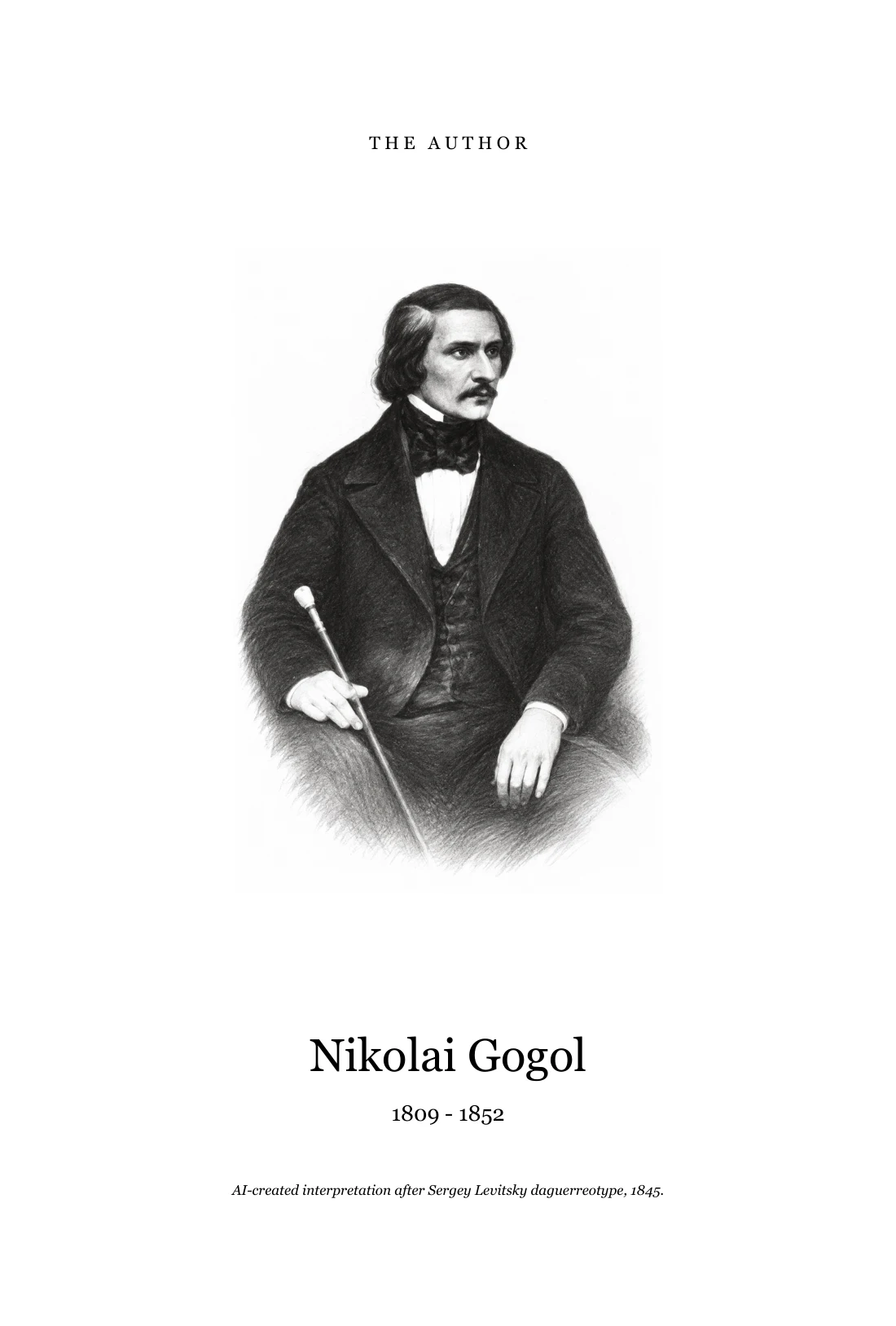
What happened to Dead Souls part two? Nikolai Gogol burned it. On a night in February 1852, in his rooms in Moscow, he put the manuscript he had laboured over for years into the stove. He died about ten days later, at forty-two. Only fragments of earlier drafts survived, and they were published after his death.
The first part, published in 1842, is complete in itself and is one of the funniest novels in Russian. But the story of the second part has haunted readers ever since, because it is the story of a great comic writer turning against his own gift.
What is Dead Souls about?
A smooth, round, entirely ordinary gentleman called Pavel Ivanovich Chichikov arrives in a provincial town with a mysterious errand. He wants to buy dead serfs. In the Russian Empire, landowners paid tax on the serfs — the “souls” — recorded at the last census, and the dead stayed on the books until the next one. Chichikov offers to take these paper peasants off their owners’ hands, for reasons he keeps to himself.
His tour of the local estates gives Gogol a gallery of grotesques: the syrupy Manilov, the suspicious widow Korobochka, the brawling liar Nozdryov, the bearish Sobakevich and the miser Plyushkin, sitting among his rotting hoards. Each visit is a comic set piece, and each landowner is in his own way a dead soul.
Why did Gogol burn Dead Souls part two?
Gogol said the idea for Dead Souls had come from Pushkin, and he planned it on a grand scale. Readers have long compared his three-part design to Dante’s journey from Hell through Purgatory to Paradise: part one would show Russia’s vices, and later parts would show its redemption, Chichikov included. You can read more about Dante’s own plan in Why is Dante’s Divine Comedy called a comedy?
Redemption proved much harder to write than satire. Through the 1840s Gogol grew increasingly devout and troubled, convinced that his writing must serve a moral and religious purpose. He burned one version of part two as early as 1845 and started again.
By early 1852 he was ill, exhausted and fasting, and under the influence of a stern spiritual adviser who is often said to have urged him to give up literature. On the night of the burning, according to those around him, he had his servant help him with the stove. Afterwards he is reported to have said he had meant to burn only some papers, and that the rest had gone by mistake or by the devil’s doing. Accounts differ, and we will never know exactly what was in his mind. He refused food in the days that followed and died in early March by the modern calendar.
Several chapters from earlier drafts of part two survived among his papers and were published in 1855. They are fascinating but uneven — Chichikov meets model landowners and virtuous officials, and the life drains out of the prose as the satire gives way to sermon.
Dead Souls
1842. Chichikov’s tour of the provincial estates in search of dead serfs to buy — a comic road trip through the absurdities of imperial Russia.
Fathers and Sons
Turgenev’s quieter vision of Russian country life twenty years on, in the season of a new generation.
Weir of Hermiston: An Unfinished Romance
Another great unfinished novel. Stevenson died suddenly in 1894 with what many readers consider his finest book only partly written.


Is Dead Souls worth reading without the ending?
Absolutely. Part one has its own shape, from Chichikov’s arrival to his hasty departure, and it ends with one of the most famous passages in Russian literature: a troika racing down the road, and Russia itself flying ahead into an unknown future. Nothing feels missing.
The pleasure is in Gogol’s voice. The narrator wanders off into long, glorious comparisons, pauses to describe a pie or a dog or a waistcoat, and turns minor clerks into epics. It suits readers who love Dickens’s comic grotesques or the absurd humour of later writers like Kafka, and anyone who enjoys a satire on bureaucracy and greed that has hardly dated.
Russian literature rarely gets funnier. For more on the generation that followed Gogol, see Did you know Fathers and Sons made the word “nihilist” famous? and the golden age of Russian literature. And for other books their authors never finished, try our list of unfinished classic novels.
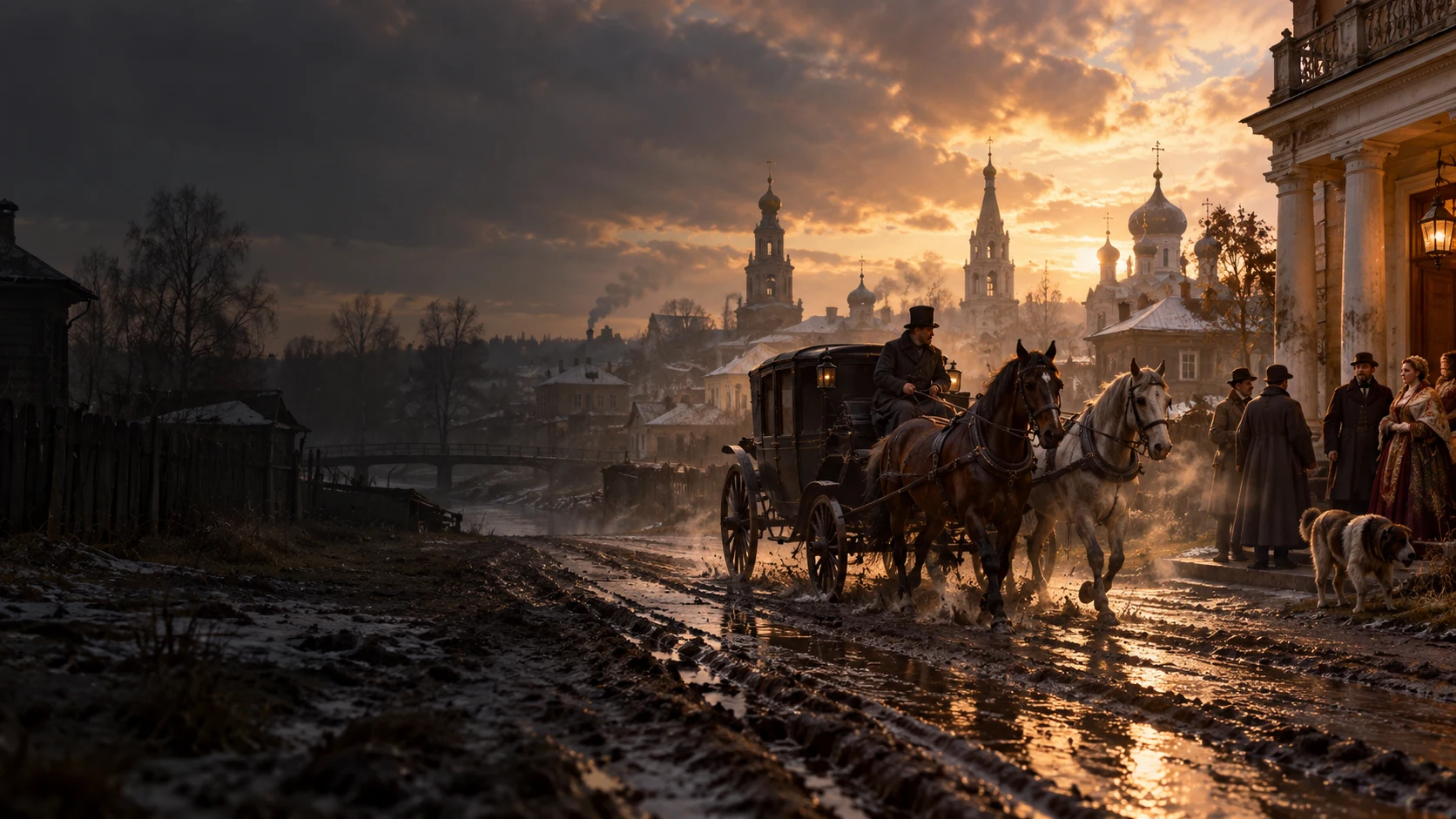
Then step into the provincial town of N, where a modest carriage has just pulled up at the inn. Dead Souls begins with two peasants arguing about whether its wheel would make it to Moscow.
Questions readers ask
Did Gogol finish Dead Souls?
No. He completed part one, published in 1842, but burned the manuscript of part two in February 1852, shortly before his death. Fragments of earlier drafts survive.
Why did Gogol burn the second part of Dead Souls?
Nobody knows for certain. He was ill, fasting and in a deep religious crisis at the time, and had come to doubt the value of his writing. He reportedly said afterwards that he had burned more than he intended.
What does Dead Souls mean?
It refers to dead serfs, or “souls”, who still appeared on the census registers that Chichikov wants to buy. It also hints at the spiritual deadness of the landowners he meets.
Is Dead Souls part two worth reading?
The surviving chapters are interesting for Gogol enthusiasts, but most readers find part one, which is complete, far more rewarding.