
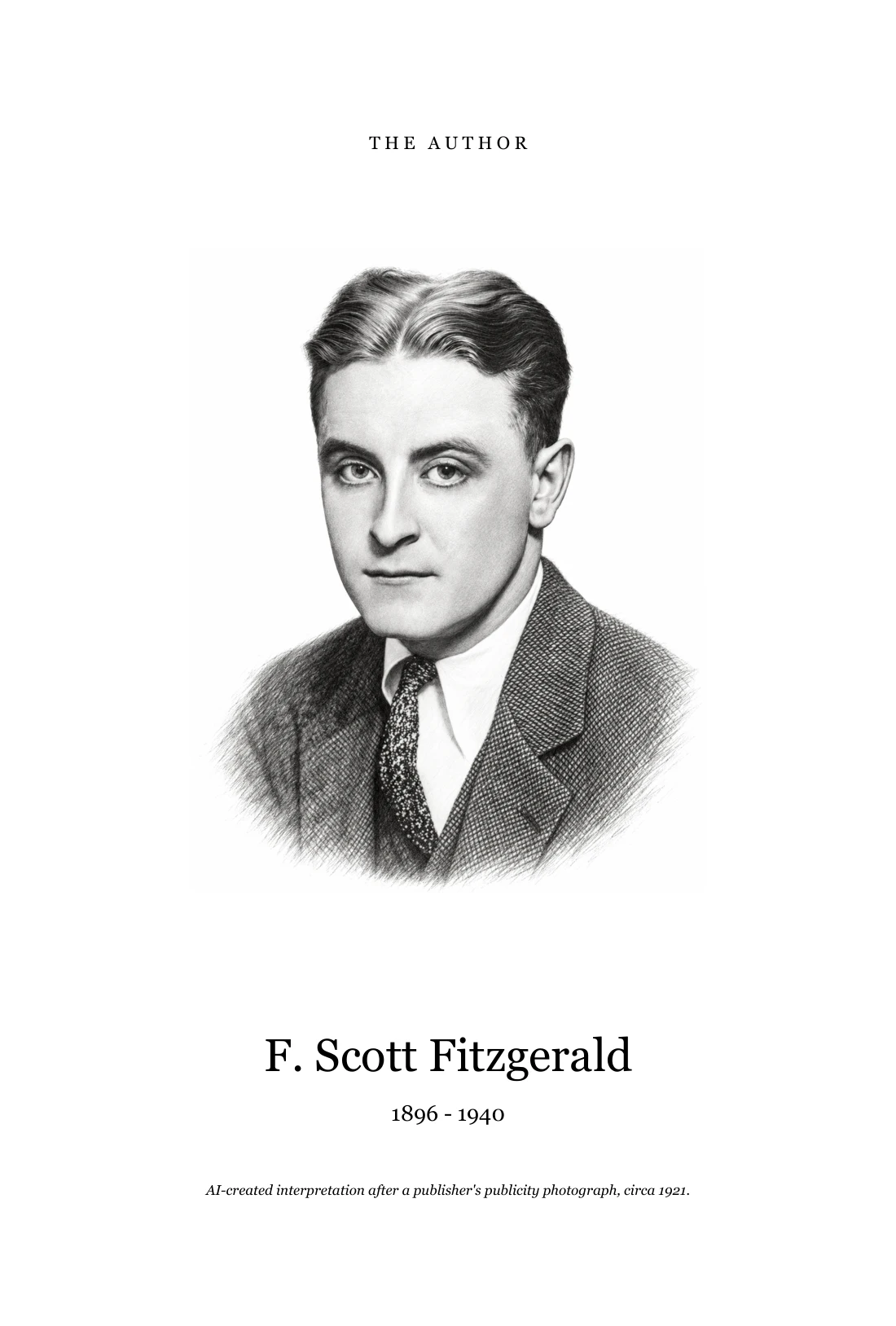
“I began it at seven in the morning and finished it at two o’clock the same night.” That is F. Scott Fitzgerald describing “The Camel’s Back”, a story he wrote in a single day in New Orleans because he wanted a platinum and diamond wristwatch that cost six hundred dollars. It sold to The Saturday Evening Post. He tells the story himself in the annotated table of contents to Tales of the Jazz Age, adding, with typical candour, that he liked it least of all the stories in the book.
That mixture of glamour, money worries and ruthless self-judgement runs through all his early work. In five years he published two novels, two collections of stories and The Great Gatsby. Reading the Fitzgerald books in order is the best way to see how a gifted, careless young writer turned into a great one.
The Fitzgerald books in order
Here are all his novels and story collections, with the years. The early books, the subject of this post, run to 1925.
- This Side of Paradise (novel, March 1920)
- Flappers and Philosophers (stories, September 1920)
- The Beautiful and Damned (novel, March 1922)
- Tales of the Jazz Age (stories, September 1922)
- The Great Gatsby (novel, April 1925)
- All the Sad Young Men (stories, 1926), Tender Is the Night (novel, 1934), Taps at Reveille (stories, 1935) and the unfinished The Last Tycoon (1941, after his death)
- $15.99
This Side of Paradise
1920. Amory Blaine, handsome, vain and Midwestern, goes to Princeton, falls in and out of love and comes out of the war unsure of everything. A young man’s book, sprawling and quotable, and an instant hit.
- $18.99
The Beautiful and Damned
1922. Anthony and Gloria Patch marry young and wait in New York for his grandfather’s fortune, drinking and quarrelling as the years go by. Darker than its reputation, and loosely drawn from his own marriage.
- $15.99
Tales of the Jazz Age
1922. Eleven stories, including “May Day”, “The Diamond as Big as the Ritz” and “The Curious Case of Benjamin Button”, each given a few lines of comment by the author in the table of contents.
- $12.99
The Great Gatsby
1925. Nick Carraway’s summer next door to the mysterious Jay Gatsby on Long Island. Short, exact and haunting: the book everything before it was building towards.



This Side of Paradise: the rejected book that made him
Fitzgerald began his first novel in 1917, while in the army, under the title The Romantic Egotist. Scribner’s turned it down twice in 1918. Zelda Sayre, the Alabama girl he wanted to marry, broke off their engagement in 1919, doubtful he could support her. He rewrote the book that summer, and in September 1919 Scribner’s, with the editor Maxwell Perkins arguing for it, said yes.
This Side of Paradise came out on 26 March 1920. Its first printing, 3,000 copies, was gone in three days, and on 3 April Fitzgerald and Zelda were married at St Patrick’s Cathedral in New York. The novel ends with a passage that seemed, to many readers, to speak for a whole generation.
Here was a new generation, shouting the old cries, learning the old creeds, through a revery of long days and nights; destined finally to go out into that dirty gray turmoil to follow love and pride; a new generation dedicated more than the last to the fear of poverty and the worship of success; grown up to find all Gods dead, all wars fought, all faiths in man shaken....
F. Scott Fitzgerald, This Side of Paradise (1920)
Do you need to read Fitzgerald in order?
No, but it rewards you. Gatsby is short enough and good enough to read first, and many people do. Coming to it after the earlier books, though, you see how much he learned: the sprawl of This Side of Paradise and the bitterness of The Beautiful and Damned give way to a novel where every sentence is weighed. For how that book fared at first, see Did you know The Great Gatsby disappointed in Fitzgerald’s lifetime?

Why read the stories?
The stories paid the bills. Fitzgerald wrote more than 160 of them, many for well-paying magazines such as The Saturday Evening Post. But the best are as good as anything he wrote, and Tales of the Jazz Age is the liveliest way into his world. “May Day”, set in New York in the spring of 1919, is a dark, ambitious novella. “The Diamond as Big as the Ritz” is a fable about a family that owns a mountain made of a single diamond. His notes on each story are a pleasure in themselves, including one that reprints a furious letter from a reader in Cincinnati who wrote, of Benjamin Button, that Fitzgerald would make a good lunatic.
Fitzgerald popularised the phrase “the Jazz Age” in books like this one, and the era has never quite shaken off his version of it; see The Jazz Age in fiction for more. When you are ready for the films, The Great Gatsby on screen covers them, and How long is The Great Gatsby? has the numbers.
He died in Los Angeles in December 1940, aged forty-four, by most accounts convinced that he was a failure. Start where he started, at Princeton with a vain and brilliant young man. Open This Side of Paradise, and see the writer of Gatsby finding his voice.
Questions readers ask
What order should I read F. Scott Fitzgerald’s books in?
Read the Fitzgerald books in order of publication: This Side of Paradise (1920), Flappers and Philosophers (1920), The Beautiful and Damned (1922), Tales of the Jazz Age (1922), The Great Gatsby (1925), then All the Sad Young Men (1926), Tender Is the Night (1934) and Taps at Reveille (1935).
How many novels did F. Scott Fitzgerald write?
He completed four novels, This Side of Paradise, The Beautiful and Damned, The Great Gatsby and Tender Is the Night, and left a fifth, The Last Tycoon, unfinished at his death in 1940.
What was Fitzgerald’s first book?
This Side of Paradise, published by Scribner’s on 26 March 1920. Its first printing sold out in three days and made him famous at twenty-three.
 All the Sad Young Men194 pages · $13.99