
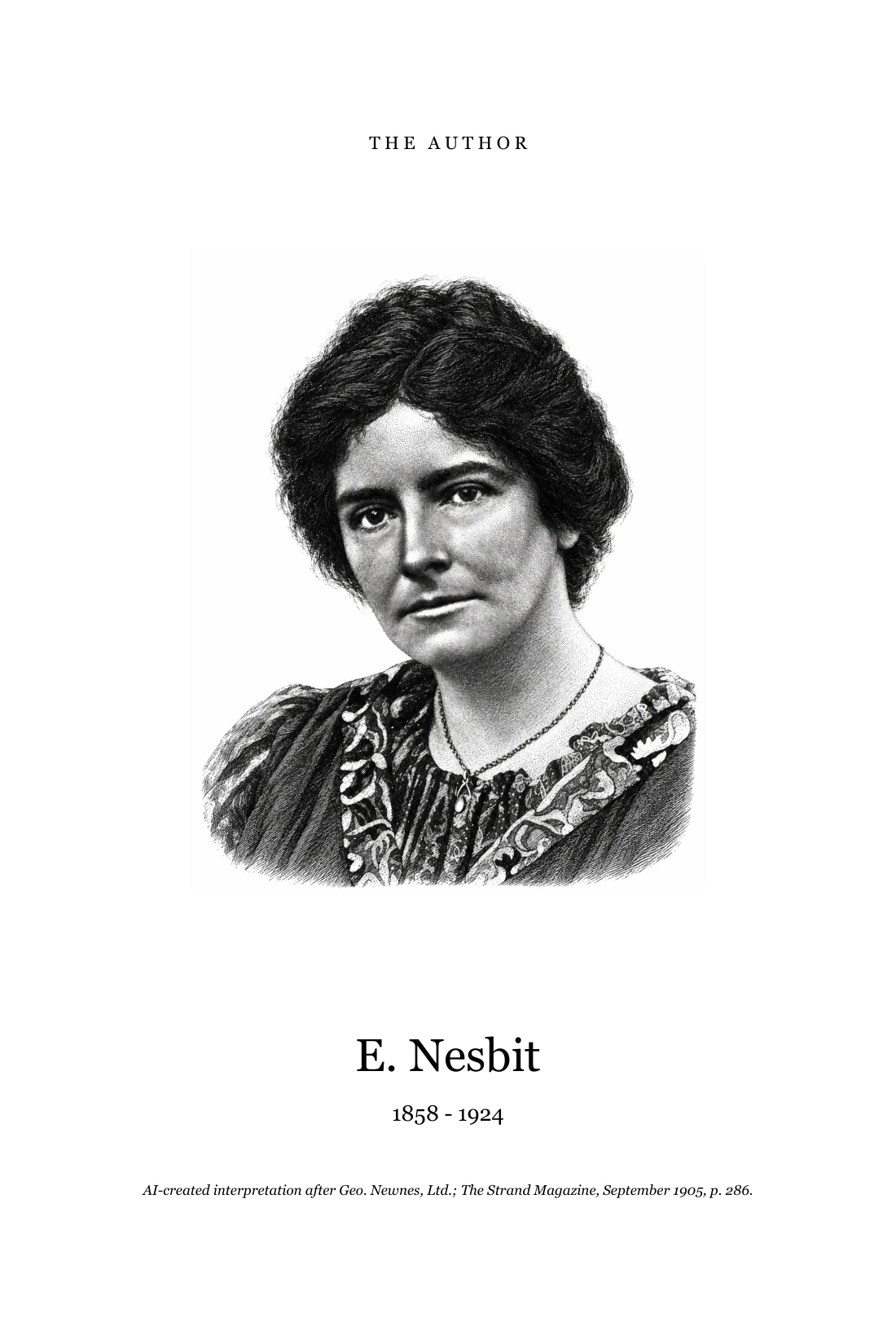
She did. In 1884 Edith Nesbit and her husband, Hubert Bland, were among the founding members of the Fabian Society, the socialist group that went on to help create the Labour Party. She was already writing, much of it to keep her household afloat, and over the next forty years, publishing as E. Nesbit, she changed children’s books for good.
Her best-known books are The Railway Children and Five Children and It, and either is a perfect place to start. If you like magic, begin with the Psammead in his gravel pit; if you prefer real-world adventure, begin at the cottage by the railway line.
Why is E. Nesbit called the mother of modern children’s fantasy?
Much of the fantasy written for children before Nesbit took place somewhere else: in fairyland, through a looking-glass, down a rabbit hole. Nesbit brought magic home. Hers turns up in a Kentish gravel pit or a London nursery, and the children who find it are ordinary, quarrelsome, funny and not especially good. They wish carelessly, and the wishes go wrong.
That formula, everyday children meeting real magic with real consequences, runs through a great deal of the fantasy that followed. C. S. Lewis nods to her Bastable children in the opening lines of The Magician’s Nephew, and the American writer Edward Eager openly modelled his magic books on hers.

E. Nesbit books: where to start
These four show her range, from family drama to comic fairy tale.
The Railway Children
1906. When their father is taken away, three children move with their mother to a cottage beside a railway and make friends with the trains, and the people on them. Warm, funny and deeply moving.
Five Children and It
1902. Five children dig up a grumpy sand-fairy who grants one wish a day, each lasting until sunset. Every wish goes wrong in a new way.
The Enchanted Castle
1907. Three children find a sleeping ‘princess’ in a hidden garden, and a ring that really is magic. Nesbit’s eeriest book, with moments of genuine strangeness.
The Book of Dragons
1900. Comic fairy tales about dragons, many of them loose in a recognisably modern world. Short, silly and perfect for reading aloud.


Where to go next
If Five Children and It wins you over, the same children return in The Phoenix and the Carpet and The Story of the Amulet; see Five Children and It has two sequels for the full trilogy in order.
If you prefer Nesbit without magic, the Bastable family begins in The Story of the Treasure Seekers, narrated by Oswald Bastable, who is very obviously not as modest as he insists. See The Bastable children: E. Nesbit’s Treasure Seekers in order.

Politics in a children’s book
Nesbit rarely preached, but her politics are there if you look. The children of The Railway Children fall on hard times and learn what it means to be poor, and they befriend a Russian refugee who had been imprisoned for writing about the poor of his own country. In The Story of the Amulet, a trip to a future London shows a cleaner, kinder city: very much a Fabian dream.
Her own life was unconventional too. Her marriage was famously complicated, and she was a lively, outspoken figure in literary London whose circle included fellow Fabians such as George Bernard Shaw and H. G. Wells. Like most books of their time, hers contain the occasional passage, particularly about other peoples and countries, that jars today; they are few, but worth knowing about before reading aloud.
Nesbit was writing at the height of what is often called the Golden Age of children’s literature, alongside Kenneth Grahame, J. M. Barrie and Beatrix Potter. Of all of them, she may be the one whose way of telling a story is closest to the children’s books we read now.
Are E. Nesbit books good for reading aloud?
Very. Her narrators talk directly to the reader, often with asides and jokes aimed at the grown-up holding the book, and her chapters are mostly self-contained adventures that end at a natural stopping point. Children of seven or eight upwards tend to love them; younger ones will enjoy The Book of Dragons.
Start with Five Children and It if you want laughter, or The Railway Children if you want to be moved. Either way, you will find a writer who took children seriously enough to let them be ridiculous.
Questions readers ask
What books did E. Nesbit write?
Dozens of books for children, plus novels, poems and stories for adults. Her best known are The Railway Children, Five Children and It, The Phoenix and the Carpet, The Story of the Treasure Seekers and The Enchanted Castle.
Was E. Nesbit a founder of the Fabian Society?
Yes. She and her husband, Hubert Bland, were among its founding members in 1884.
What is the best E. Nesbit book to start with?
Five Children and It for magic and comedy, or The Railway Children for a real-world story. Both read aloud beautifully for children of about seven and up.
 The Phoenix and the Carpet176 pages · $13.99
 The Story of the Amulet206 pages · $14.99
 Wet Magic144 pages · $12.99
 The Story of the Treasure Seekers144 pages · $12.99