Herland first appeared in 1915, one chapter a month, in a magazine that Charlotte Perkins Gilman wrote, edited and paid for herself. When the magazine closed the following year, the novel went with it. It was not issued as a book until 1979, when Pantheon brought it out under the subtitle “A Lost Feminist Utopian Novel”, forty-four years after its author’s death.
That delay says a good deal about Gilman. In her lifetime she was famous as a lecturer and economist rather than a novelist, and the two Charlotte Perkins Gilman books most people read today, The Yellow Wallpaper and Herland, were not the ones that made her name in her lifetime. If you are new to her, start with the story, which takes under an hour, then spend a weekend in Herland.
Who was Charlotte Perkins Gilman?
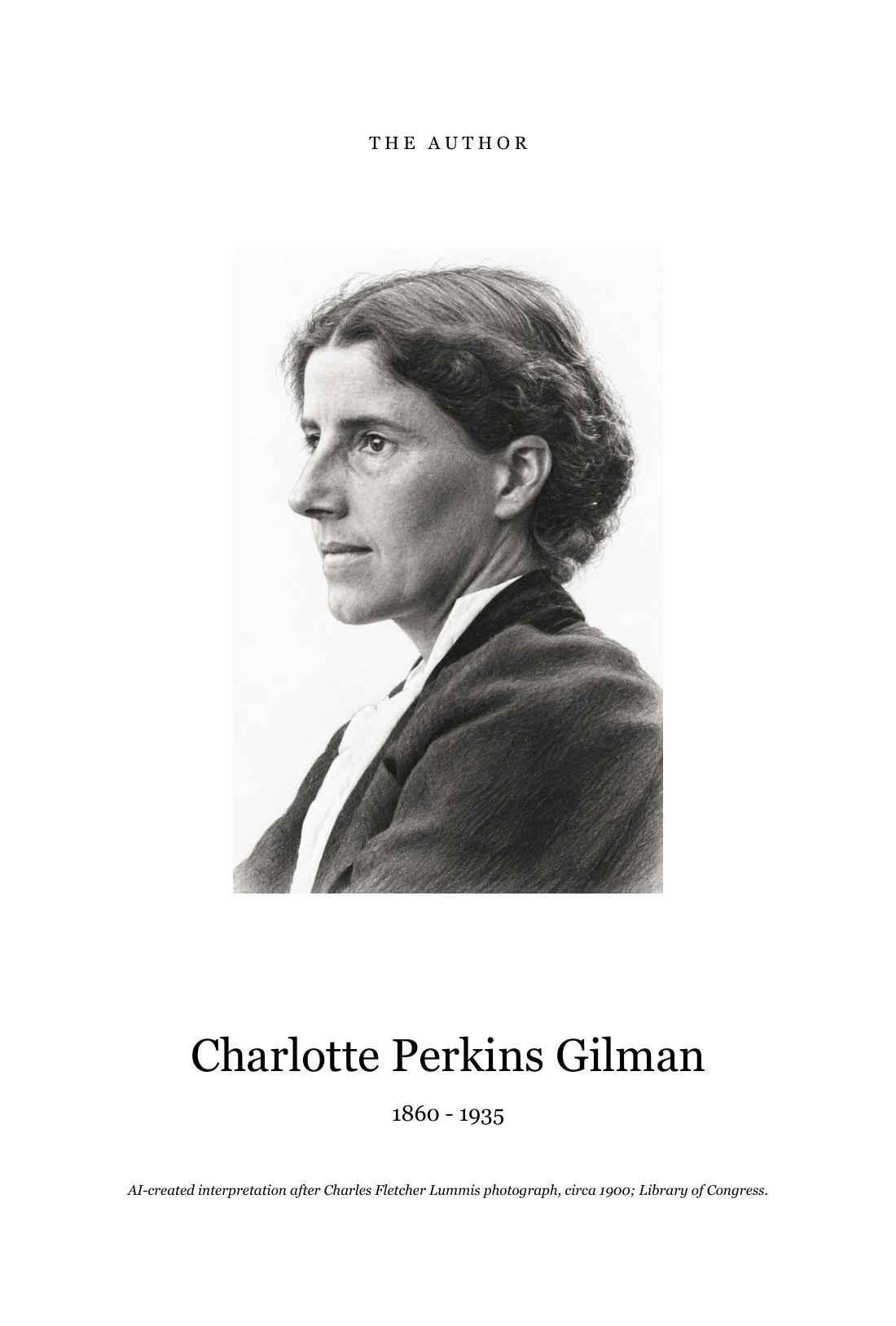
She was born Charlotte Anna Perkins into the Beecher family, so Harriet Beecher Stowe was her great-aunt, but she grew up poor after her father left home. Her schooling was patchy, and she studied at the Rhode Island School of Design before marrying the painter Charles Walter Stetson in 1884.
Their daughter was born the following year, and Charlotte sank into a severe depression. The treatment she received, and the near-collapse that followed, became The Yellow Wallpaper; we tell that story in full in Did you know The Yellow Wallpaper was written to warn against a medical treatment?. She left the marriage in 1888, moved to Pasadena, and began to earn her living by writing and lecturing.
- 1860
Born in Hartford, Connecticut, on 3 July.
- 1884
Marries the artist Charles Walter Stetson; their daughter Katharine is born in 1885.
- 1887
Treated for depression by the Philadelphia neurologist S. Weir Mitchell.
- 1890
Writes The Yellow Wallpaper in Pasadena.
- 1892
The story appears in the January issue of The New England Magazine.
- 1898
Women and Economics makes her famous.
- 1900
Marries her cousin Houghton Gilman and settles in New York.
- 1909
Launches The Forerunner, which she writes almost single-handed.
- 1915
Herland runs as a serial through the year.
- 1935
Dies in Pasadena; her autobiography appears the same year.
- 1979
Herland is published as a book for the first time.

The book that made her famous was not a novel
Women and Economics argued that women’s financial dependence on men was the root of most of their troubles, and that housework, cooking and childcare could be organised far more efficiently than one woman per kitchen. Jane Addams called it a masterpiece, and it was translated into several languages. Almost overnight Gilman became one of the leading voices of the American women’s movement.
Fiction was, for her, another way of making the same arguments. Between 1909 and 1916 she filled The Forerunner with stories, poems, essays and serialised novels, eighty-six monthly issues in all, almost all of it her own work. Herland and its sequel ran there, and so did dozens of the short stories that critics long overlooked.
Charlotte Perkins Gilman books to start with
- $9.99
The Yellow Wallpaper
1892. A young mother confined to an upstairs room starts to see something moving behind its pattern. Short enough for one sitting, and it gets under your skin anyway.
- $12.99
Herland
1915. Three American men fly a biplane into a hidden country where there have been no men for two thousand years, and find their every assumption politely taken apart.


What is Herland about?
Three young Americans, a sociologist, a doctor and a swaggering adventurer called Terry, hear rumours of a country made up entirely of women. They fly in expecting to be worshipped, or at least obeyed. Instead they are caught, sedated, taught the language and gently questioned about how things are done back home, and their answers sound worse and worse as they give them.
The narrator, Van, admits at the start that he has lost all his notes and photographs, and that is part of the joke: the most important expedition of his life has left him with nothing but his memory and his embarrassment.
Nobody will ever believe how they looked. Descriptions aren’t any good when it comes to women, and I never was good at descriptions anyhow.
Charlotte Perkins Gilman, Herland (1915)
It is a comedy before it is a sermon. Gilman lets the men argue, and lets the women answer them with patient, devastating questions about dogs, cats, poverty and marriage. The sequel, With Her in Ourland, sends Van home with a Herland wife to see the outside world through her eyes; it began in The Forerunner in January 1916.
Reading Gilman with open eyes
Her vision of progress had ugly limits. Gilman believed in eugenics and held racist views about immigrants and non-white Americans, and Herland is not free of them: its mothers speak of breeding out “the lowest types”. Readers who come for her sharp feminism should expect to meet that too, and many find it makes the book more interesting to argue with, not less.
If her ideas grip you, follow them into Utopian classics and Feminist classics everyone should read, or set her beside a contemporary in Did you know The Awakening was Kate Chopin’s last novel?.
If you read only one thing by her, make it The Yellow Wallpaper: one summer, one rented house, one room at the top of the stairs. When you come out the other side, Herland is waiting, and it is a good deal funnier than you would guess.
Questions readers ask
What are Charlotte Perkins Gilman’s most famous books?
The short story The Yellow Wallpaper (1892), the utopian novel Herland (1915) and the non-fiction study Women and Economics (1898). She also wrote poetry, hundreds of stories and essays, and an autobiography.
When was Herland published?
It was serialised in Gilman’s magazine The Forerunner in 1915, but it was not published as a book until 1979.
Should I read The Yellow Wallpaper or Herland first?
The Yellow Wallpaper, which is a short story you can finish in under an hour. Herland is longer and lighter in tone, and shows the playful, satirical side of Gilman.