The title page of the early London editions gave no author’s name at all, only three letters: F. R. S., for Fellow of the Royal Society. Below the copyright notice came a motto, presented as an old saying of the apes.
What one fool can do, another can. (Ancient Simian Proverb.)
Calculus Made Easy, epigraph
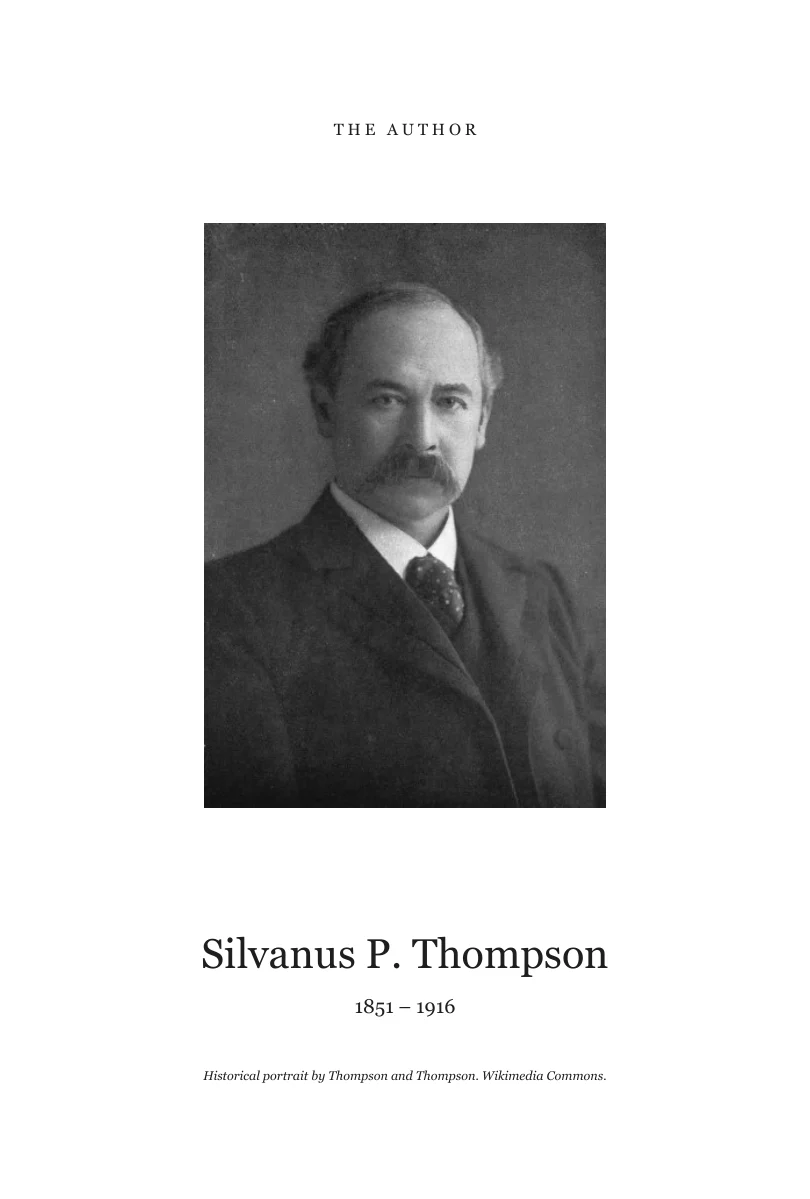
The book was Calculus Made Easy, first published by Macmillan in 1910, and the anonymous Fellow was Silvanus P. Thompson, a physicist and electrical engineer elected to the Royal Society in 1891. The proverb was his own joke, and it is the whole philosophy of the book in seven words. If ordinary people can learn calculus, so can you.
What does “What one fool can do, another can” mean?
Thompson explains in a one-page prologue that begins with the same idea turned round: considering how many fools can calculate, it is surprising that anyone should think calculus difficult for any other fool to learn. He then turns on the experts, the clever fools who write advanced textbooks and never take the trouble to show how easy the easy parts are, preferring to impress you by doing everything the hard way. His own credentials, he says, are rather different.
Being myself a remarkably stupid fellow, I have had to unteach myself the difficulties, and now beg to present to my fellow fools the parts that are not hard.
Silvanus P. Thompson, Calculus Made Easy, prologue
Master those parts thoroughly, he promises, and the rest will follow. The prologue ends by repeating the proverb, this time as a promise rather than a joke.
It is easy to read this as false modesty, and it partly is. But it is also a teaching method. A reader who expects to feel stupid stops trying. A reader told that the subject has been made to look hard by people showing off can relax enough to learn it.

How does Calculus Made Easy explain calculus?
The first chapter is called “To Deliver You from the Preliminary Terrors”. Thompson says the terror that stops most beginners can be abolished at once by explaining the two symbols they dread. The little d, he writes, merely means “a little bit of”: dx is a little bit of x. The tall, curling integral sign is merely a long S, and may be read as “the sum of”. Put the two together and you have the whole idea in miniature: calculus is about little bits of things, and about adding little bits up.
From there he builds up slowly, through chapters with names like “On Different Degrees of Smallness” and “On Relative Growings”, with worked examples on everyday quantities such as money and growth, and exercises with answers at the back. He deliberately skips the formal theory of limits that mathematicians use to make calculus rigorous, and works instead with the intuitive idea of quantities so small that their squares can be ignored, much as the subject’s founders did.
- First edition: 1910
- Reprinted twice in 1911, then in 1912 and 1913
- Second edition, enlarged with more worked examples and exercises: 1914
- Updated in 1998 by Martin Gardner, who modernised the notation and changed “fifth-form boys” to “high school students”
Who was Silvanus P. Thompson?
Thompson was born in York in 1851 into a Quaker family; his father taught at the Quaker school, Bootham, where Silvanus later became science master. He spent some thirty years as principal and professor of physics at the Finsbury Technical College in London, worked on electrical machinery and telegraph cables, and wrote biographies of Michael Faraday and Lord Kelvin. Calculus Made Easy appeared when he was nearly sixty, six years before his death in 1916.
That epilogue is the funniest thing in the book. Thompson lists the crimes the experts will charge him with: showing how ridiculously easy most of calculus is, letting readers see that the mathematical swells have no great reason to be puffed up, and leaving out all the difficult parts. To the last charge he pleads guilty. That, he says, is exactly why the book was written: for the legion of beginners put off by the stupid way the subject is usually taught.
Is Calculus Made Easy still useful today?
Yes, with a little allowance for age. Some notation and examples are old-fashioned, and the prices are in pounds, shillings and pence. But the core explanations of differentiation and integration are as clear as anything written since, and the tone is still a relief. It suits adults returning to mathematics, students who want the ideas before the rigour, and anyone who has ever stared at an integral sign and felt their mind go blank.
Calculus Made Easy
1910. Differentiation and integration explained by a physicist who thought the experts were showing off. Patient, funny and full of worked examples, it still delivers on its title.
Flatland: A Romance of Many Dimensions
1884. A square in a two-dimensional world tries to imagine a third dimension. A Victorian schoolmaster’s proof that mathematical ideas can be taught through comedy.


For more mathematics with a sense of humour, read about Flatland’s satire. If you are building a home curriculum, our homeschool classics reading list has more books that teach without talking down. And for other great explainers, see philosophy books for beginners.
Then start where Thompson starts, with the two dreadful symbols. Open Calculus Made Easy, read the prologue, and remember the proverb: what one fool can do, another can.
Questions readers ask
Who wrote Calculus Made Easy?
Silvanus P. Thompson (1851–1916), an English physicist and Fellow of the Royal Society. Early London editions credited the book only to “F. R. S.”
Where does “What one fool can do, another can” come from?
It is the epigraph of Calculus Made Easy, where Thompson presents it jokingly as an “Ancient Simian Proverb”. He repeats it at the end of his prologue.
Is Calculus Made Easy good for beginners?
Yes. It was written for beginners who were frightened of the subject, starts by explaining the basic symbols in plain words and builds up gradually with worked examples and exercises.
When was Calculus Made Easy published?
Macmillan first published it in 1910. A second, enlarged edition followed in 1914, and Martin Gardner produced an updated version in 1998.