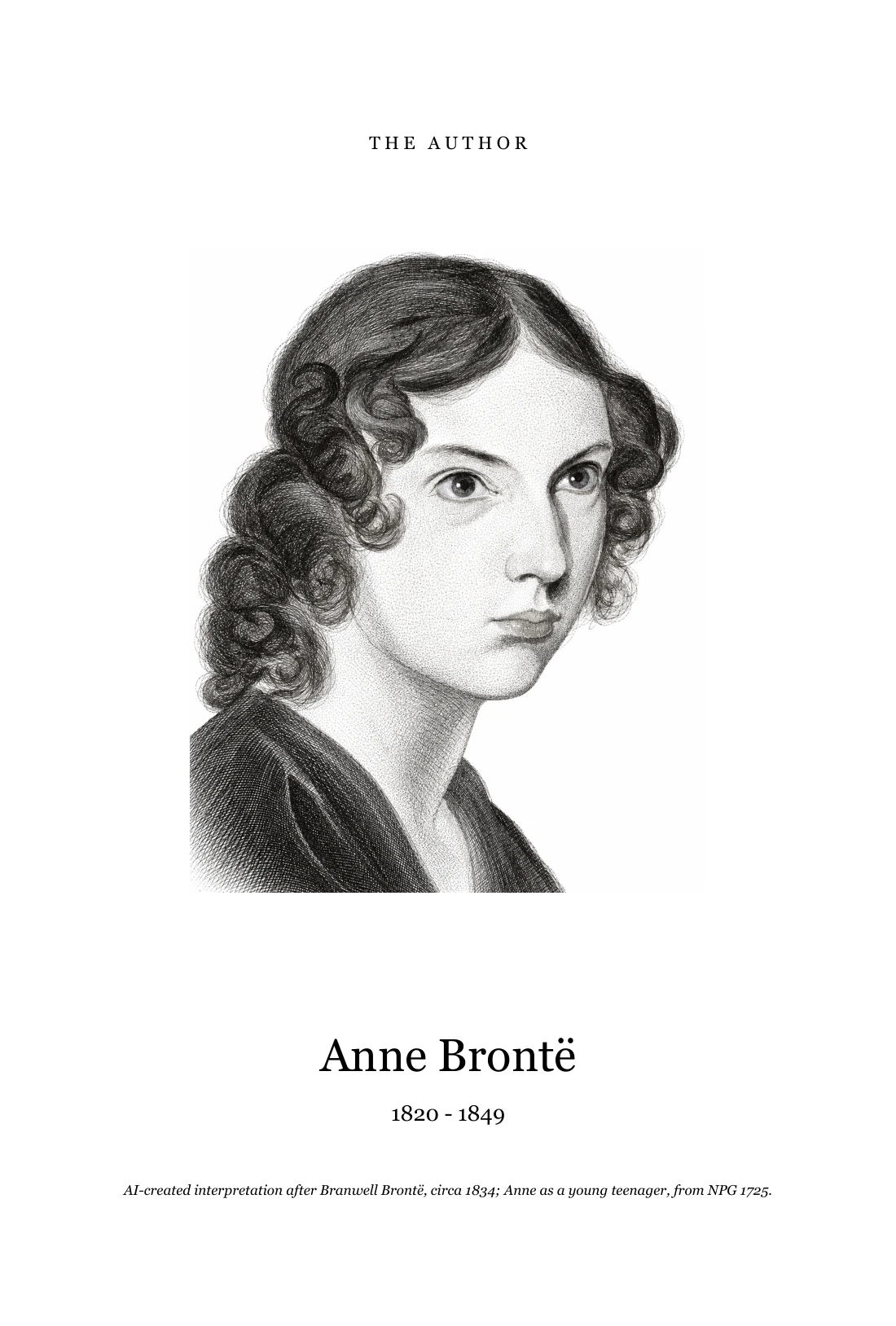
In the National Portrait Gallery in London hangs the only surviving portrait of the three Brontë sisters together, painted by their brother Branwell around 1834. Anne is on the left, then Emily, then Charlotte. Between Emily and Charlotte is a ghostly smudge of paint: Branwell had first included himself, then painted himself out. The figure who vanished from the picture is the brother. The sister who was nearly lost from the story is the one standing at its edge.
Anne Brontë wrote two novels, Agnes Grey (1847) and The Tenant of Wildfell Hall (1848), and a body of poetry, and she died at twenty-nine. For a century and more she was treated as the least of the three, the gentle one, a footnote to Jane Eyre and Wuthering Heights. Readers who actually open the Anne Brontë books tend to come away with a very different view.
Why is Anne called the forgotten Brontë sister?
Partly because she was the youngest, born at Thornton in Yorkshire on 17 January 1820, the last of six children, and partly because her first novel appeared alongside Wuthering Heights and was overshadowed by it. But the biggest reason is her sister. After Anne’s death, Charlotte prevented The Tenant of Wildfell Hall from being republished, and her lukewarm public comments about it shaped critical opinion for generations. Some critics think she was protecting Anne’s memory from a book she thought coarse; others suspect a less generous motive.
The revival came in the twentieth century, and since the mid-1900s scholars have increasingly ranked Anne as a major novelist in her own right. The Tenant of Wildfell Hall is now widely regarded as one of the first feminist novels.
The Anne Brontë books
- $13.99
Agnes Grey
1847. A clergyman’s daughter takes work as a governess and meets spoilt, cruel children and indifferent parents. Quiet, exact and often very funny, drawn from Anne’s own years in other people’s houses.
- $20.99
The Tenant of Wildfell Hall
1848. A young widow with a small son takes refuge in a half-ruined Elizabethan house, and the neighbours want to know why. Her answer, told through her own diary, is one of the boldest novels of its century.


Agnes Grey and the governess’s view
Of the three sisters, Anne spent longest as a governess. In April 1839, at nineteen, she became governess to the Ingham children at Blake Hall in Mirfield, whom she privately called “little dunces”, and was dismissed after nine months. She then spent five years with the Robinson family at Thorp Green near York, where Branwell later joined her as tutor and was sent home in disgrace in 1845. Agnes Grey grew from that experience. It opens with a sentence that could stand as Anne’s whole method.
All true histories contain instruction; though, in some, the treasure may be hard to find, and when found, so trivial in quantity, that the dry, shrivelled kernel scarcely compensates for the trouble of cracking the nut.
Anne Brontë, Agnes Grey (1847)
The book is short and plain, with none of the storms of Jane Eyre, and that is its strength. Anne shows exactly how a governess was treated, neither servant nor family, and how cruelty to animals and children was tolerated in respectable homes. The novelist George Moore later called it the most perfect prose narrative in English letters; you need not go that far to see how good it is.

The Tenant of Wildfell Hall: the book her sister buried
The Tenant of Wildfell Hall was published in June 1848 and was an immediate success, which only made the critics angrier. (If you want to meet its secret unprepared, skip to the next heading.) Its heroine, Helen, has left a drunken, abusive husband and is living under a false name with her child, something that defied both convention and the law of the time, under which a married woman had almost no rights over her property or her children. The novel is told in letters from Gilbert Markham, a local farmer who falls for her, and through Helen’s own diary of her marriage.
When reviewers called it coarse, Anne answered them in a preface to the second edition, written in July 1848. It is one of the great statements of a writer’s purpose.
when I feel it my duty to speak an unpalatable truth, with the help of God, I will speak it, though it be to the prejudice of my name and to the detriment of my reader’s immediate pleasure as well as my own.
Anne Brontë, preface to the second edition of The Tenant of Wildfell Hall (1848)
In the same preface she dismissed speculation about whether Acton Bell was a man or a woman: if a book is good, she wrote, it is good whatever the sex of its author. For the full story of the pseudonyms, see Did you know the Brontë sisters first published as Currer, Ellis and Acton Bell?
Which Anne Brontë book should you read first?
The Tenant of Wildfell Hall if you want the full force of her writing, Agnes Grey if you want a short, clear introduction. Many readers find that Agnes Grey reads better second, once they know what Anne could do. The BBC adapted The Tenant in 1996, with Tara Fitzgerald as Helen and Toby Stephens and Rupert Graves as the men in her life.
Anne also belongs on any list of feminist classics, and alongside her sister’s work in Charlotte Brontë’s four novels, in order. But start with the stranger who moves into the ruined hall. Open The Tenant of Wildfell Hall, and let the village gossip draw you in.
Questions readers ask
How many books did Anne Brontë write?
Two novels, Agnes Grey (1847) and The Tenant of Wildfell Hall (1848), plus poems, many of which appeared in the sisters’ joint volume of 1846. The two Anne Brontë books were first published under the name Acton Bell.
Why did Charlotte Brontë stop The Tenant of Wildfell Hall being republished?
After Anne’s death Charlotte prevented its republication and spoke of it coolly in public. Critics disagree whether she was protecting her sister’s reputation from a book she found too frank or acting from something closer to jealousy.
Is The Tenant of Wildfell Hall a feminist novel?
Many critics consider it one of the first. Its heroine stands up to the conventions and laws of her day to protect her son, and supports them both by her own work as a painter.