
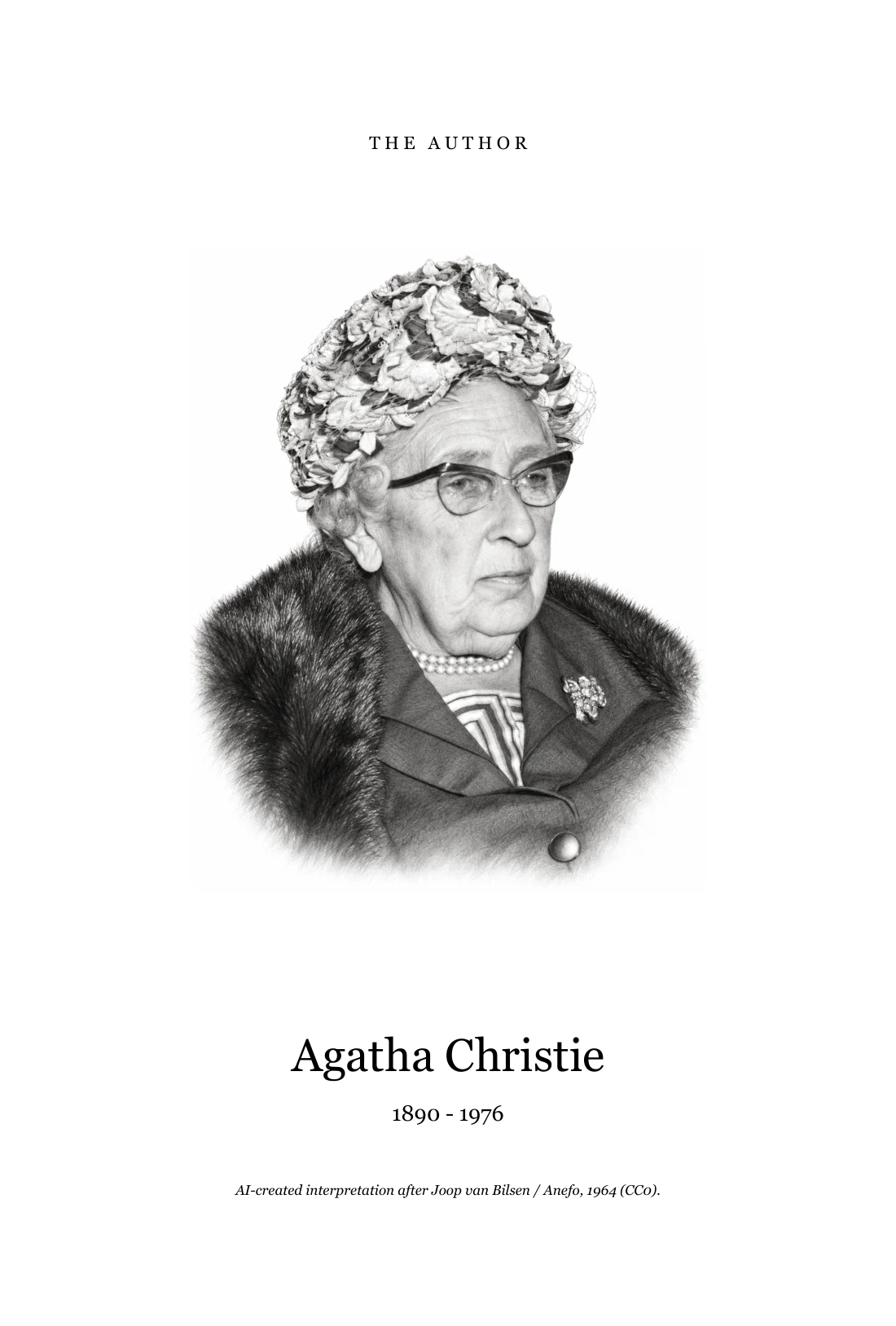
She did. Between 1930 and 1956 Agatha Christie published six novels as Mary Westmacott: books about love, marriage, family and self-deception, with no detective and no corpse. The first, Giant’s Bread, appeared in 1930, the same year Miss Marple made her first full-length appearance in The Murder at the Vicarage.
The pseudonym let Christie write a different kind of book without readers expecting a puzzle, and the secret held for well over a decade until a newspaper revealed it in 1949. The novels have lived in the shadow of the mysteries ever since, which is a pity, because they include some of the most personal things she wrote.
What are the Mary Westmacott books?
There are six, and they are best read as a sequence of separate portraits rather than a series.
- Giant’s Bread (1930): a young man from an old English family, torn between music, duty and two very different women.
- Unfinished Portrait (1934): a woman looks back over her childhood and a failing marriage. It is often read as Christie’s most autobiographical book.
- Absent in the Spring (1944): a woman stranded alone at a desert rest house begins to see her life and her family as they really are.
- The Rose and the Yew Tree (1948): a love story set against post-war politics in a Cornish seaside town.
- A Daughter’s a Daughter (1952): a widowed mother and her grown daughter, and the resentments that build between them.
- The Burden (1956): two sisters, and the weight of loving someone too much.
Giant’s Bread is the one in our library, and it is also the natural place to start.

Are the Mary Westmacott books really romance novels?
Not quite, despite how they are usually described. There is love in all of them, but rarely the happy-ever-after kind. They are closer to psychological novels: studies of how people misread those closest to them, and themselves. Christie’s gift for misdirection is still at work, only now the thing hidden in plain sight is a character’s own heart.
She seems to have valued them highly. Christie later said she wrote Absent in the Spring in a single burst of three days, a book she had been carrying in her head for years, and it is often singled out as the finest of the six.
Giant’s Bread: where to start with Mary Westmacott
Giant’s Bread follows Vernon Deyre from a lonely childhood in a great country house to a career as a composer, a marriage and the First World War. Christie had studied singing and piano in Paris as a young woman, and once hoped for a musical career, so the book’s feeling for music is hard-won.
It is a long, absorbing family novel, and there is a turn in the plot that any Christie fan will recognise as her handiwork. We won’t spoil it. What surprises most is how tender the book is, and how much it understands about ambition and the people it hurts along the way.
Giants' bread
1930, as Mary Westmacott. A composer’s life from childhood to the trenches and beyond. The first of Christie’s six novels without a crime.
The Murder of Roger Ackroyd
1926. The Poirot novel whose ending caused an uproar and is still argued over. Read it before anyone tells you why.



From Westmacott back to the mysteries
If you come to Westmacott from the detective stories, read The Murder of Roger Ackroyd alongside it. It is the novel that made Christie’s reputation in 1926, and its solution so divided readers that people still debate whether she played fair. No spoilers here; for the spoiler-free story of the fuss, see Did The Murder of Roger Ackroyd really cause a scandal?.
The two make a fascinating pair. Both are about what people conceal, and both show a writer who understood that the most interesting secrets are rarely the ones anyone is looking for. If you would rather meet Poirot from the very beginning, start with Hercule Poirot’s first cases, in the order they were published, which open with The Mysterious Affair at Styles.
Christie was not the only bestselling author with a second name. Louisa May Alcott wrote lurid thrillers as A. M. Barnard; see Did you know Louisa May Alcott secretly wrote thrillers? For more literary disguises, try Famous pen names in classic literature.
If you know Christie only as a maker of puzzles, Giant’s Bread is the best way to meet the rest of her. Settle in for a few long evenings with Vernon Deyre, and watch the Queen of Crime turn her eye for human weakness on a story where nobody needs to be murdered.
Questions readers ask
Why did Agatha Christie write as Mary Westmacott?
To write a different kind of novel without the expectations attached to her famous name. The Westmacott books are about love and family rather than crime, and the pseudonym let them find readers on their own terms until it was revealed in 1949.
How many Mary Westmacott books are there?
Six: Giant’s Bread (1930), Unfinished Portrait (1934), Absent in the Spring (1944), The Rose and the Yew Tree (1948), A Daughter’s a Daughter (1952) and The Burden (1956).
Which Mary Westmacott book should I read first?
Giant’s Bread, the first, is a good place to start: a sweeping novel about a young composer, as readable as her crime fiction. Absent in the Spring is often named the finest of the six.
 The Mysterious Affair at Styles172 pages · $13.99
 The Murder at the Vicarage216 pages · $14.99
 The Secret Adversary246 pages · $15.99
 The Man in the Brown Suit234 pages · $14.99