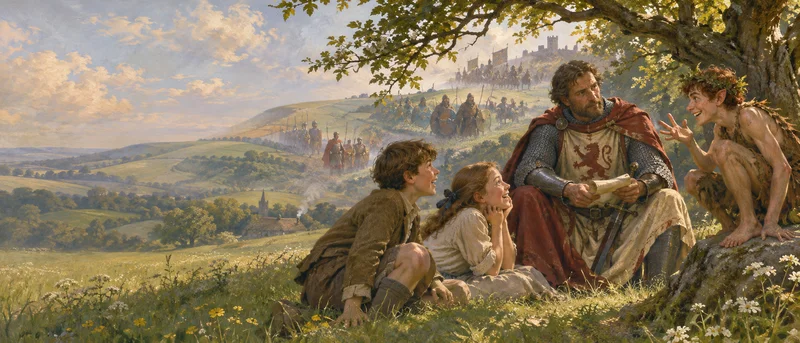
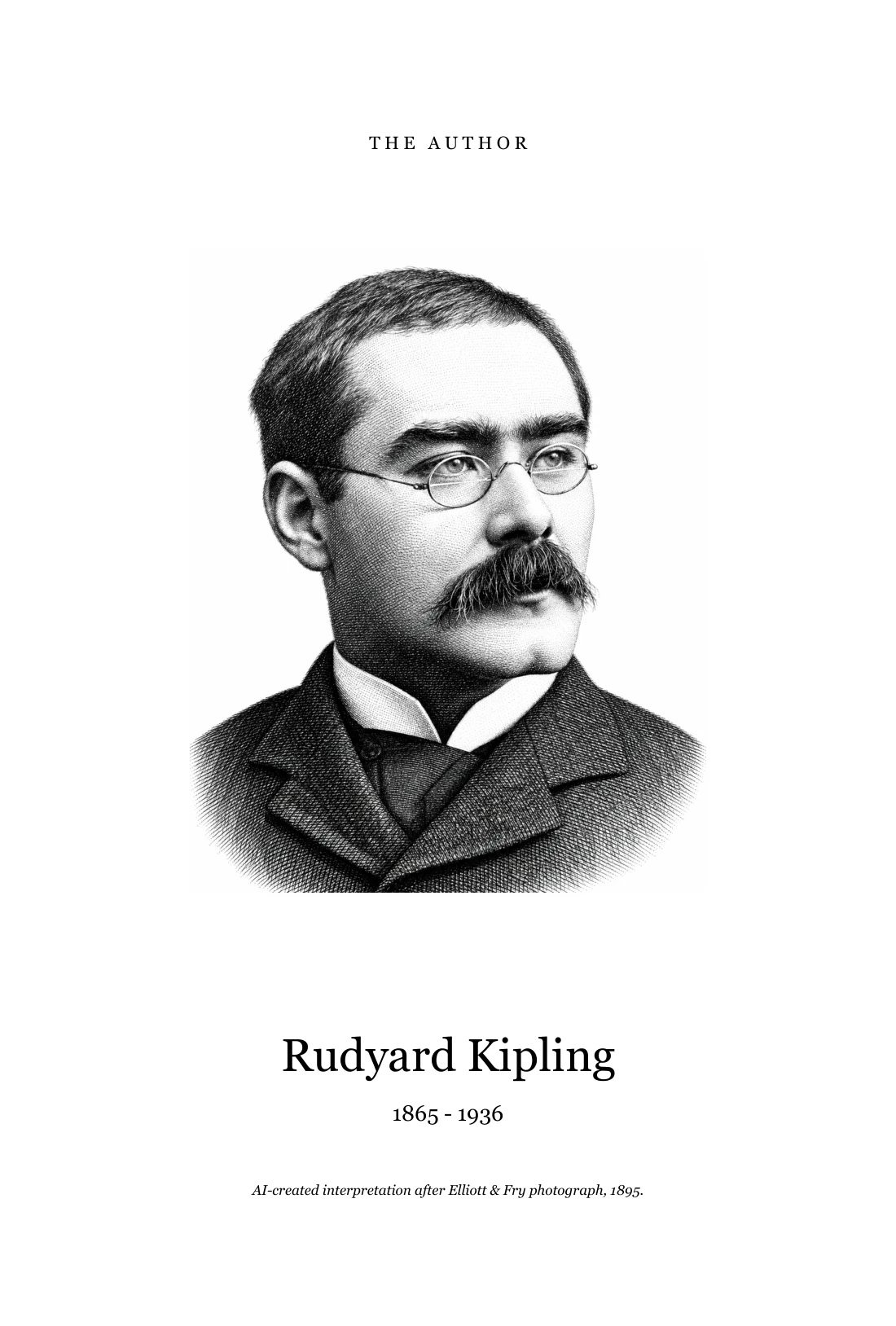
“O my Best Beloved.” That is how the narrator of the Just So Stories speaks to the child listening, and it began as a real voice at a real bedside. Rudyard Kipling first told the earliest of these stories to his daughter Josephine, who insisted that each one be repeated exactly as before, with not a word changed. They had to be told just so.
Josephine died of pneumonia in 1899, aged six, and the book came out three years later. Its comedy is the more remarkable for that. It is also the right first Kipling for many readers, children or not, because it shows in a few pages what made him one of the most popular storytellers of his age: rhythm, cheek and the sense that the story is being spoken aloud just for you.
Which Rudyard Kipling books should you start with?
It depends who is reading. Kipling wrote for every age, and his books divide neatly into those best read aloud and those best read alone.
For reading aloud
Just So Stories
1902. How the whale got his throat, the camel his hump and the leopard his spots, told in a voice of mock solemnity that children love to imitate. Ideal for ages five and up.
The Jungle Book
1894. Mowgli among the wolves, Baloo and Bagheera, plus stories that have nothing to do with him, including the mongoose Rikki-Tikki-Tavi. Fiercer and stranger than any film version.


For reading alone
- $12.99
Captains Courageous
1897. A spoiled American rich boy falls off a liner, is fished out by a Gloucester schooner on the Grand Banks, and has to work his passage for a season. A short, salty coming-of-age story.
- $13.99
Stalky & Co.
1899. Three boys at a Devon boarding school wage a war of wits on masters and rivals. Beetle, the bespectacled one who writes, is Kipling himself.
- $16.99
Kim
1901. An Irish orphan running wild on the streets of Lahore attaches himself to a Tibetan lama on a spiritual quest, and is recruited into the Great Game of espionage. His masterpiece.



Kim: the best Kipling book for adults
If you read only one Kipling as an adult, make it Kim. It opens with its hero sitting, against the rules, on the great gun outside the Lahore Museum, the “Wonder House” where Kipling’s own father had been curator, and it never loses that sense of a city and a country seen by someone who loved them.
He sat, in defiance of municipal orders, astride the gun Zam Zammah on her brick platform opposite the old Ajaib-Gher—the Wonder House, as the natives call the Lahore Museum.
Rudyard Kipling, Kim (1901)
The plot, about the rivalry between Britain and Russia for Central Asia, popularised the phrase “the Great Game”, but the heart of the book is the friendship between the street boy and the old lama, two people from different worlds who come to need each other. It is also, inevitably, a novel written from inside the Raj, and it takes British rule for granted in ways that a modern reader will notice.
Kipling’s life in brief
- 1865
Born in Bombay on 30 December, the son of an artist and teacher.
- 1871
Sent to England with his sister and boarded with a family in Southsea, a house he later called the House of Desolation.
- 1878
Enters the United Services College in north Devon, the school of Stalky & Co.
- 1882
Returns to India as a journalist on the Civil and Military Gazette in Lahore.
- 1892–96
Lives near Brattleboro, Vermont, where he writes the Jungle Books and Captains Courageous.
- 1899
His daughter Josephine dies, aged six.
- 1907
Becomes the first English-language writer to win the Nobel Prize in Literature, aged forty-one.
- 1936
Dies in London and is buried in Poets’ Corner, Westminster Abbey.
Those Lahore years made the writer. Kipling was a working journalist at sixteen, and twenty-eight of the forty stories in his first book of stories, Plain Tales from the Hills (1888), first appeared in the Gazette. The habit of saying a great deal in very few words never left him, and it is why even his longest books move so quickly.

Reading Kipling today
Kipling was a passionate believer in the British Empire, and some of his poems, notably “The White Man’s Burden”, have been read as imperial propaganda ever since they appeared. His stories can also be generous, curious and deeply attached to India and its people. Both things are true, and reading him well means noticing both. The children’s books carry the least of that weight, which is one reason they make such a good start.
If you love the Jungle Book, its sequel The Second Jungle Book finishes Mowgli’s story; see Did you know there are two Jungle Books? and Did you know Kipling wrote The Jungle Book in Vermont?. Puck of Pook’s Hill, in which two children meet figures from English history, is another fine read-aloud. Captains Courageous belongs with the greatest sea stories, and the 1937 film, which won Spencer Tracy an Oscar, is a classic in its own right.
Wherever you go next, start with a voice at a bedside. Open the Just So Stories, find a listener, and tell them how the elephant got his trunk. Tell it just so.
Questions readers ask
What is the best Rudyard Kipling book to start with?
For children, the Just So Stories or The Jungle Book. For adults, Kim (1901), widely considered his masterpiece. Captains Courageous is a short, gripping middle ground.
What age are the Rudyard Kipling books for?
The Just So Stories suit ages five and up as read-alouds, The Jungle Book roughly seven and up, and Kim, Stalky & Co. and Captains Courageous are best for teenagers and adults.
Did Kipling win the Nobel Prize?
Yes, in 1907. He was the first English-language writer to win the Nobel Prize in Literature and, at forty-one, remains its youngest recipient.
 The Second Jungle Book170 pages · $13.99
 Puck of Pook's Hill132 pages · $12.99
 Thy Servant a Dog100 pages · $11.99