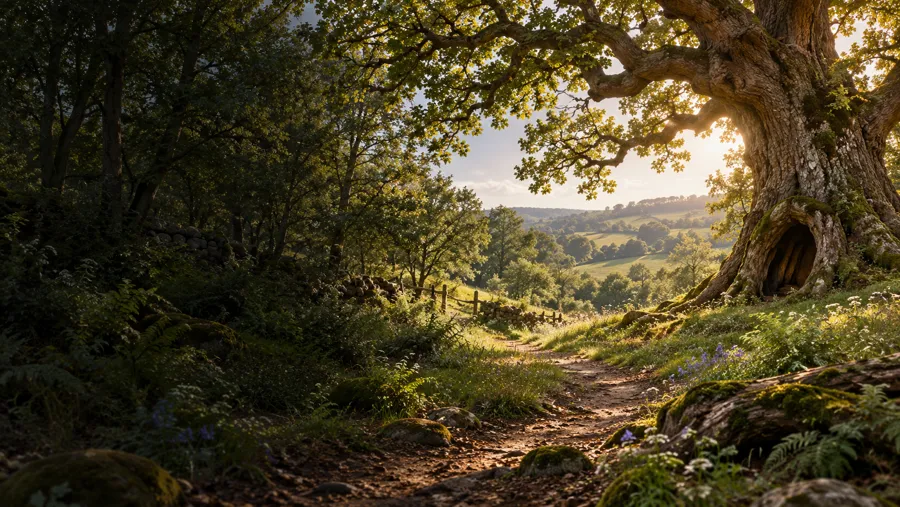
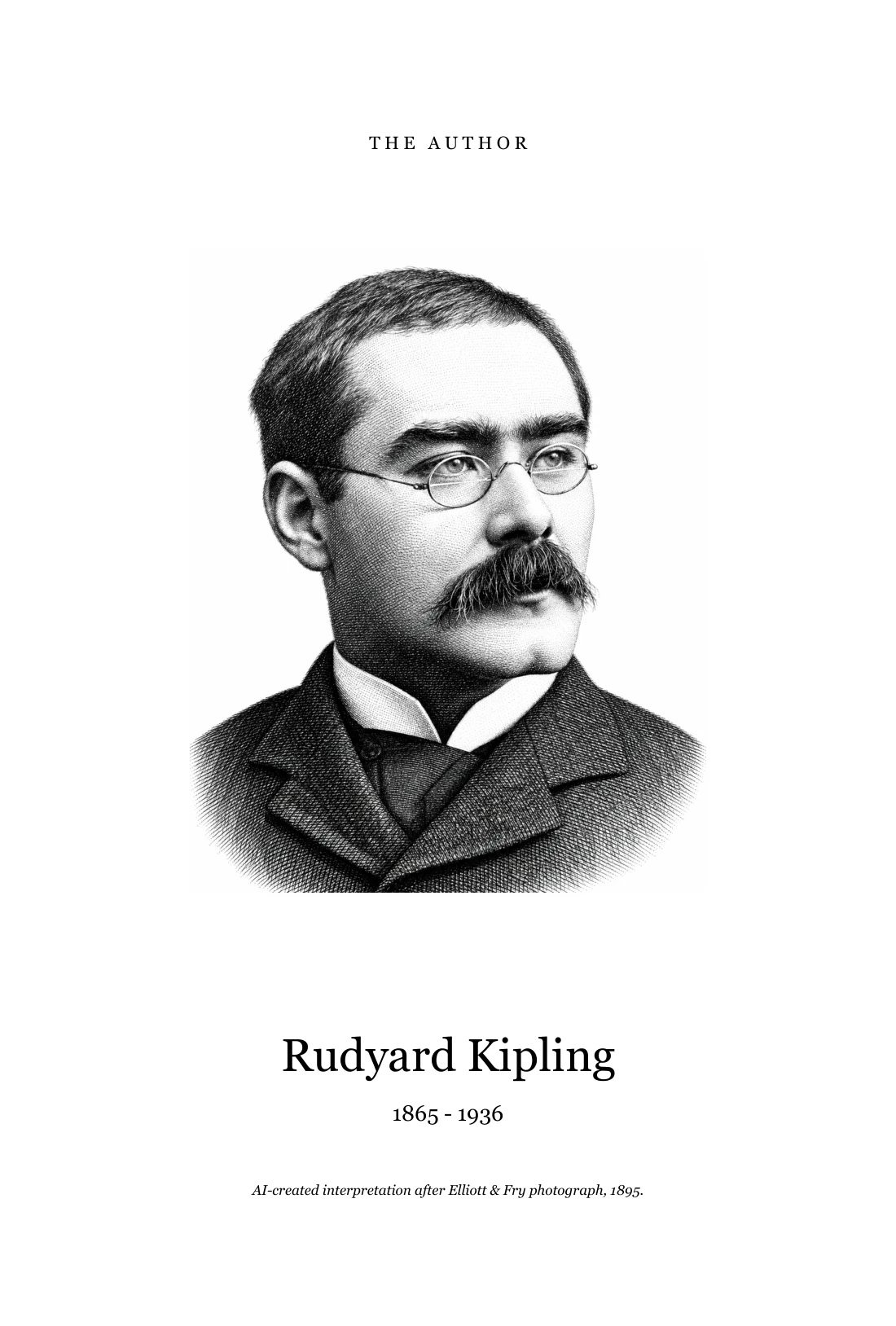
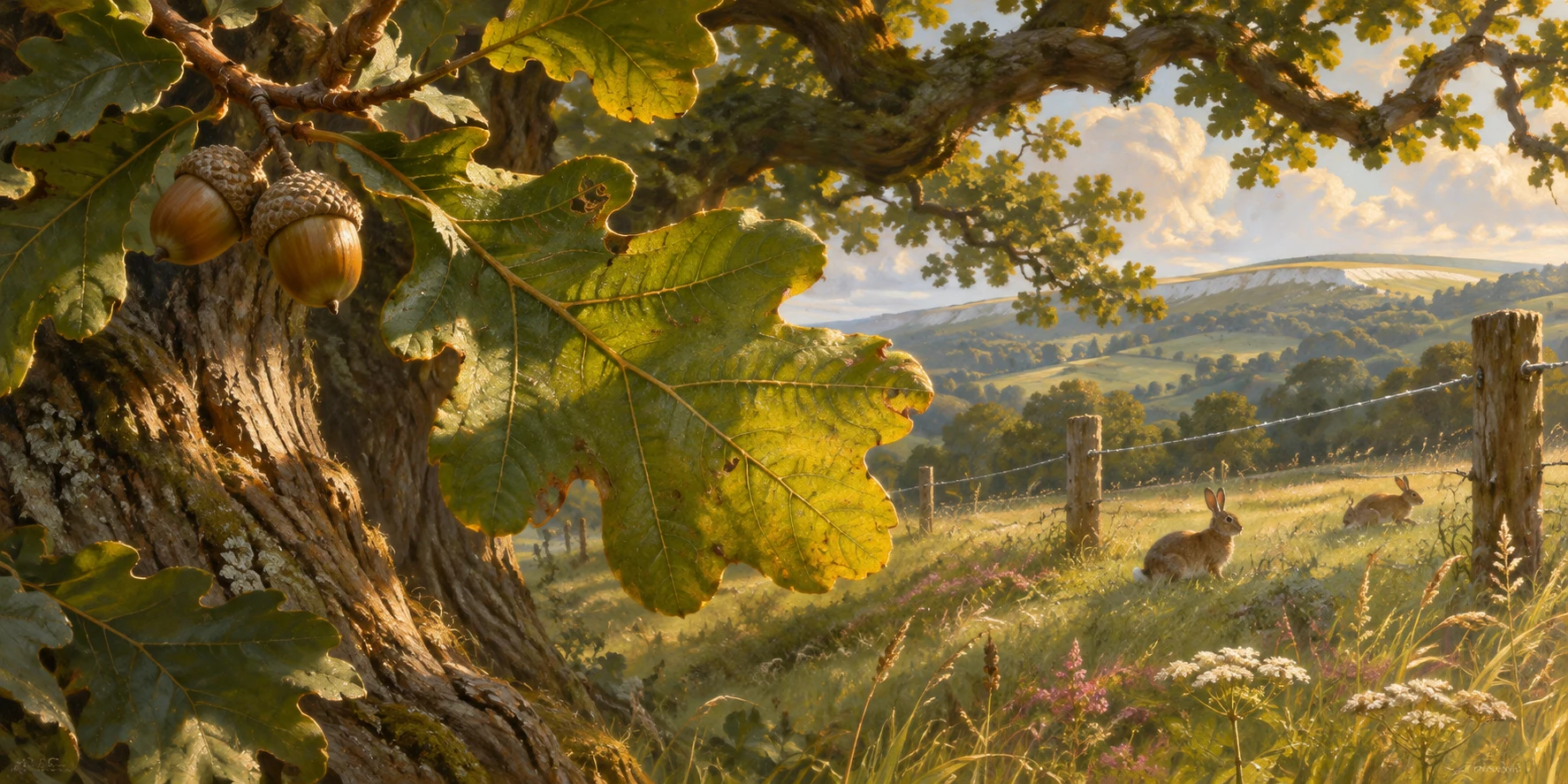
From his house in Sussex, Rudyard Kipling could see Pook’s Hill. He had moved to Bateman’s, a seventeenth-century house at Burwash, in 1902, and he lived there until his death in 1936. Puck of Pook’s Hill, published in 1906, is set in the meadows, woods and mill streams around it, and its two heroes, Dan and Una, are children who live in the valley below it.
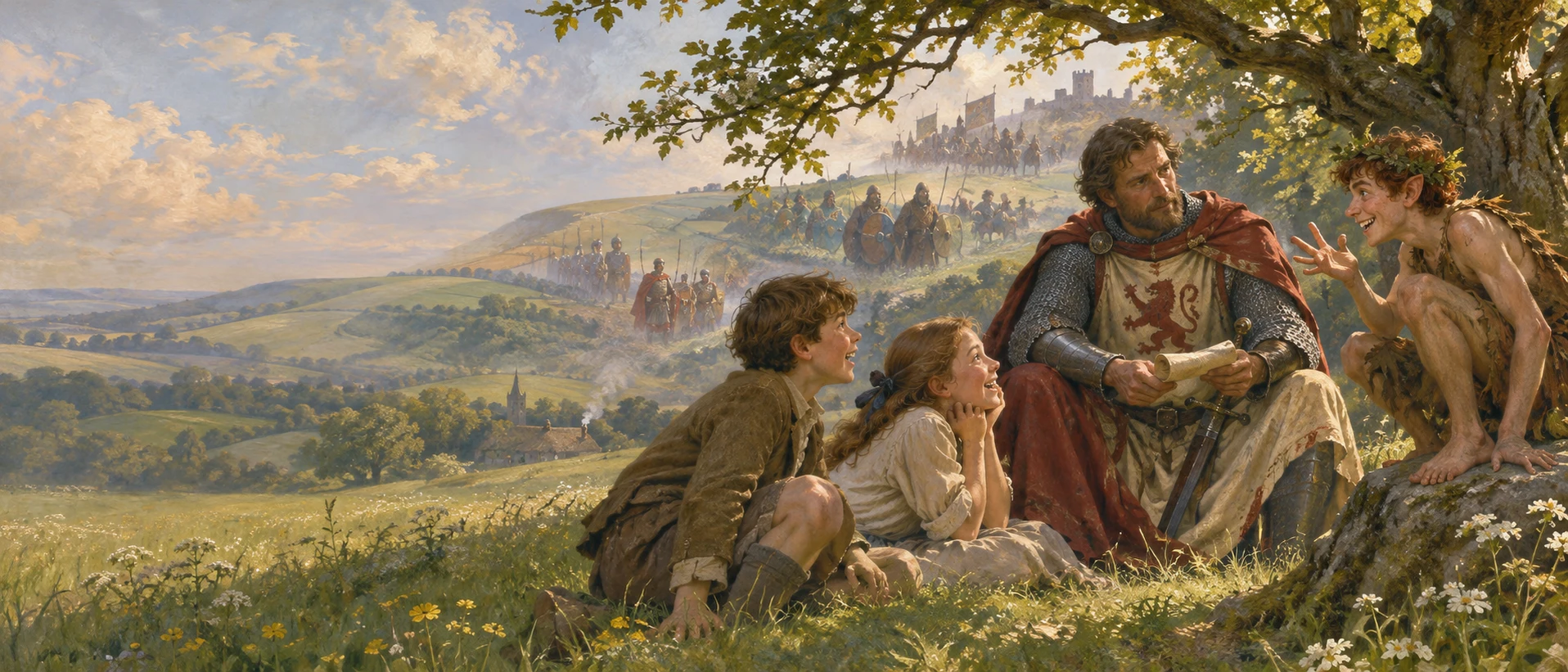
The book is made of linked stories. Puck, the last of the People of the Hills, brings people out of the past to talk to the children, and each of them tells a tale of the land Dan and Una are standing on: a Norman knight, a Roman centurion, a Tudor artist, a Jewish moneylender at the time of Magna Carta. It was written for children and has never quite stopped being read by adults.
What happens in Puck of Pook’s Hill?
It begins with a play. Dan and Una’s father has made them a short version of A Midsummer Night’s Dream, and on Midsummer Eve they perform it to an audience of three cows, in a fairy ring in a meadow called the Long Slip. Dan plays Puck, Bottom and all three fairies; Una is Titania. They act it three times, and by doing so on that night, in that place, they break the Hills.
I’m Puck, the oldest Old Thing in England, very much at your service if—if you care to have anything to do with me.
Rudyard Kipling, *Puck of Pook’s Hill* (1906), “Weland’s Sword”
Puck gives them seisin of the meadow, a handful of turf in the old way of handing over land, so that they truly own it and can see what is in it. Then, at the end of each visit, he gives them a leaf of Oak, one of Ash and one of Thorn to bite, and they walk home remembering nothing, which spares them from having to explain to anyone that they spent the afternoon with a Roman soldier.

The people Puck brings
- Weland, the smith of the old gods, who ends up shoeing horses in Sussex for pennies and makes a sword for a novice monk
- Sir Richard Dalyngridge, a young Norman knight who fought at Hastings and must win over the Saxons of the manor he is given
- Parnesius, a centurion born in Britain, sent to guard Hadrian’s Wall as Rome’s power ebbs and the Winged Hats raid from the sea
- Hal o’ the Draft, a Tudor artist who rebuilt the village church, with unexpected help from the Scottish pirate Sir Andrew Barton
- Kadmiel, a Jewish moneylender, whose story links the old treasure to the Law signed at Runnymede
The Roman stories, “A Centurion of the Thirtieth”, “On the Great Wall” and “The Winged Hats”, form a short novel of their own and are the strongest in the book. They are also its most adult: loyalty, a crumbling empire and men left to hold a frontier alone.
The poems
Every story is framed by verses, and some of Kipling’s best-known poems first appeared here: “Puck’s Song”, “A Tree Song” with its refrain of Oak and Ash and Thorn, and “A Smugglers’ Song”, with its five and twenty ponies trotting through the dark and its advice to “watch the wall, my darling, while the Gentlemen go by”. Children who will not sit still for history will often learn the smugglers by heart.
Puck of Pook's Hill
1906. Ten stories of English history, told to two children by the people who lived it. Kipling at his most magical and most serious.
Just So Stories
1902. The leopard’s spots, the elephant’s nose and the cat who walked by himself. The Kipling to read to younger brothers and sisters.


What age is Puck of Pook’s Hill for?
It is a read-aloud for children from eight to twelve or so, and a book older readers come back to. The language is rich and sometimes old-fashioned, and some stories need a little background: where Hadrian’s Wall is, what Magna Carta was. Like much of Kipling, it carries the assumptions of its age about empire, and the story of Kadmiel deals directly with the persecution of Jews in medieval England. Reading it together makes all of that easier to talk about.
For younger children, the Just So Stories are the place to begin. For Kipling as a whole, see Where to start with Rudyard Kipling, and for the jungle books, Did you know Kipling wrote The Jungle Book in Vermont?. And since Dan and Una begin with Shakespeare, E. Nesbit’s Shakespeare for children makes a natural companion.
Go down to the Long Slip on Midsummer Eve with Dan and Una. Puck of Pook’s Hill is Rudyard Kipling’s love letter to one small corner of England, and to everything that happened in it.
Questions readers ask
What is Puck of Pook’s Hill about?
Two children, Dan and Una, meet Puck in a Sussex meadow after acting A Midsummer Night’s Dream on Midsummer Eve. He brings figures from English history, including a Norman knight and a Roman centurion, to tell them stories of the land around their home.
Where is Pook’s Hill?
Pook’s Hill is near Burwash in East Sussex, and is visible from Bateman’s, the house where Rudyard Kipling lived from 1902 until his death in 1936.
Did Kipling write a sequel to Puck of Pook’s Hill?
Yes. Rewards and Fairies (1910) brings Dan, Una and Puck back for a second set of stories, and includes Kipling’s poem “If—”.
What age is Puck of Pook’s Hill suitable for?
It suits children of about eight to twelve as a read-aloud, and confident readers of ten or more alone. Adults often enjoy it as much as children.
 The Jungle Book158 pages · $12.99
 Kim286 pages · $16.99
 Captains Courageous146 pages · $12.99
 The Second Jungle Book170 pages · $13.99