

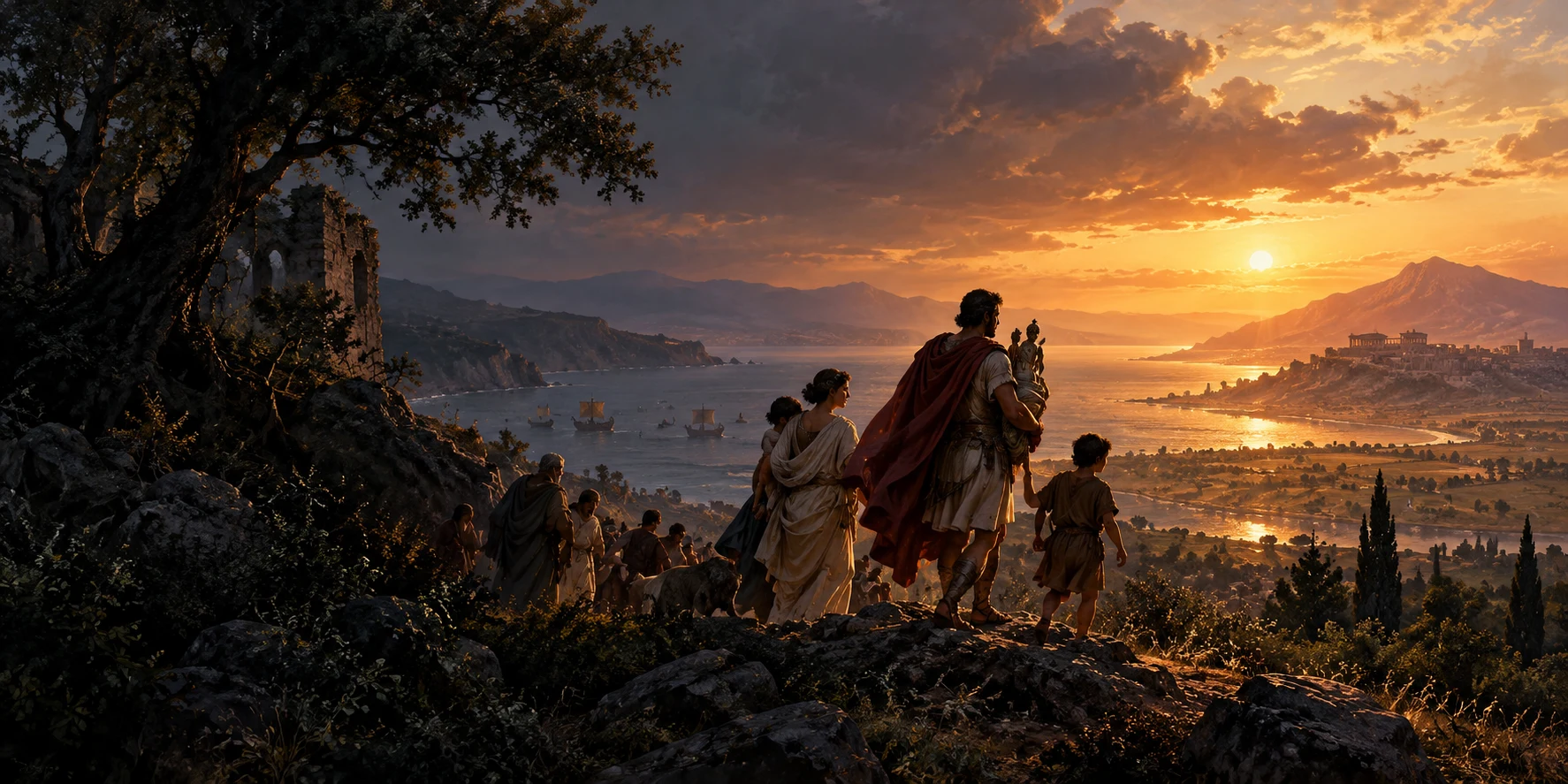
What do you do when a dying friend asks you to burn the greatest poem of his age? That was the choice facing Lucius Varius Rufus and Plotius Tucca in September 19 BC, as Virgil lay ill at Brundisium on the heel of Italy. They refused, and so did the emperor. The ancient lives of the poet agree that Virgil wanted The Aeneid burned, and that Augustus would not allow it.
We have the poem because his wishes were ignored. We also have, scattered through its twelve books, the marks of a work its author never had time to finish.
How Virgil died
The fullest account is a fourth-century life of the poet by the grammarian Donatus. By then Virgil had spent eleven years on The Aeneid, after three on his pastoral Eclogues and seven on the Georgics. He planned to go to Greece and Asia Minor and spend three years doing nothing but revising, so that the rest of his life could be given to philosophy.
It did not work out. On the way to Athens he met Augustus, who was returning from the East, and decided to go back to Italy with him. Visiting the nearby town of Megara in the blazing sun, he fell ill. He was worse by the time the ship reached Brundisium, and he died there a few days later, on 21 September.
Did Virgil really want The Aeneid burned?
Every ancient source that mentions it says so. The earliest is Pliny the Elder, writing in the first century AD, who records that Augustus forbade the burning of Virgil’s poems. Aulus Gellius repeats the story in the second century, and the reason he and Donatus give is the same: the poem lacked its final polish.
Donatus adds the details. Before leaving Italy, Virgil had made Varius promise to burn the epic if anything happened to him, and Varius had flatly refused. As his health failed, Virgil kept asking for his book-boxes so that he could burn the poem himself. Nobody brought them.
His will left his writings to Varius and Tucca, on condition that they publish nothing he had not revised himself. They published anyway, on the authority of Augustus, correcting only lightly and leaving any unfinished lines exactly as they found them. A poet called Sulpicius of Carthage later put it neatly: unlucky Troy had very nearly burned a second time.
Is The Aeneid unfinished?
In one sense, visibly so. Scattered through the poem are about fifty-eight half-lines, verses that stop short of the full six-beat line Virgil used everywhere else. Donatus says later writers tried to complete them and gave up, because nearly all of them already make complete sense on their own. Modern scholars are still divided over whether they are scaffolding Virgil meant to remove or pauses he came to like.
Whether he would have changed more is anyone’s guess. Some readers find the ending, which stops abruptly on a moment of violence, too sudden to be what he intended. Others think it is exactly right. Either way, the poem’s shape is the one Varius and Tucca left us.
Augustus’s reasons were not purely literary. The poem traces the founding of Rome back to Aeneas, a refugee prince from Troy, and through Aeneas’s son Iulus to Augustus’s own Julian family. Donatus says Virgil read three whole books aloud to the emperor, among them Book Six, and that when he reached the lines mourning the young Marcellus, Octavia, who was listening, is said to have fainted at this tribute to her son.
The Aeneid
Aeneas escapes burning Troy, loves and abandons Dido of Carthage, visits the underworld and fights for a new home in Italy. The epic Virgil wanted destroyed; Dante later cast its author as his guide through Hell.
The Odyssey
Homer’s tale of a long voyage home, echoed in the wanderings that fill the first six books of Virgil’s poem.
The Iliad
The siege of Troy, ending before the city falls. Virgil picks up where the Trojans’ story leaves off, from the losing side.


Reading the poem Virgil could not finish
The half-lines are easy to miss in translation, where the verse has been remade anyway. What survives is a poem of exile, duty and enormous cost, written for a new regime and yet full of grief for everyone the founding of Rome destroys. Knowing that its author wanted it gone makes that grief feel more personal.
Our guide The great epics: where to begin sets The Aeneid beside its rivals, and the choice of which Homer poem to start with is tackled in The Iliad or The Odyssey: which should you read first?. Another epic that survived a fire by the narrowest of margins appears in Did you know Beowulf survives in a single manuscript that nearly burned?, and books whose authors never got to finish them are gathered in Unfinished classic novels and how they might have ended.
Varius and Tucca disobeyed a dying friend so that you could read this. Begin The Aeneid with Aeneas looking back at Troy in flames, and decide whether they were right.
Questions readers ask
Why did Virgil want The Aeneid burned?
The ancient sources say he considered it unfinished. He had planned three more years of revision, and when he fell fatally ill in 19 BC he asked for the manuscript to be destroyed rather than published imperfect.
Who saved The Aeneid from being burned?
The emperor Augustus overruled Virgil’s wishes, and the poet’s friends Lucius Varius Rufus and Plotius Tucca edited and published the poem with only light corrections.
Is The Aeneid finished?
Not entirely. It contains about fifty-eight incomplete lines, and the ancient biographers say Virgil had not given it its final revision, though scholars disagree about how much more he would have changed.

