
When Jules Verne finally passed judgement on H. G. Wells’s moon novel, he got the planet wrong. “He goes to Mars in an airship,” Verne told a visiting English journalist in 1903, “which he constructs of a metal which does away with the law of gravitation.” The book he meant was The First Men in the Moon, and the metal was cavorite.
So yes, Verne really did scoff, and in print. The interview, by Robert H. Sherard, appeared in T.P.’s Weekly on 9 October 1903. Verne, then in his mid-seventies and losing the sight of one eye to a cataract, received Sherard at his house in Amiens and answered the question about Wells he said he had been expecting.
I make use of physics. He invents. I go to the moon in a cannon-ball, discharged from a cannon. There is no invention.
Jules Verne, interviewed by Robert H. Sherard, T.P.’s Weekly, 9 October 1903
Then, as Sherard tells it, Verne grew animated. It was all very pretty, he said in French, but “show me this metal. Let him produce it.”
What is The First Men in the Moon about?
H. G. Wells’s novel was serialised in The Strand Magazine in Britain and The Cosmopolitan in America in 1900–01, and came out as a book in 1901. Its narrator, Mr Bedford, is a businessman in financial trouble who rents a cottage at Lympne in Kent to write a play. He is disturbed every afternoon by a strange little man who walks past making odd noises. This is Mr Cavor, a physicist on the verge of inventing a substance that blocks gravity.
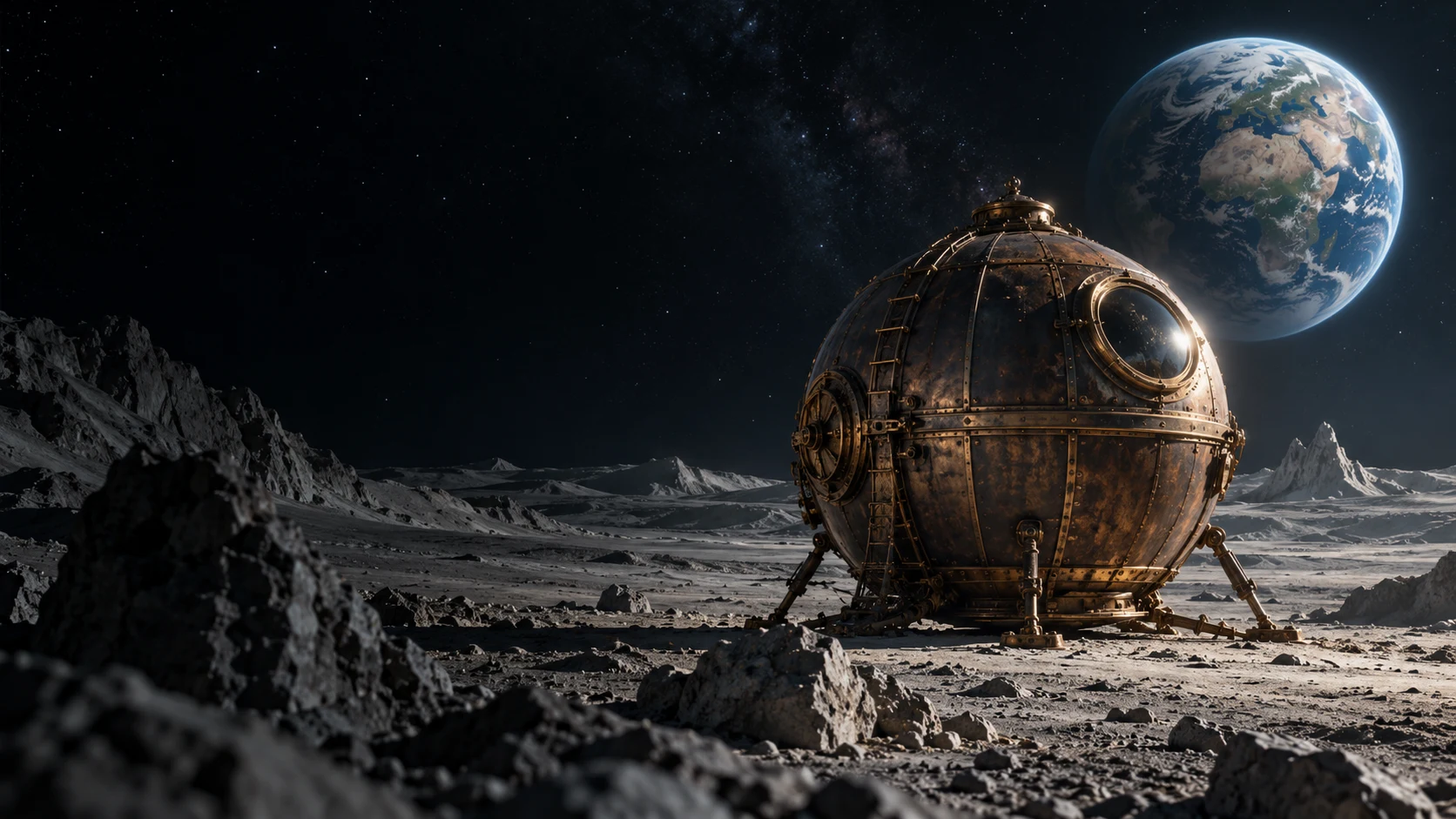
Bedford, who sees money in it, persuades Cavor to build a sphere, steel outside and glass within, with sliding blinds of the stuff that can be opened towards whatever they want to fall towards. They fly to the Moon. There they find a lunar morning that brings a frozen landscape to life, grazing “mooncalves”, gold lying about like common metal and, underground, the insect-like Selenites, whose society is divided into castes so rigid that each individual is shaped from birth for a single job.

How does cavorite work, and why did it annoy Verne?
It doesn’t, really, and Wells knew it. He lets Bedford, who admits he understood none of the mathematics, explain the principle.
Now all known substances are “transparent” to gravitation. You can use screens of various sorts to cut off the light or heat, or electrical influence of the sun, or the warmth of the earth from anything; you can screen things by sheets of metal from Marconi’s rays, but nothing will cut off the gravitational attraction of the sun or the gravitational attraction of the earth.
H. G. Wells, The First Men in the Moon (1901)
Cavor, Bedford says, made his substance from an alloy of metals and “something new”, which he thinks was helium. Then he wishes he had taken notes. It is a wonderfully cheeky piece of writing, and it is exactly what Verne objected to: the hard part is skipped, and the story gets on with the Moon.
Verne’s own method was the opposite. In From the Earth to the Moon (1865) the members of the Baltimore Gun Club spend chapters on the size of the gun, the charge, the metal of the shell and where in the United States to fire it from.
“I think so too,” replied Barbicane; “that is why I propose to quadruple that length, and to construct a gun of nine hundred feet.”
Jules Verne, From the Earth to the Moon (1865)
What did Wells think of the comparison?
He disliked it. Wells complained for years about being called “the English Jules Verne”, and in a preface written in 1933 he argued that there was no literary resemblance at all. Verne, he said, wrote about practical possibilities of invention and discovery, many of which had since come true; his own stories were fantasies, using an impossible device to get somewhere interesting. Elsewhere in the same preface he described The First Men in the Moon as an attempt to improve on Verne’s shot so that he could look at mankind from a distance.
Both men had a point. Verne’s cannon was at least an attempt at real ballistics, worked out in numbers. Wells was after something else: the Selenites’ regimented, caste-bound society is a satire on specialisation, and the Moon is simply a vantage point from which to look back at us.

Which should you read first?
- $17.99
From the Earth to the Moon
1865. After the American Civil War the bored gunners of the Baltimore Gun Club decide to shoot a projectile at the Moon, and then a Frenchman asks to ride inside it. Engineering as comedy, and the template for half a century of space fiction.
- $13.99
The First Men in the Moon
1901. A failing businessman and an absent-minded scientist fly to the Moon in a sphere fitted with cavorite blinds and find a whole civilisation underground. Funny, eerie and sharper than its reputation.


Read them in order of publication and you can watch science fiction splitting into two traditions: Verne’s, which asks how it could be done, and Wells’s, which asks what it would mean. Both have been filmed; Wells’s novel was filmed in 1964 with Lionel Jeffries as Cavor, and in 2010 Mark Gatiss adapted it for BBC Four and played Cavor himself.
For more of the pioneers, see The science fiction firsts and Jules Verne’s Extraordinary Voyages: where to start. Wells’s gift for prophecy is in Did you know H. G. Wells predicted the atomic bomb? Then take sides. Open The First Men in the Moon, find Bedford at his cottage in Kent, and decide whether you care how cavorite works.
Questions readers ask
What did Jules Verne say about H. G. Wells?
In a 1903 interview with Robert H. Sherard in T.P.’s Weekly, Verne said that Wells’s stories did not rest on scientific foundations: “I make use of physics. He invents.” He challenged Wells to produce his anti-gravity metal.
What is cavorite?
Cavorite is the imaginary substance in The First Men in the Moon (1901) that blocks gravity. Mr Cavor invents it, and he and Bedford travel to the Moon in a sphere fitted with cavorite blinds.
Is The First Men in the Moon based on From the Earth to the Moon?
Not directly, but Wells was writing in Verne’s shadow. Later he described his novel as an attempt to improve on Verne’s cannon shot, in order to look at humanity from a distance.
Who are the Selenites in The First Men in the Moon?
They are the insect-like inhabitants of the Moon, who live in a vast system of tunnels beneath the surface and are each shaped from birth for a single role in their society.

 The Time Machine118 pages · $11.99
 The War of the Worlds156 pages · $12.99
 The Invisible Man138 pages · $12.99
 The Island of Doctor Moreau126 pages · $11.99