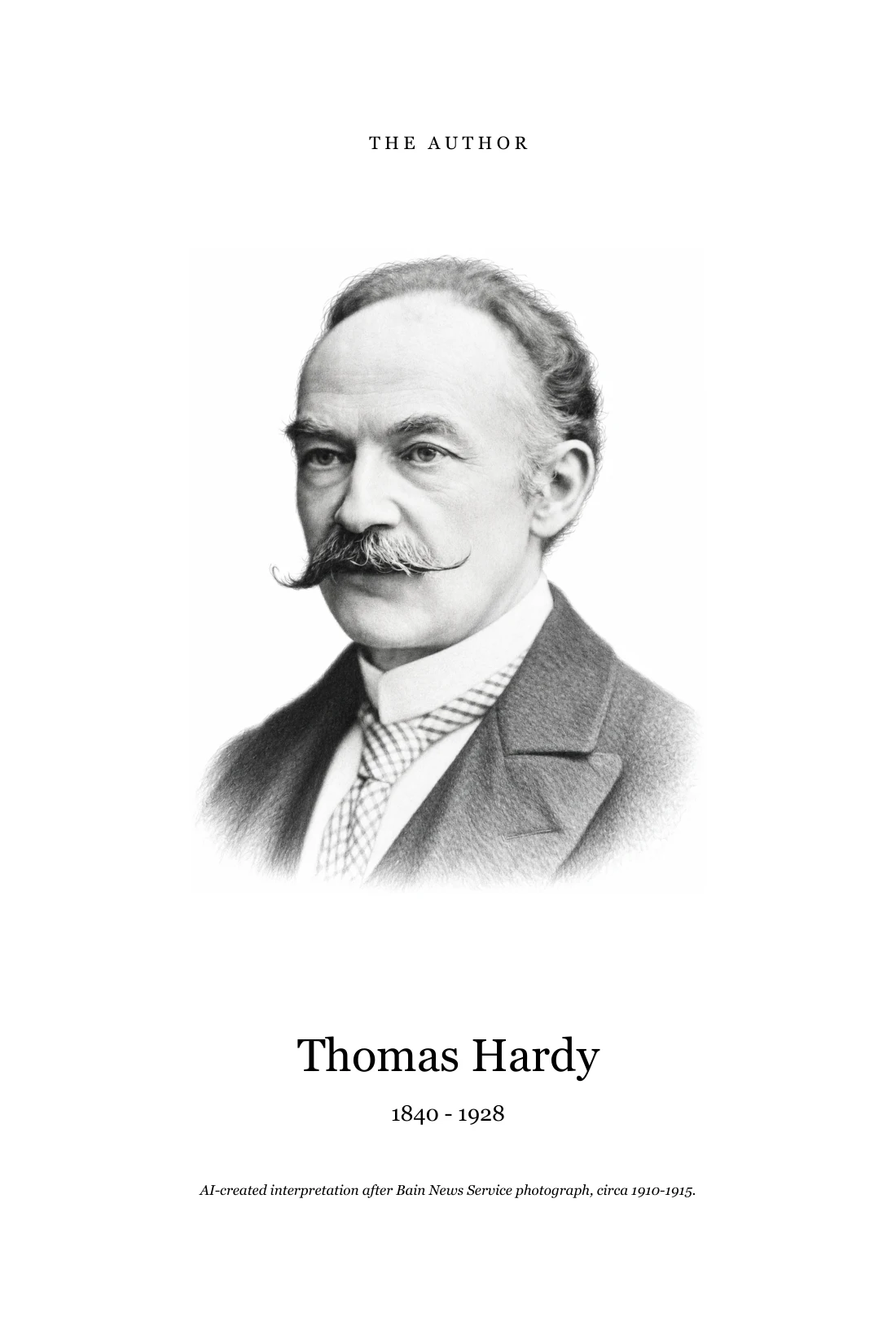
Long after he had stopped writing novels, Thomas Hardy did something few authors get to do: he arranged his own shelf. For the collected Wessex Edition of his works, which Macmillan began publishing in 1912, he divided his fiction into “Novels of Character and Environment”, “Romances and Fantasies” and “Novels of Ingenuity”. It is the closest thing we have to a reading guide from the man himself, and it is a useful way to find your way through his work.
Thomas Hardy published fourteen novels. In order they are Desperate Remedies (1871), Under the Greenwood Tree (1872), A Pair of Blue Eyes (1873), Far from the Madding Crowd (1874), The Hand of Ethelberta (1876), The Return of the Native (1878), The Trumpet-Major (1880), A Laodicean (1881), Two on a Tower (1882), The Mayor of Casterbridge (1886), The Woodlanders (1887), Tess of the d’Urbervilles (1891), Jude the Obscure (1895) and The Well-Beloved (1897). We stock twelve of them; only The Hand of Ethelberta and A Laodicean are missing.
Thomas Hardy’s novels in order
- $19.99
Desperate Remedies
1871. Ingenuity. A sensation plot of bigamy, blackmail and murder, published anonymously by Tinsley Brothers. Hardy trying his hand at the sensation novel Wilkie Collins had made popular, with plot firmly in charge.
- $13.99
Under the Greenwood Tree
1872. Character and Environment. The Mellstock church musicians at Christmas, with Mellstock modelled on Stinsford and the Bockhamptons, where Hardy was born. Subtitled “A Rural Painting of the Dutch School”.
- $19.99
A Pair of Blue Eyes
1873. Romances and Fantasies. Elfride Swancourt, a rector’s daughter on the north Cornish coast, and the two men who love her. Endelstow is St Juliot, where Hardy met his first wife.
- $19.99
Far from the Madding Crowd
1874. Character and Environment. Bathsheba Everdene inherits a farm at Weatherbury, Hardy’s Puddletown. The book that made his name, serialised in The Cornhill.
- $19.99
The Return of the Native
1878. Character and Environment. Clym Yeobright comes home from Paris to the heath he grew up on, and Eustacia Vye wants nothing more than to leave it. Egdon Heath is one of the great characters in English fiction.
- $17.99
The Trumpet-Major
1880. Romances and Fantasies. Anne Garland, the miller Loveday’s two sons and a coast waiting for Napoleon, in Overcombe, drawn from Sutton Poyntz near Weymouth. His sunniest book, first serialised in Good Words.
- $15.99
Two on a Tower
1882. Romances and Fantasies. Lady Constantine and a young astronomer, Swithin St Cleeve, whose observatory is the tower on her estate at Welland. A love story measured against the size of the universe.
- $17.99
The Mayor of Casterbridge
1886. Character and Environment. Michael Henchard rises to be mayor of Casterbridge, which is Dorchester, the town Hardy knew best, and is undone by the one thing he did as a young man.
- $19.99
The Woodlanders
1887. Character and Environment. Timber, cider and unhappy marriages in the woods around Little Hintock. In 1912 Hardy admitted that he had once spent hours on a bicycle hunting for the real Little Hintock, and failed to find it.
- $19.99
Tess of the d'Urbervilles
1891. Character and Environment. Tess Durbeyfield of Marlott, which is Marnhull in the Blackmore Vale. Subtitled “A Pure Woman Faithfully Presented”, and the novel Hardy is still most read for.
- $20.99
Jude the Obscure
1895. Character and Environment. A stonemason who longs for Christminster, Hardy’s Oxford, and the cousin he loves. The last novel he wrote.
- $13.99
The Well-Beloved
1897. Romances and Fantasies. A sculptor from the Isle of Slingers, which is Portland, falls in love with three generations of the same family. Serialised in 1892 and revised for its book publication.


Hardy’s three groups, explained
Hardy’s Novels of Character and Environment are the ones most readers mean by “Hardy”: Under the Greenwood Tree, Far from the Madding Crowd, The Return of the Native, The Mayor of Casterbridge, The Woodlanders, Tess and Jude. In each, people are shaped and often broken by the place they live in, its work, its customs and its gossip.
The Romances and Fantasies are lighter on their feet and more willing to bend realism: A Pair of Blue Eyes, The Trumpet-Major, Two on a Tower and The Well-Beloved. The Novels of Ingenuity, the smallest group, are the plot-driven books Hardy seems to have thought of as apprentice work or experiments: Desperate Remedies, The Hand of Ethelberta and A Laodicean.
The groups are not a ranking, but they are a hint. If you love Tess, go next to the other Character and Environment novels. If you want something less harrowing, the Romances are where Hardy smiled most.
Why fourteen and not fifteen?
Because his first novel never appeared. The Poor Man and the Lady, written in 1867–68, was turned down by publishers, and George Meredith, who read it, warned Hardy that its politics might damage his chances. He salvaged scenes from it for later work, and in old age he destroyed the last surviving fragment of the manuscript. His first published novel was Desperate Remedies, in 1871.
Was Wessex a real place?
Half real. Hardy borrowed the name of the old Saxon kingdom, applied it to Dorset and the counties around it, and gave every town a new name: Dorchester became Casterbridge, Weymouth became Budmouth, Salisbury Melchester. Readers soon went looking for the originals. In 1895 Hardy noted, half rueful, that the name had escaped from his books into everyday use.
Since then the appellation which I had thought to reserve to the horizons and landscapes of a merely realistic dream-country, has become more and more popular as a practical definition; and the dream-country has, by degrees, solidified into a utilitarian region which people can go to, take a house in, and write to the papers from.
Thomas Hardy, preface to Far from the Madding Crowd (1895)
He then asked his “good and gentle readers” to forget it, and to keep Wessex inside the books. That is the best way to read the novels in order: as one country, mapped book by book. The darker side of the story, why Hardy stopped after Jude, is told in Did you know Thomas Hardy gave up novels after Jude the Obscure?, and the magazines that first carried these books are in Victorian serial novels. His short stories, gathered in volumes like Life’s Little Ironies, belong to the same map.
The gentlest way in is a choir walking through Mellstock on Christmas Eve, in Under the Greenwood Tree. After that, cross the parish to Weatherbury for Far from the Madding Crowd, and keep going.
Questions readers ask
How many novels did Thomas Hardy write?
Hardy published fourteen novels between 1871 and 1897. An earlier novel, The Poor Man and the Lady, was rejected and never published, and its manuscript is lost.
What order should I read Thomas Hardy’s novels in?
Publication order shows his development, but the books are not sequels. Many readers start with Far from the Madding Crowd or Under the Greenwood Tree and leave Tess of the d’Urbervilles and Jude the Obscure until later.
What are Hardy’s Novels of Character and Environment?
It is Hardy’s own name, from the 1912 Wessex Edition, for his major novels: Under the Greenwood Tree, Far from the Madding Crowd, The Return of the Native, The Mayor of Casterbridge, The Woodlanders, Tess of the d’Urbervilles and Jude the Obscure.
What was Thomas Hardy’s last novel?
Jude the Obscure (1895) was the last novel he wrote, but The Well-Beloved, serialised in 1892, was the last published as a book, in 1897.
 Life's Little Ironies218 pages · $14.99