
For most of its long life, the Stratemeyer Syndicate went to great lengths to stay out of sight. Its books carried invented names, its writers signed contracts promising never to claim them, and the only face it showed the public was the cover. It took a court case in 1980, over which publisher owned what, to bring its working methods fully into the open.
So who really wrote Nancy Drew and the Hardy Boys? A syndicate did, and a remarkable number of people. Its founder, Edward Stratemeyer, invented the characters and the series; his staff drafted outlines; hired writers such as McFarlane and Mildred Wirt Benson wrote the chapters; and the finished books went out under house names the firm owned. The story of Nancy’s side of the family is told in Did you know Carolyn Keene was never a real person?. This is the story of the factory itself.
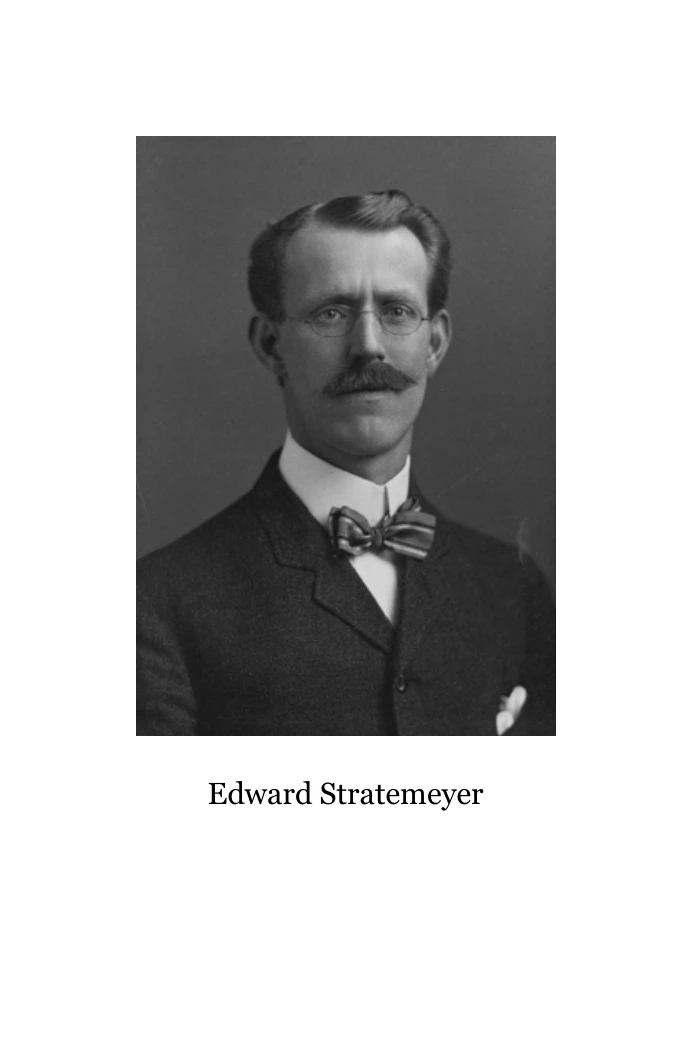
Who was Edward Stratemeyer?
Stratemeyer was born in Elizabeth, New Jersey, in 1862, the son of a tobacconist, and grew up on the rags-to-riches stories of Horatio Alger and William T. Adams. At twenty-six he sold his first story, Victor Horton’s Idea, to the boys’ magazine Golden Days for $76. Over the next decade he wrote dozens of dime novels, edited a story paper for Street & Smith, and published boys’ books under his own name and several invented ones.
He also stepped into Alger’s shoes quite literally. Before his death Alger asked Stratemeyer to finish his uncompleted manuscripts, and in 1901 Young Captain Jack appeared as Alger’s last work, completed by Stratemeyer. By then he had launched the Rover Boys under the name Arthur M. Winfield. The series ran to thirty volumes between 1899 and 1926, and he called it his personal favourite.
How did the Stratemeyer Syndicate make its books?
Around 1905 Stratemeyer realised he had more series in his head than he could write, and began hiring others to write them. He paid each writer a flat rate per book and kept the copyright himself. Some series still carried his own name, including the Oak Hall school stories about Dave Porter, which began in 1905; the rest appeared under pseudonyms that could outlive any one writer.
I did not imagine that so many thousands of boys and girls all over our broad land would take to Dave as they have, and would insist upon knowing more about him.
Edward Stratemeyer, preface to Dave Porter and His Rivals (1911)
That appetite for more was the whole business model, and the firm’s house rules were built to feed it:
- Every book belonged to a series, and a new series usually launched with several titles at once, so readers could tell quickly whether it would catch on. The first three Hardy Boys came out together in 1927, and the first three Nancy Drews in 1930.
- Chapters ended mid-situation, so that a reader could not comfortably stop.
- New volumes opened with a quick recap of earlier ones, which doubled as an advertisement for the backlist.
- Heroes did not grow up. Early series had let their characters age and marry, and sales had suffered.
- Writers worked from outlines, signed away their claim to the pen name, and received no royalties. The fee in the early years was $125 a book, later cut during the Depression to $100 and then $75.
The librarians’ war
Not everyone admired the system. In November 1914 Franklin K. Mathiews, chief librarian of the Boy Scouts of America, published an essay in The Outlook called “Blowing Out the Boy’s Brains”, an attack on cheap, mass-produced series fiction. It is often read as aimed at Stratemeyer, though whether Mathiews then knew how the syndicate worked is doubtful. Mathiews went on to propose the event that became Children’s Book Week, first held under that name in 1919, as a way of steering young readers towards better books.
The sales suggest children did not take much notice. Tom Swift, launched in 1910 under the name Victor Appleton and written mostly by Howard Garis, sold steadily for decades, and the Bobbsey Twins, begun in 1904 as Laura Lee Hope, became the syndicate’s longest-running series.
- 1899
The Rover Boys begin, credited to Arthur M. Winfield.
- 1904
The first Bobbsey Twins book appears under the name Laura Lee Hope.
- c. 1905
Stratemeyer starts hiring writers to fill his series; Dave Porter begins under his own name.
- 1910
Tom Swift arrives, credited to Victor Appleton.
- 1927
The Hardy Boys begin with three books at once.
- 1930
Nancy Drew appears in April; Stratemeyer dies on 10 May.
- 1959
The syndicate starts rewriting its early mysteries to modernise them and remove racist stereotypes.
- 1984
Simon & Schuster buys the syndicate.
What happened after Stratemeyer died?
His daughters inherited the firm. Edna Stratemeyer Squier ran the daily business at first, and Harriet Stratemeyer Adams dealt with publishers and wrote; Harriet eventually ran the syndicate for fifty-two years. She launched new series, including the Dana Girls in 1934, whose first four books McFarlane wrote under the Carolyn Keene name, and from 1959 she oversaw the long revision of the old Hardy Boys and Nancy Drew titles.
In 1979 she moved the two big mysteries into paperback, and the following year a switch of publishers led to the lawsuit that exposed the syndicate’s methods. Harriet Adams died in 1982, and two years later Simon & Schuster bought the company, which has kept the characters going ever since.
Reading the syndicate’s originals today
The early books in their first versions are now in the US public domain, and they are a good way to see the formula working at full speed.
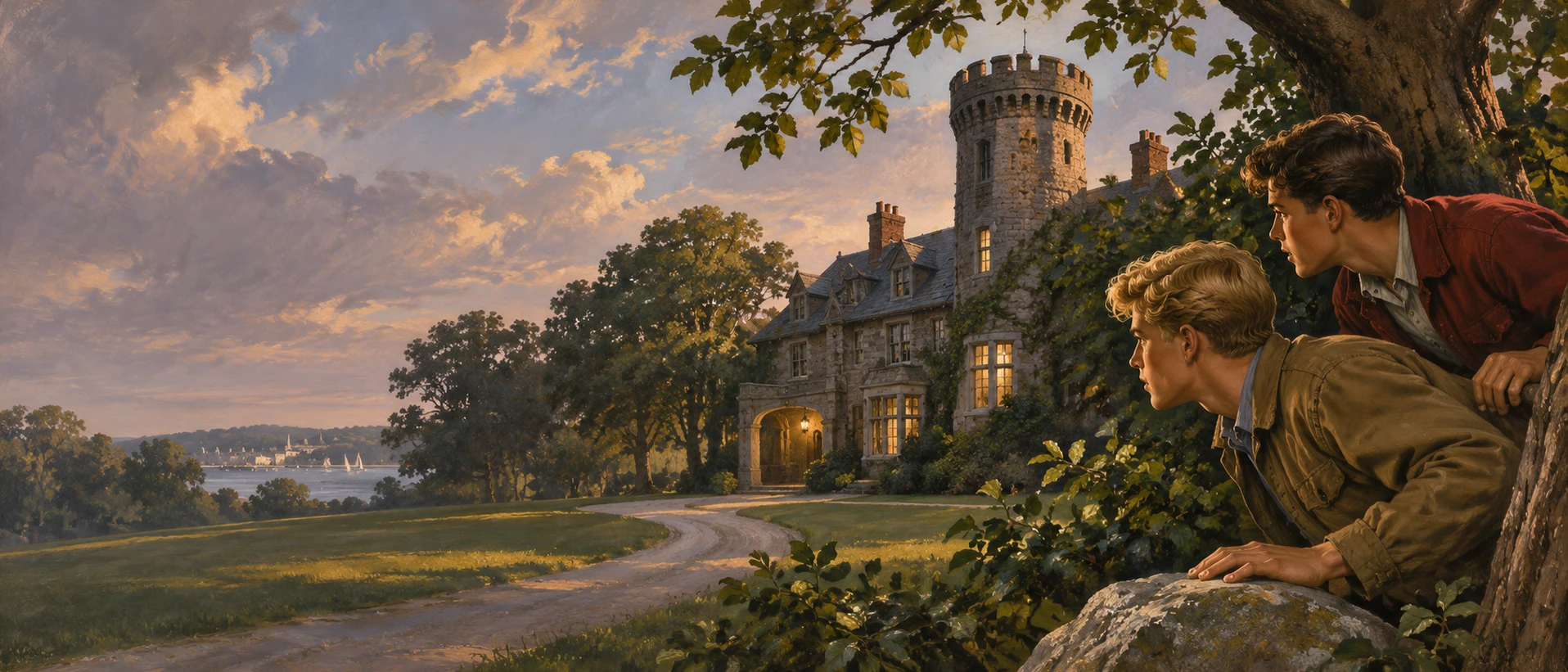
The Tower Treasure
1927. Frank and Joe Hardy chase a stolen fortune in the first Hardy Boys book, written by McFarlane from the syndicate’s outline.
The House on the Cliff
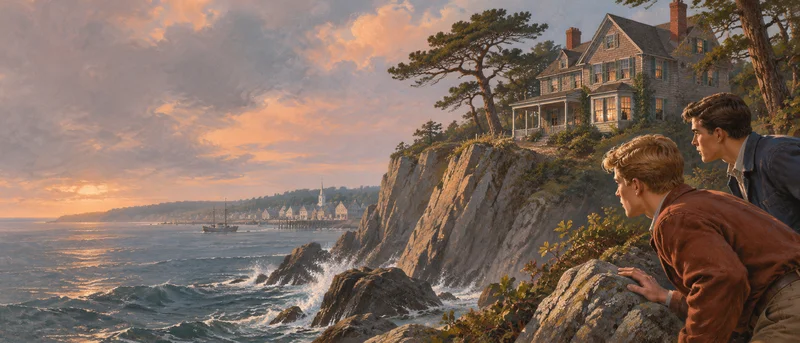
1927. The second of the three launch titles: a clifftop house, strange lights and smugglers, with every chapter ending on a hook.
The Secret of the Old Clock
1930. Mildred Wirt’s Nancy, sixteen and fearless, hunts for a missing will. The book that gave the syndicate its most famous heroine.
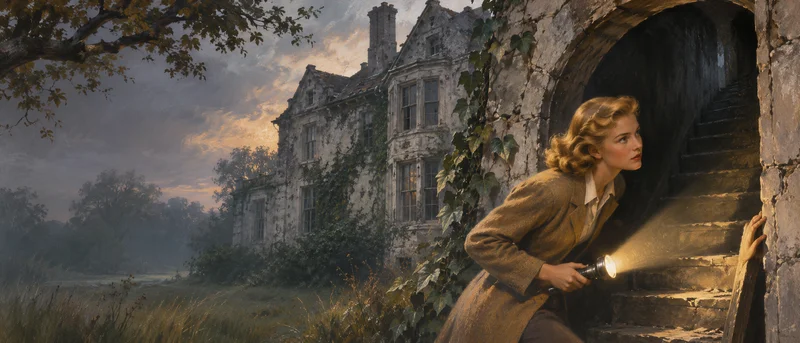
The Hidden Staircase
1930. Nancy’s second case, a haunted-seeming mansion, published alongside the first to test the market.
Dave Porter and His Rivals
1911. The seventh Dave Porter book, published under Stratemeyer’s own name. School rivalries, football and pranks, with the pace he later demanded from his writers.


For the boys’ series in detail, read the first Hardy Boys books; for the girl detective, the first Nancy Drew mystery and the first three Nancy Drew books. The author pages for Carolyn Keene and Franklin W. Dixon gather the titles, and Famous pen names in classic literature has more invented authors.
Then start where the factory hit its stride, with The Tower Treasure, and notice how hard it is to stop at the end of a chapter. That was the point.
Questions readers ask
What was the Stratemeyer Syndicate?
A New Jersey-based book packager founded by Edward Stratemeyer around 1905. It planned children’s series, hired writers to draft them from outlines and published the books under house pseudonyms such as Carolyn Keene and Franklin W. Dixon.
Did Edward Stratemeyer write Nancy Drew?
He created the character and the series, but the first books were written by Mildred Wirt Benson from the syndicate’s outlines. Stratemeyer died in May 1930, less than a fortnight after Nancy Drew first went on sale.
Who wrote the Hardy Boys?
Many ghostwriters, all as Franklin W. Dixon. The Canadian journalist Leslie McFarlane wrote most of the early volumes, including nineteen of the first twenty-five.
Does the Stratemeyer Syndicate still exist?
Not as an independent company. Simon & Schuster bought it in 1984 and has published the characters’ later adventures.