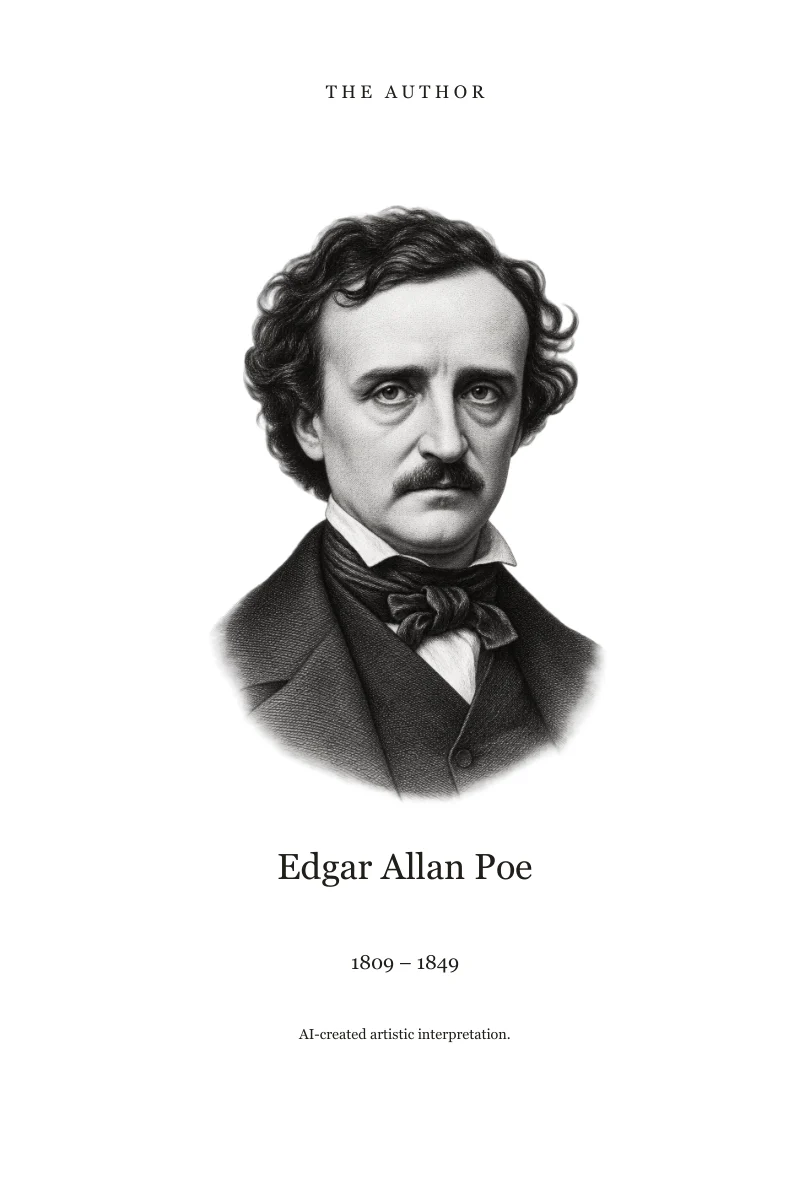
Nine dollars. That, by the usual account, is what The American Review paid Edgar Allan Poe for “The Raven”. Graham’s Magazine had already turned it down, though its publisher, George Graham, is said to have given Poe fifteen dollars out of charity. The poem was set to appear in the Review’s February 1845 issue under a pen name, “Quarles”.
It never had the chance to arrive quietly. On 29 January 1845 the New York Evening Mirror printed it early, as an “advance copy”, this time with Poe’s name attached. Other papers copied it, and then others copied them. Within weeks “The Raven” was being reprinted, recited, imitated and mocked across the country, and its author had become, almost overnight, a household name.
When was The Raven published?
The first printing with Poe’s name was in the Evening Mirror on 29 January 1845. The American Review printing followed in its February number. That November the poem gave its title to a collection, The Raven and Other Poems, published in New York by Wiley and Putnam, which Poe dedicated to the English poet Elizabeth Barrett as “the Noblest of her Sex”.
Once upon a midnight dreary, while I pondered, weak and weary, / Over many a quaint and curious volume of forgotten lore, / While I nodded, nearly napping, suddenly there came a tapping, / As of some one gently rapping, rapping at my chamber door.
Edgar Allan Poe, “The Raven”
Why was The Raven such a sensation?
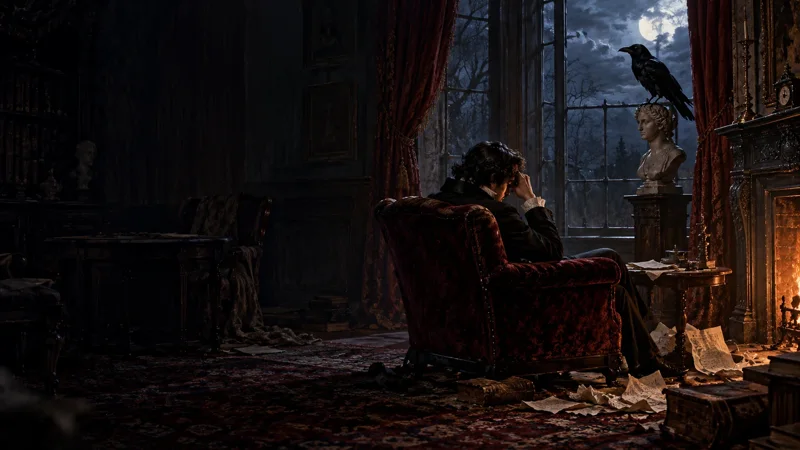
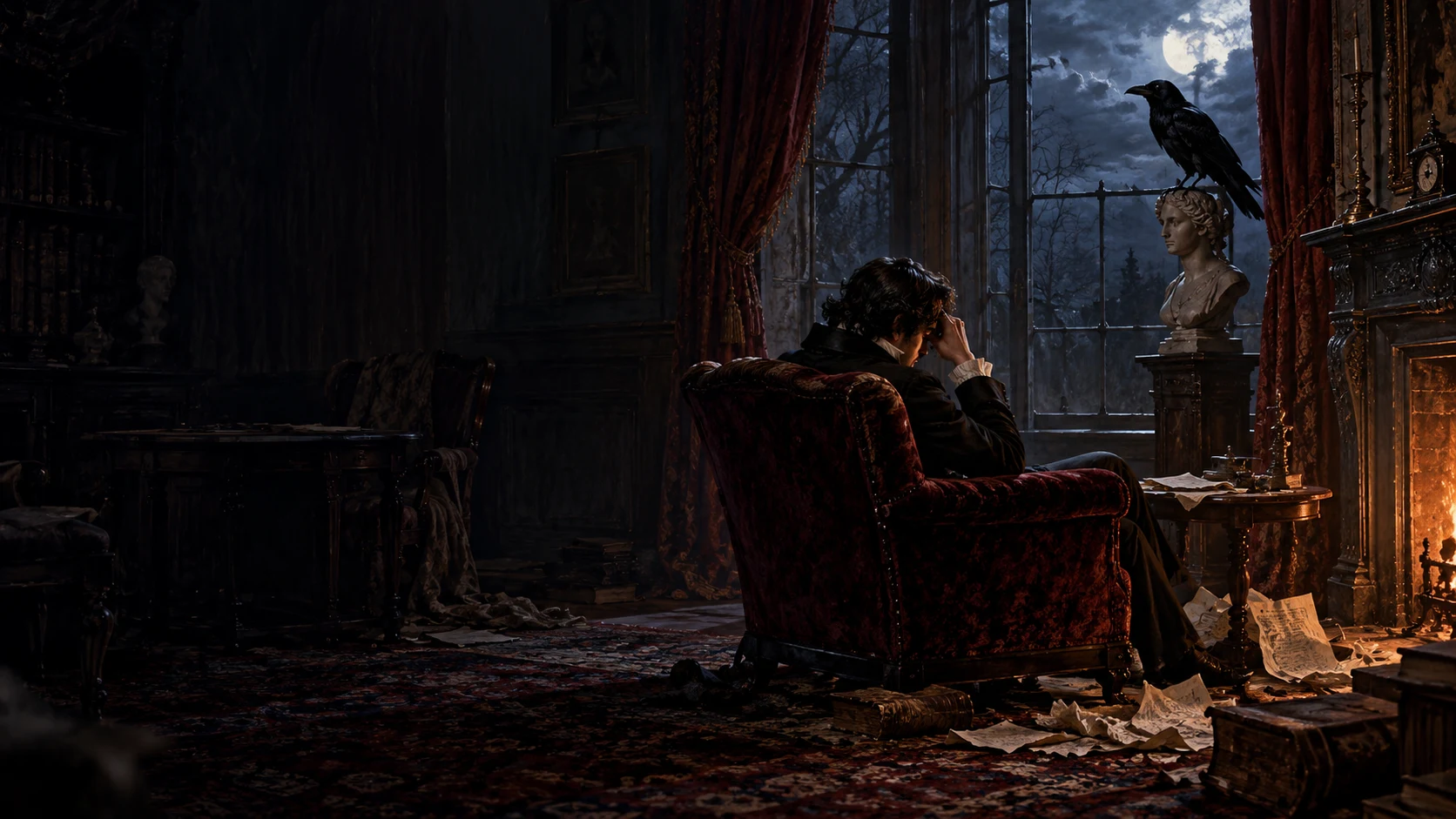
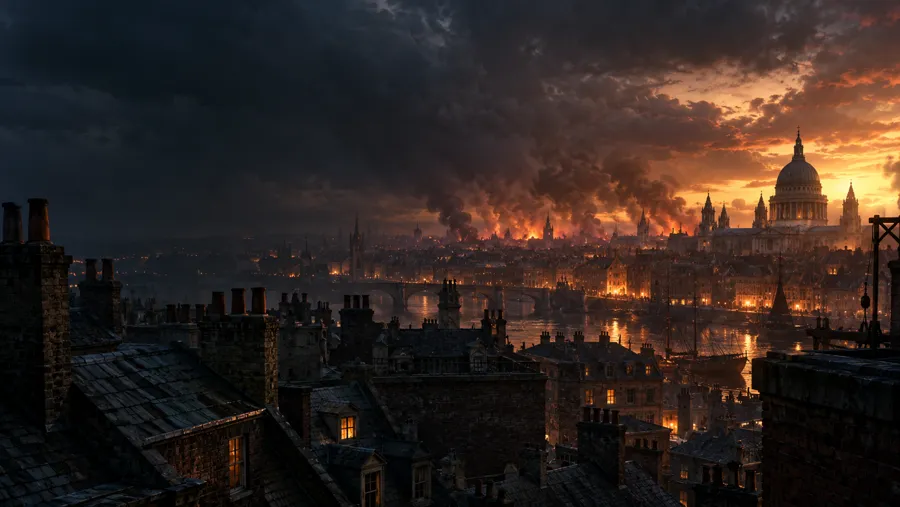
Partly it was the sound. The poem runs in long, insistent lines of eight beats, packed with internal rhymes (“dreary” and “weary”, “napping” and “tapping”), and every stanza closes on a short refrain that soon hardens into a single doom-laden word. It is almost impossible to read silently. People learned it by heart, and Poe was soon invited to recite it at literary gatherings, sometimes, it was later remembered, in a room with the lamps turned down almost to darkness.
Partly it was the story: a grieving scholar at midnight, a bird of ill omen on a bust of Pallas above the door, and a single answer, “Nevermore”, that turns every hopeful question into a wound. It was simple enough for anyone to follow and strange enough to stay in the mind. And it was instantly parodied, which spread it further: there were versions called “The Craven”, “The Gazelle”, “The Whippoorwill” and “The Turkey”.
The fame crossed the Atlantic, too. In April 1846 Elizabeth Barrett wrote to thank Poe for his dedication and told him that “Your ‘Raven’ has produced a sensation — a ‘fit horror’ — here in England,” adding that some of her friends were caught by the fear of it and some by the music, and that she heard “of persons haunted by the ‘nevermore’”.
Did The Raven make Poe rich?
No. In the same letter of May 1845 he told his friend Frederick Thomas: “I have made no money. I am as poor now as ever I was in my life — except in hope, which is by no means bankable.” The fame did bring work. Wiley and Putnam published a volume of his Tales that June, his first full collection of stories since 1840, and invitations to lecture and recite followed. He died four years later, in 1849.

How Poe said he wrote it
In 1846 Poe published “The Philosophy of Composition”, an essay that claims to explain, step by step, how “The Raven” was built. He says he chose a length of about a hundred lines (“It is, in fact, a hundred and eight”), picked “Nevermore” for its sound, and first thought of a parrot as the bird that would repeat it, before choosing a raven as “infinitely more in keeping with the intended tone”. He also declares that the death of a beautiful woman is “the most poetical topic in the world”.
Few readers have believed the poem really came together so coolly, and the essay may be partly a performance. But it is a fascinating one, and it shows how carefully Poe thought about effect.
He did have a real raven in mind. Dickens’s novel Barnaby Rudge features a talking raven called Grip, and Poe had reviewed the book, complaining that the bird should have been made more prophetic. Readers noticed. In A Fable for Critics (1848), James Russell Lowell wrote: “There comes Poe, with his raven, like Barnaby Rudge, / Three fifths of him genius and two fifths sheer fudge”.
The Raven
1845. Eighteen stanzas, one bird and one word. It takes five minutes to read and rather longer to stop hearing.
Barnaby Rudge
1841. Dickens’s historical novel of the Gordon Riots, and the home of Grip, the talking raven Poe could not forget.
The Narrative of Arthur Gordon Pym of Nantucket
1838. Poe’s only completed novel, a voyage that turns from shipwreck and mutiny into something far stranger.


Grip gets a post of his own in Did you know a raven in Barnaby Rudge helped inspire Poe’s The Raven?, and Poe’s other great invention is covered in Did you know Edgar Allan Poe invented the detective story?. For more poems to learn by heart, see Classic poetry collections to keep by the bed.
Best of all, read The Raven aloud, late, with the lamps turned down. Poe would have approved.
Questions readers ask
When was The Raven by Poe published?
It was first printed under Poe’s name in the New York Evening Mirror on 29 January 1845, ahead of its appearance in The American Review for February 1845, where it ran under the pen name “Quarles”.
How much was Poe paid for The Raven?
About nine dollars from The American Review, by the commonly cited account. The poem made him famous, but he wrote that spring that he had “made no money” from it.
Why does the raven say Nevermore?
In “The Philosophy of Composition” (1846) Poe claimed he chose the word for its sound, built around the long “o” and the “r”, and wanted a creature that could repeat it without reasoning. He considered a parrot before settling on a raven.
How long is The Raven?
It has 18 six-line stanzas, 108 lines in all, and takes about five minutes to read aloud.