

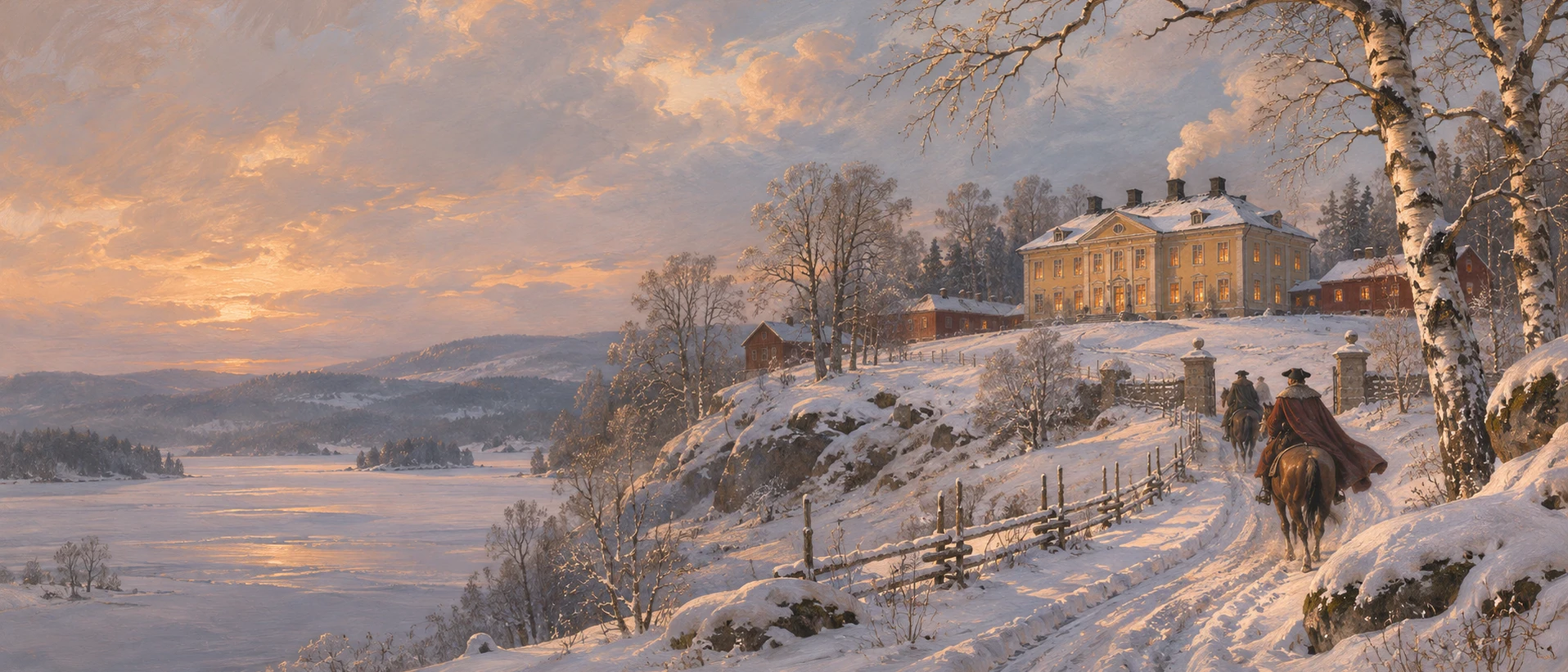
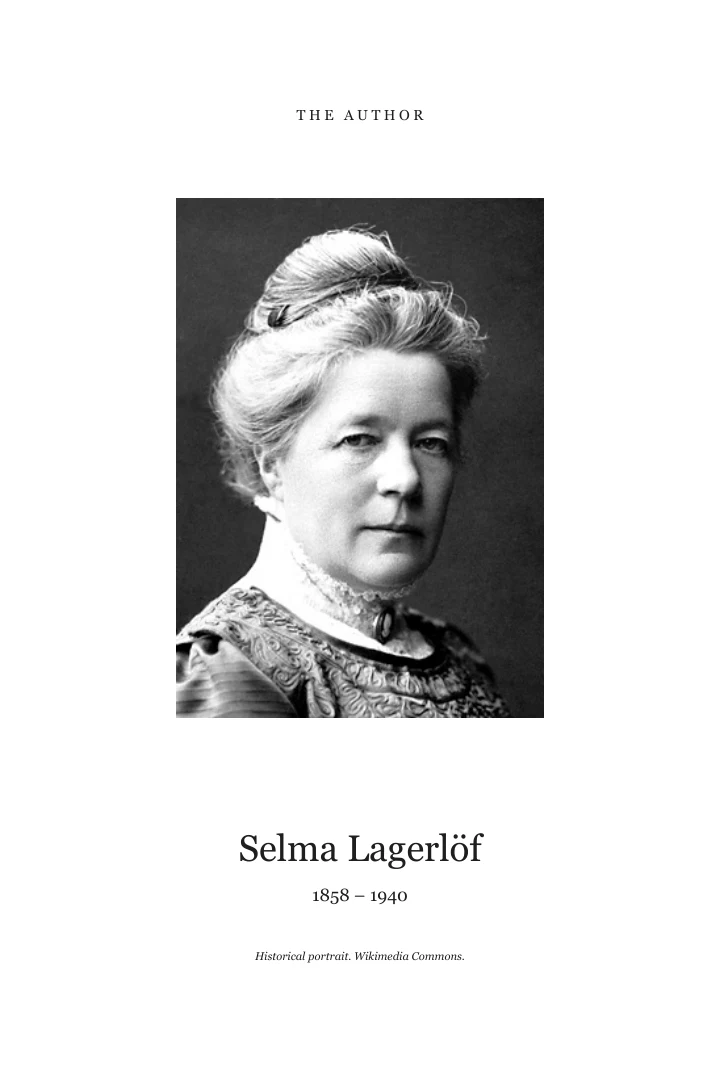
Selma Lagerlöf was born at Mårbacka, a manor farm in Värmland, and was thirty when her family lost it, in 1889. She spent the next two decades getting it back. She bought the main house in 1907 and, in 1910, with the help of her Nobel Prize money, the rest of the estate. She lived there for the rest of her life, and it is now a museum.
The prize that paid for it made history. In 1909 Selma Lagerlöf became the first woman to win the Nobel Prize in Literature, which the Swedish Academy gave her “in appreciation of the lofty idealism, vivid imagination and spiritual perception that characterize her writings”. Of the Selma Lagerlöf books in English, two are the ones to start with: her first novel, The Story of Gösta Berling, and the children’s book that made her famous around the world, The Wonderful Adventures of Nils.
- 1858
Born on 20 November at Mårbacka, a farm manor in Värmland, western Sweden.
- 1882–85
Trains as a teacher in Stockholm.
- 1885
Begins ten years of teaching at a girls’ school in Landskrona.
- 1890
Wins a novel competition in the magazine Idun with the opening chapters of Gösta Berling.
- 1891
Gösta Berlings saga, her first novel, is published.
- 1902
The National Teachers’ Association asks her to write a geography reader for schools.
- 1906–07
The Wonderful Adventures of Nils appears in two volumes.
- 1909
Awarded the Nobel Prize in Literature, the first woman to receive it.
- 1914
Becomes the first woman elected to the Swedish Academy.
- 1940
Dies at Mårbacka on 16 March, aged 81.
Why was Selma Lagerlöf the first woman to win the Nobel Prize?
By 1909 she was a celebrity in Sweden and widely read abroad. The Academy had already given her its great gold medal in 1904, and five years later it gave her the Nobel too. The decision was not a quiet one. It followed a hard internal struggle within the Academy, and she went on to break a second barrier in 1914, when she became its first woman member.
She accepted it in her own way. At the banquet in Stockholm on 10 December 1909 she told the guests that she was hopelessly in debt, and described a daydream she had had on the train: meeting her late father in Paradise and asking his advice about all she owed, to the storytellers of her childhood, the vagabonds and old women in grey cottages, the poets before her and the birds and animals that had told her their secrets.
Lagerlöf grew up at Mårbacka, schooled at home and steeped in the folk tales her grandmother told. She was born with a hip problem and, after an illness at three, could not walk for a time. As an adult she trained as a teacher and spent ten years at a girls’ school in Landskrona, writing on the side. Only in 1895 did she give up teaching for good.
The Selma Lagerlöf books to read first
The Story of Gösta Berling
1891. A defrocked priest, a band of ageing cavaliers who drink and dance their way through a year at Ekeby manor, wolves on the ice and a woman who rules them all. Wild, romantic and very Swedish.
The Wonderful Adventures of Nils
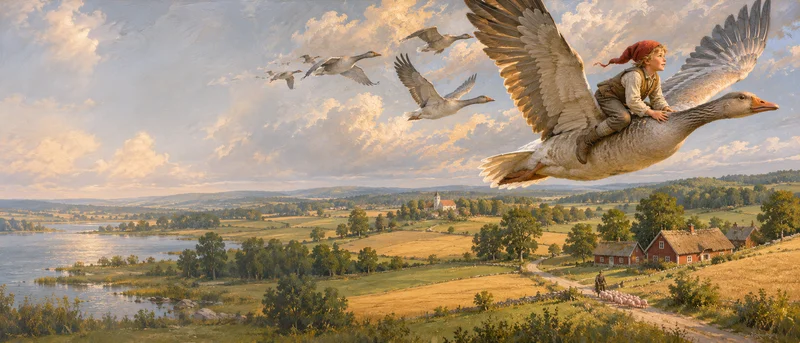
1906–07. A mean-spirited farm boy is shrunk by a tomte and carried across Sweden on the back of a goose. Written as a school geography book, it reads like a folk tale with a map in its pocket.


The Story of Gösta Berling
In the summer of 1890 the Swedish magazine Idun offered a prize for a novel. Lagerlöf, then teaching in Landskrona, sent in a few chapters of a story that was then taking shape in her mind. She won, and with the prize came a contract for the whole book. It was published in 1891 and reviewed mildly, until the influential Danish critic Georg Brandes praised its Danish translation and her reputation took off.
The book is a deliberate rebellion against the realism of Strindberg’s generation. It is set in the 1820s on the shores of Lake Fryken in Värmland, which she renames Löven, around the manor of Ekeby, where the formidable Major’s wife keeps twelve cavaliers, gentlemen-adventurers past their prime, as her pensioners. Gösta, the poet and charmer among them, is a priest who has been thrown out of the Church for drinking. It opens with him in the pulpit.
At last the minister stood in the pulpit. The heads of the congregation were lifted. Well, there he finally was.
Selma Lagerlöf, The Story of Gösta Berling, translated by Pauline Bancroft Flach (1898)
The novel had a second life on screen. In 1924 Mauritz Stiller filmed it as a silent epic, and cast a young actress named Greta Garbo in her first leading role.

The Wonderful Adventures of Nils
In 1902 the National Teachers’ Association asked Lagerlöf to write a reader that would teach Swedish children the geography of their own country. She spent years studying the wildlife and folklore of the provinces and then did something no committee could have expected. She invented Nils Holgersson, a boy of about fourteen who is cruel to the farm animals, and had a tomte shrink him to the size of a thumb as a punishment.
Once there was a boy. He was—let us say—something like fourteen years old; long and loose-jointed and towheaded. He wasn’t good for much, that boy.
Selma Lagerlöf, The Wonderful Adventures of Nils, translated by Velma Swanston Howard (1907)
When the farm’s white gander, Morten, takes off after a flock of wild geese, Nils clings to his neck and goes with him. The flock, led by the old goose Akka from Kebnekaise, carries him the length of Sweden, from the southern farmland to Lapland, and the country’s rivers, mines, forests and legends unroll beneath him. The book has been translated into more than thirty languages.
Who helped whom: Lagerlöf and Nelly Sachs
One of the young readers who fell for Lagerlöf’s books was Nelly Sachs, a Berlin girl who began writing to her. In the last months of her life Lagerlöf helped Sachs and her mother get out of Nazi Germany, and they reached Sweden in May 1940. Sachs stayed in Stockholm, and in 1966 she shared the Nobel Prize in Literature herself.
For more of the prize’s early history, see the first non-European winner in Did you know Rabindranath Tagore was the first non-European to win the Nobel Prize in Literature? and the playwright who added an Oscar to his, in Did you know George Bernard Shaw was the first person to win a Nobel Prize and an Oscar?
Then choose your door. Adults who like their novels big and stormy should begin with the minister in his pulpit in The Story of Gösta Berling. Anyone reading with a child, or anyone who has ever wanted to see a country from above, should start at the farm in Skåne with The Wonderful Adventures of Nils, and keep going until the geese turn north.
Questions readers ask
Who was the first woman to win the Nobel Prize in Literature?
Selma Lagerlöf of Sweden, in 1909. She was cited for “the lofty idealism, vivid imagination and spiritual perception that characterize her writings”, and in 1914 she also became the first woman member of the Swedish Academy.
What Selma Lagerlöf books should I read first?
Start with The Story of Gösta Berling (1891), her first novel, or The Wonderful Adventures of Nils (1906–07), her famous book about a boy who flies across Sweden on a goose.
Is The Wonderful Adventures of Nils a children’s book?
Yes. It was commissioned as a geography reader for Swedish schoolchildren, but its folklore, animals and adventure make it enjoyable for adults too.
Was Gösta Berling made into a film?
Yes. Mauritz Stiller’s silent film of 1924 gave Greta Garbo her first leading role.
 The Emperor of Portugallia172 pages · $13.99


