
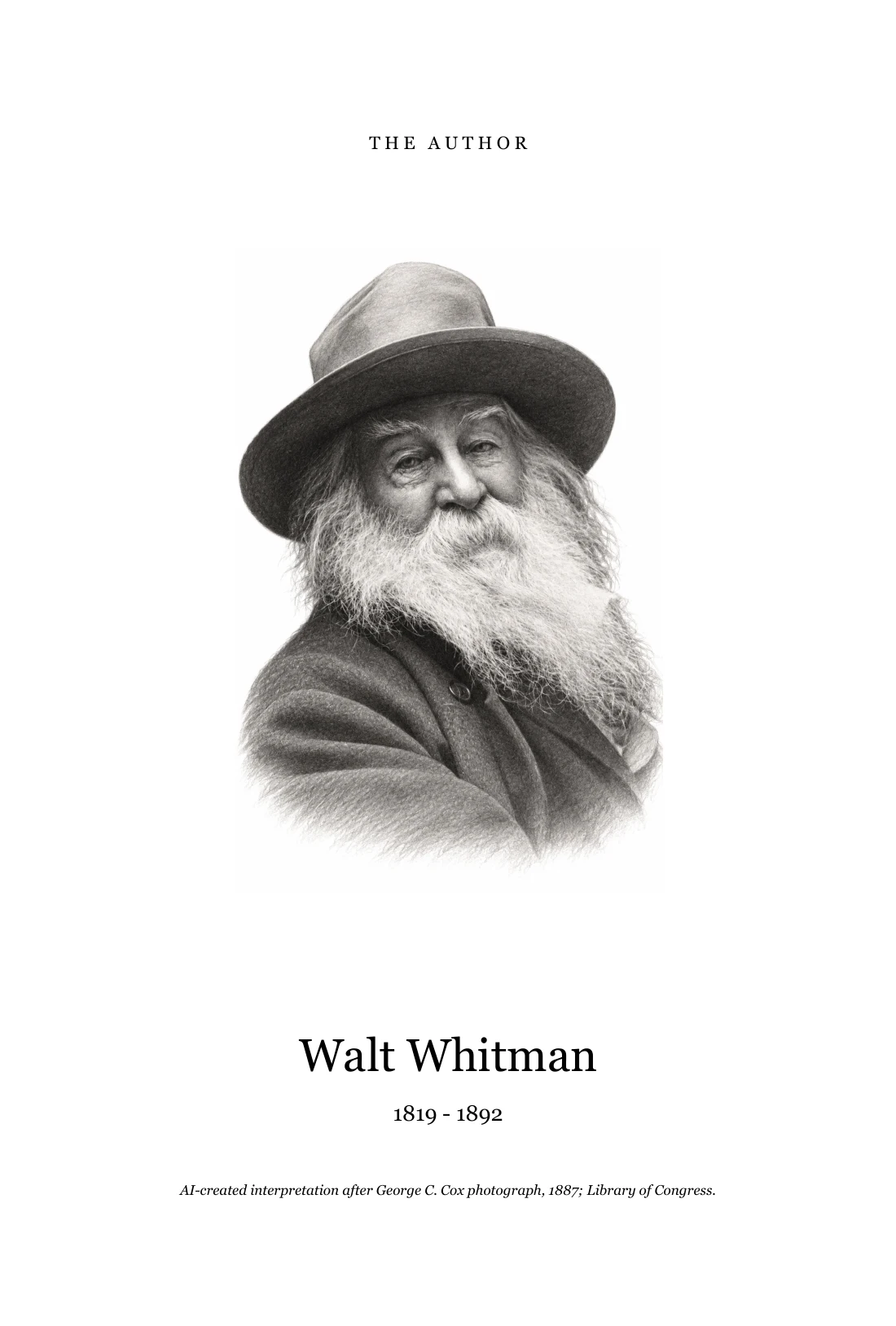
In 1855 the poem now known as “Song of Myself” began like this:
I celebrate myself, / And what I assume you shall assume,
Walt Whitman, Leaves of Grass (1855)
By the final edition, nearly forty years later, it began like this:
I celebrate myself, and sing myself, / And what I assume you shall assume,
Walt Whitman, Leaves of Grass (1891–92)
Three extra words, and a whole history in them. Walt Whitman never wrote a second book of poems in the usual sense. He wrote Leaves of Grass over and over, adding poems, retitling them, cutting lines and regrouping everything, from the first edition of 1855 to the so-called deathbed edition he finished in late 1891, just months before he died in 1892. Depending on how you count, there are six or nine editions, and no two are the same book.
What was the first edition of Leaves of Grass like?
Small, strange and anonymous. Whitman paid for it himself, and it appeared in July 1855, printed in a Brooklyn shop run by the Rome brothers. About 795 copies were printed. It held twelve poems, and not one of them had a title. The title page gave the name of the book, the place and the year — Brooklyn, New York, 1855 — but no author. Facing it was an engraved portrait of the poet, unnamed.
Apart from a copyright notice on the back of the title page, crediting “Walter Whitman”, the reader had to wait until well into the first poem to learn who he was, and even then Whitman introduced himself in the third person:
Walt Whitman, an American, one of the roughs, a kosmos,
Walt Whitman, Leaves of Grass (1855)
By the deathbed edition, that line had become “Walt Whitman, a kosmos, of Manhattan the son” — the rough gone, the city claimed.

How many editions of Leaves of Grass are there?
Scholars usually count six or nine, depending on whether reissues with new material count as new editions. What matters more is how much changed each time. The book grew from twelve poems to around four hundred, and the long first poem alone went through four titles.
- 1855
Twelve untitled poems, self-published in Brooklyn; no author’s name on the title page
- 1856
Second edition: more poems, and the first poem becomes “Poem of Walt Whitman, an American”
- 1860
A Boston edition from Thayer and Eldridge, who go bankrupt soon after; the first poem is now called “Walt Whitman”
- 1865
Whitman is dismissed from a government clerkship after the Secretary of the Interior objects to the book
- 1867
A new edition absorbs his Civil War poems, Drum-Taps
- 1881
Osgood of Boston publishes a rearranged edition; the first poem is finally titled “Song of Myself”
- 1882
Boston’s district attorney calls the book obscene; Osgood gives up the plates
- 1891–92
The deathbed edition, the last arrangement Whitman approved
Even late in life the book could still cause trouble. On 1 March 1882, Boston’s district attorney, Oliver Stevens, wrote to the publisher James R. Osgood describing the new edition as “obscene literature”. Osgood handed the plates back to Whitman, and an edition launched by an established Boston house found itself looking for a new home.
The copy that cost him his job
Whitman’s habit of constant revision once got him fired. In 1865 he was working as a clerk in the Department of the Interior in Washington, and he kept at his desk a copy of the 1860 Leaves of Grass that he was marking up for a future edition. The Secretary of the Interior, James Harlan, examined it. On 30 June Whitman was dismissed. Harlan’s own later accounts of the dismissal varied, but most biographers believe the book was the reason. The dismissal caused an outcry among Whitman’s friends and helped gather the literary following he had been waiting for.
Which edition of Leaves of Grass should you read?
There is no single right answer. The 1855 edition is raw and electric, the book that startled Emerson. The deathbed edition is the one Whitman himself wanted to last, with the poems arranged into the clusters he spent decades refining and the late poems of his old age. Many readers start with the final version and then go looking for the first, to see how the young Whitman sounded before he started tidying.
However you approach it, read it aloud. Whitman’s lines are built from breath, lists and repetition, and they make far more sense spoken than skimmed. For more verse to keep beside you, see our classic poetry collections, and How to read poetry if long poems make you nervous. Whitman’s world overlapped with Emerson and Thoreau’s; Transcendentalism explained maps it.
Begin with the first three lines of “Song of Myself” and see which version you hear. Then keep going: the poem has a long way to walk, and it wants company.
Questions readers ask
How many editions of Leaves of Grass are there?
Scholars count six or nine, depending on how a new edition is defined. The first appeared in 1855 and the last, the deathbed edition, in 1891–92.
What is the deathbed edition of Leaves of Grass?
It is the final edition Whitman prepared, completed in late 1891 and published in 1892, the year he died. It contains around 400 poems and reflects his last arrangement of the book.
Was Walt Whitman’s name on the first edition of Leaves of Grass?
Not on the title page. The 1855 edition had an engraved portrait of Whitman as a frontispiece, and his name appeared only in the copyright notice, as “Walter Whitman”, and inside the first poem.