L. M. Montgomery wrote more than twenty books, and while Anne gets eight of them, the others are full of heroines who deserve the same devotion. There is Emily Byrd Starr, the orphan determined to be a writer; Valancy Stirling, the timid spinster who decides to live at last; Sara Stanley, the Story Girl who can hold a room spellbound; and Kilmeny Gordon, the silent girl who plays the violin in an abandoned orchard.
If you have finished the Anne books and want more of the same mixture of landscape, humour and longing, these are the L. M. Montgomery books to read next.
Who was L. M. Montgomery?
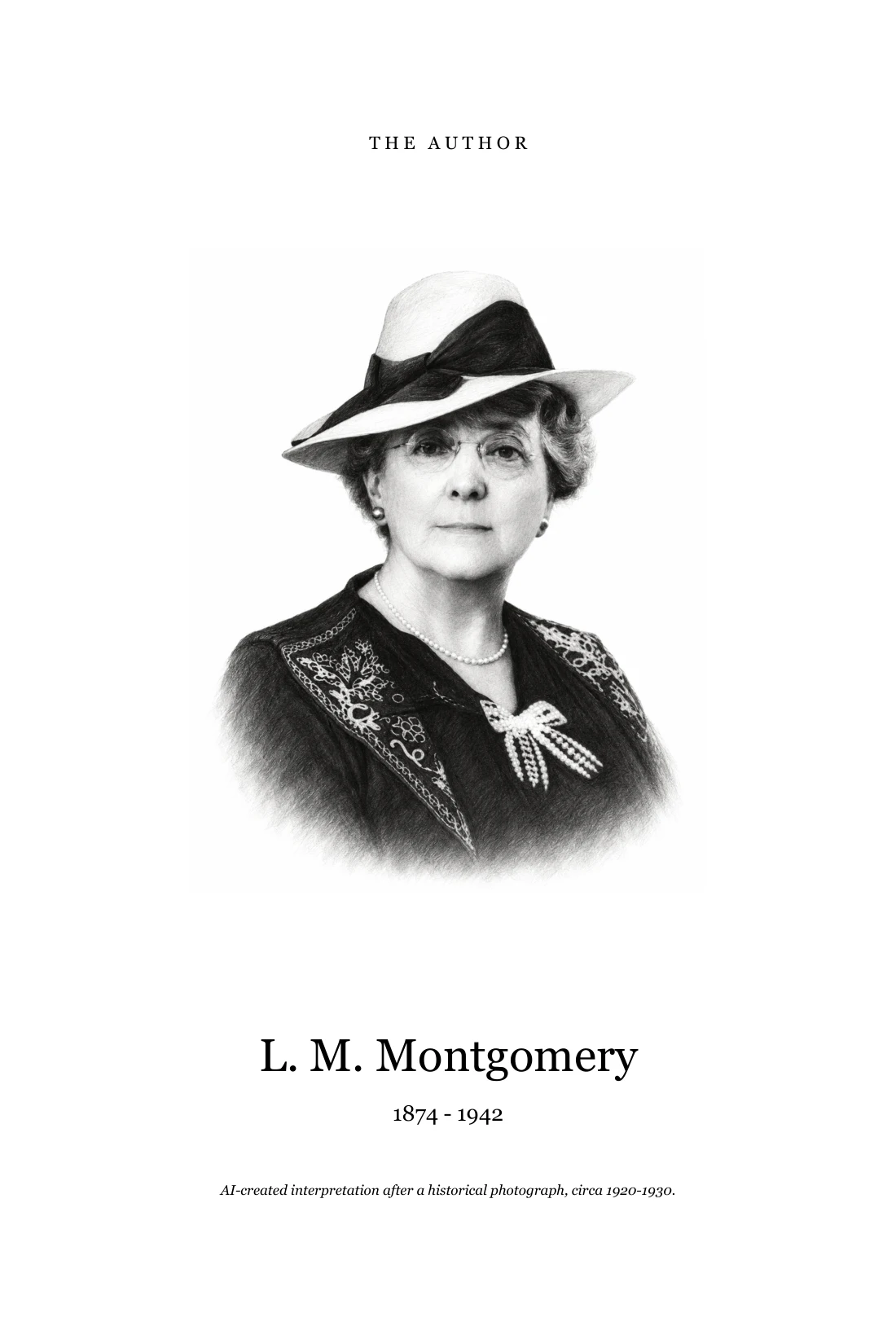
Lucy Maud Montgomery was born on Prince Edward Island in 1874. Her mother died before she was two, and she was raised by her strict, elderly grandparents in the farming village of Cavendish, a childhood she drew on again and again. Anne of Green Gables made her famous in 1908. In 1911 she married a Presbyterian minister and moved to Ontario, but in her books she kept returning to the Island.
The best L. M. Montgomery books beyond Anne
Emily of New Moon
1923. Orphaned Emily goes to live with stern Aunt Elizabeth and gentle Aunt Laura at New Moon farm and fills notebook after notebook with stories and letters to her dead father. The first of three Emily books.
The Blue Castle
1926. Valancy Stirling, twenty-nine and crushed by her family, gets news from her doctor that makes her stop doing what she is told. Montgomery’s funniest book, written for adults.
The Story Girl
1911. Two boys from Toronto spend a summer with their cousins on an Island farm, under the spell of Sara Stanley and her stories.
Kilmeny of the Orchard
1910. A young teacher wanders into an orchard and hears a girl playing the violin. A short, dreamy romance with a fairy-tale shape.


Emily: the heroine closest to Montgomery herself
Emily of New Moon is often called Montgomery’s most autobiographical novel, and readers who know her journals can see why. Emily is a writer from the start, alert to what she calls “the flash”, a sudden glimpse of beauty that leaves her shaken. Like Montgomery, she grows up with older relatives who love her but do not always understand her, and she clings to her writing as a way of making sense of the world.
Where Anne is sunny, Emily is darker and more stubborn, and the trilogy that follows her, through Emily Climbs and Emily’s Quest, is as much about ambition as it is about romance. Many readers who come to Emily as adults find her the more grown-up heroine.
Valancy and The Blue Castle
The Blue Castle is one of very few novels Montgomery wrote for adults, and the only one of her major books set in the lakes and forests of Ontario’s Muskoka country rather than on the Island. Valancy has spent her whole life being sneered at by her relatives. When a letter from her doctor changes everything, she starts saying exactly what she thinks, with results that are both very funny and very moving.
It is a romance, and a satisfying one, but it is also a sharp comedy about family respectability. If you have friends who think Montgomery is only for children, this is the book to give them.
The Story Girl and Kilmeny
The Story Girl is narrated by Beverley King, who spends a long summer at his family’s old farm with a crowd of cousins. At the centre is Sara Stanley, who tells local legends and family tales so vividly that the other children forget where they are. It is gentle, episodic and full of the Island’s orchards and shorelines, and it continues in The Golden Road. We look at the pair in The Story Girl and The Golden Road.
Kilmeny of the Orchard, published two years after Anne, is shorter and more fairy-tale-like than anything else she wrote. Eric Marshall, filling in as a village schoolteacher, finds a beautiful girl who cannot speak but plays the violin with astonishing feeling. It has the atmosphere of an old ballad, and it reads in an evening.
Back in Avonlea
If you are not ready to leave Anne’s world entirely, Chronicles of Avonlea gathers stories about her neighbours, and Rilla of Ingleside follows Anne’s youngest daughter through the First World War on the Canadian home front. For the full Anne sequence, see the Anne of Green Gables books in order, and for other spirited girls of the period try brave heroines in classic children’s books.
If you read only one, make it Emily of New Moon. It has everything that made you love Anne, and something of its own besides: the sense of a writer discovering what she was born to do.
Questions readers ask
What other books did L. M. Montgomery write besides Anne of Green Gables?
She wrote more than twenty books, including the Emily trilogy beginning with Emily of New Moon, The Blue Castle, The Story Girl and its sequel The Golden Road, and Kilmeny of the Orchard, as well as several story collections.
Is Emily of New Moon like Anne of Green Gables?
Both are about imaginative orphan girls on Prince Edward Island, but Emily is a more serious, determined character whose story centres on her ambition to become a writer. Many readers see her as Montgomery’s most personal heroine.
Is The Blue Castle a children’s book?
No. The Blue Castle (1926) was written for adults. It follows a twenty-nine-year-old woman who rebels against her family, and is one of Montgomery’s few adult novels.
What is the best L. M. Montgomery book after Anne?
Emily of New Moon and The Blue Castle are the most popular choices. Emily is the closest in spirit to Anne, while The Blue Castle is a witty romance for adult readers.
 Anne of Green Gables258 pages · $15.99
 Anne of Avonlea244 pages · $15.99
 Anne of the Island228 pages · $14.99
 Rilla of Ingleside264 pages · $15.99