The famous five pick themselves: Twenty Thousand Leagues Under the Sea, Journey to the Centre of the Earth, Around the World in Eighty Days, The Mysterious Island and From the Earth to the Moon. Past those, most readers stop, which means they miss a spy thriller across Siberia, a shipwreck told as a diary, a whole town built inside a Scottish coal mine and an inventor who conquers the sky.
Here are five lesser-known Jules Verne books, each matched to the famous one it most resembles, so you can follow the thread you enjoyed. If you are new to Jules Verne altogether, start with Jules Verne’s Extraordinary Voyages: where to start and come back.
If you loved Around the World in Eighty Days: Michael Strogoff
“Sire, a fresh dispatch.” With that line, spoken at a palace ball in the small hours, Michael Strogoff (1876) launches into one of Verne’s fastest plots. A Tartar rising has cut the telegraph to eastern Siberia, a traitor named Ivan Ogareff is on his way to betray the Tsar’s brother in besieged Irkutsk, and only a courier on horseback, by boat and on foot can carry the warning. Strogoff travels under a false name, with a young woman, Nadia, as his companion and two squabbling war correspondents, one English and one French, never far behind.
It is not science fiction at all, but it has the same race-against-the-clock pleasure as Phileas Fogg’s journey, with real danger in place of the comedy. Verne and Adolphe d’Ennery turned it into a stage spectacle in 1880.
If you loved The Mysterious Island: The Survivors of the Chancellor
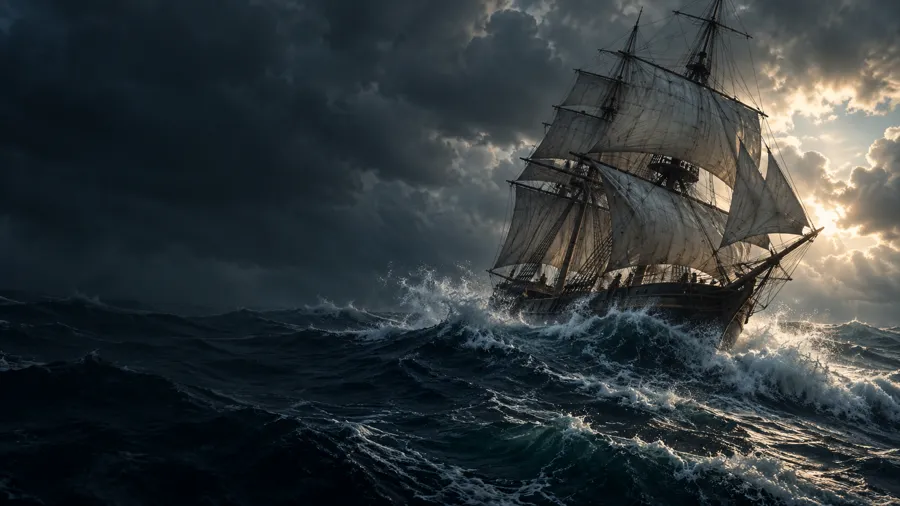
The Survivors of the Chancellor (1875) is written as the diary of a passenger, J. R. Kazallon, aboard a sailing ship that leaves Charleston in September 1869 loaded with cotton. The crew discover a fire in the hold, and a passenger has smuggled something far worse aboard. What follows, ending on a raft, is survival without the comforts of Lincoln Island: no engineer’s ingenuity, only hunger, weather and the worst of human nature. It is one of Verne’s darkest books and best suited to older readers.
If you loved Journey to the Centre of the Earth: The Underground City
Verne’s strangest underground world is not volcanic but industrial. In The Underground City (1877), also known as The Black Indies and The Child of the Cavern, the mining engineer James Starr returns to the abandoned Aberfoyle mine near Stirling and finds the old overman Simon Ford still living below ground with his family, convinced there is coal left. A new seam brings a town to life around an underground loch, but someone or something in the darkness does not want them there. Then Ford’s son finds a girl, Nell, who has never seen daylight.
Michael Strogoff; Or, The Courier of the Czar
1876. A courier’s ride from Moscow to Irkutsk through a Siberia at war. Verne without gadgets, and one of his most exciting books.
The Survivors of the Chancellor: Diary of J.R. Kazallon, Passenger
1875. Fire at sea, a reef and a raft, recorded day by day. Grim, compelling and nothing like the cosy castaway story you might expect.
The Underground City; Or, The Black Indies
1877. A Scottish mine, a family who refuse to leave it and a mystery in the dark. Atmospheric, with a touch of the Gothic.



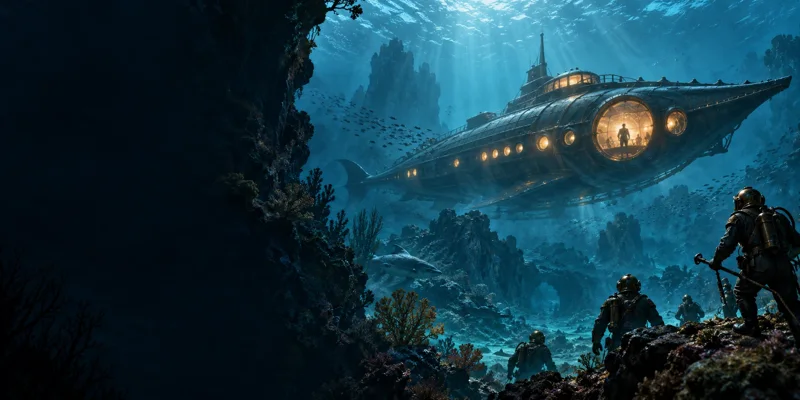
If you loved Twenty Thousand Leagues: Robur the Conqueror and The Master of the World
Captain Nemo has a brother in spirit. In Robur the Conqueror (1886), also called The Clipper of the Clouds, the members of a Philadelphia balloon club are sure the future of flight lies with gas bags. A stranger named Robur tells them they are wrong, and that night he carries off their president and secretary aboard the Albatross, a heavier-than-air ship held up by a forest of propellers, to prove it by flying them round the world.
Verne brought Robur back in The Master of the World (1904), one of the last novels published in his lifetime. It is set in 1903 and narrated by John Strock, a Washington police inspector chasing a machine that can be a car, a boat, a submarine or an aircraft. Robur is no longer a showman but a menace, and the book is much darker than its predecessor, written as Verne’s health was failing.
Robur the Conqueror
1886. Balloonists versus a flying-machine inventor, with a kidnapping and a voyage round the world by air. Comic, quarrelsome and visionary.
The Master of the World
1904. Robur returns with a machine for land, sea and sky. Short, tense and haunted by the fear of what invention might do in the wrong hands.


Which lesser-known Jules Verne book is the best place to start?
Michael Strogoff, without hesitation. It has the strongest story and the most likeable hero, and many readers rank it with his very best. If you would rather keep the science, read Robur the Conqueror and The Master of the World back to back; they are short enough to finish in a weekend.
For Verne’s rivalry with the next generation of science-fiction writers, see Did Jules Verne really scoff at H. G. Wells’s The First Men in the Moon?, and for the predictions he got right, Books that predicted the future. The science fiction shelf has the rest.
Then let a courier set the pace. Michael Strogoff opens with news that the telegraph wire beyond Tomsk has been cut, and from that moment it barely pauses for breath.
Questions readers ask
What is Jules Verne’s best lesser-known book?
Michael Strogoff (1876) is usually named first: a fast, dramatic adventure about the Tsar’s courier crossing Siberia during a rebellion. Robur the Conqueror (1886) is the pick for readers who want Verne’s inventions.
Is Michael Strogoff science fiction?
No. Unlike most of Verne’s best-known novels it is a historical adventure without futuristic machines, set during an invented Tartar rising in Siberia.
Is there a sequel to Robur the Conqueror?
Yes. The Master of the World (1904) brings Robur back with a new machine, the Terror, which can travel on roads, on water, under the sea and through the air.
What is The Underground City by Jules Verne about?
Published in 1877 and also known as The Black Indies or The Child of the Cavern, it follows a mining family who find a new coal seam in the Aberfoyle mine in Scotland and build a town underground.
 Journey to the Centre of the Earth246 pages · $15.99
 Around the World in Eighty Days190 pages · $13.99
 The Mysterious Island556 pages · $24.99
 Twenty Thousand Leagues Under the Sea334 pages · $17.99