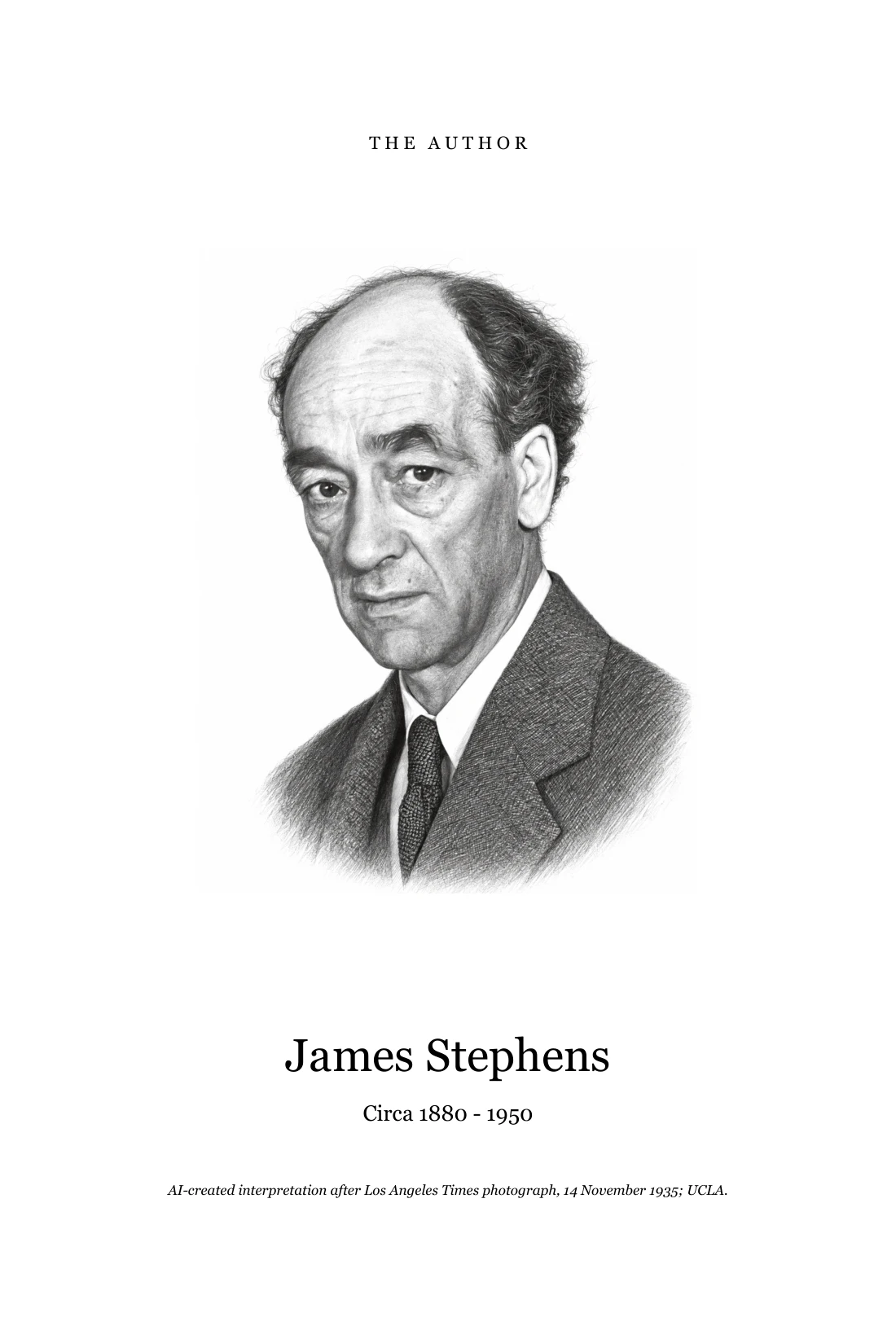
There is hardly a fairy in it, at least not the kind with wings. The fairy folk in James Stephens’s Irish Fairy Tales are the people of the Shí, who live inside the hills, play music that puts whole halls to sleep and are not to be trifled with. They are introduced, without any fuss, as gods.
What the book mostly holds is the Fenian cycle: the old Irish stories of Fionn mac Cumhaill, the leader the English-speaking world often calls Finn McCool, and his band of warriors, the Fianna. Irish Fairy Tales was published in 1920 with colour plates by Arthur Rackham, and it is one of the most enjoyable ways for older children to meet Ireland’s heroic stories in English. Younger children will need it read to them, a story at a time, picked by a grown-up.
What is in James Stephens’s Irish Fairy Tales?
Ten stories, of very different lengths and moods. Six follow Fionn, from his hidden boyhood to his years as chief of the Fianna, and the cast includes his son Oisín, his grandson Oscar, the swift runner Caelte and his old rival Goll mac Morna.
- “The Story of Tuan mac Cairill”: an old man tells a saint how he has lived through the ages of Ireland as a stag, a boar, a hawk and a salmon.
- “The Boyhood of Fionn”: the boy raised in secret by two women druids, his schooling with the poet Finegas and the Salmon of Knowledge, and the night he stays awake at Tara while a fire-breathing visitor from the Shí plays everyone else to sleep.
- “The Birth of Bran”: why Fionn’s two great hounds, Bran and Sceólan, are really his cousins. A jealous woman of the Shí strikes his aunt with a hazel rod and turns her into a hound.
- “Oisín’s Mother”: a fawn that Fionn’s hounds refuse to hunt turns out to be an enchanted woman of Faery.
- “The Wooing of Becfola” and “Becuma of the White Skin”: stories of wives who leave their husbands, and of a queen banished from the Land of Promise.
- “The Little Brawl at Allen”: a feast that turns into a fight between Fionn’s people and the clan of Goll.
- “The Carl of the Drab Coat”: a boastful champion arrives demanding a race, and the only taker is a huge, slovenly stranger in a dull coat.
- “The Enchanted Cave of Cesh Corran”: three hag daughters of a Shí lord spin an enchanted yarn that leaves the Fianna helpless.
- “Mongan’s Frenzy”: the longest piece, a rambling comic epic about a king, a god and a poet who must be proved wrong.
Which Irish fairy tales are best for children?
Start with “The Boyhood of Fionn”. It is a story about a child, it moves quickly once Fionn leaves his guardians, and its climax at Tara, with Fionn pressing a hot spearhead to his forehead to stay awake against the magic music, is an image children remember. It also holds the line the book is best known for.
“The music of what happens,” said great Fionn, “that is the finest music in the world.”
James Stephens, Irish Fairy Tales (1920)
After that, “The Birth of Bran” and “Oisín’s Mother” make a natural pair: both are about women changed into animals, both end with Fionn’s household made bigger and stranger, and both are moving without being frightening. “The Carl of the Drab Coat” is pure comedy and works as a stand-alone bedtime story for nine-year-olds.
“Mongan’s Frenzy” deserves a mention for one scene alone. An Ulster army is routed by a flock of venomous sheep and has to sit out the battle in the trees, while their despairing king is assured by the man on the branch below him that it is very lucky a sheep cannot climb a tree. Children who find the book’s grand style heavy going are usually won back by that.
What should parents know first?
Stephens wrote these for readers of any age, not specifically for children, and his prose is rich. Sentences wander off into jokes and reflections before returning to the plot. That makes the book a pleasure to read aloud to children of about nine and up and a natural solo read from eleven or twelve, but a hard first chapter book for anyone younger.
- Violence: this is a warrior saga. A robber kills a band of travelling poets in “The Boyhood of Fionn”, battles and brawls recur, and in “The Enchanted Cave of Cesh Corran” Goll slices two hags in half with one stroke and cuts off the head of a third. It is told briskly and comically rather than in gory detail.
- Grown-up themes: “The Wooing of Becfola” and “Becuma of the White Skin” turn on unhappy marriages and elopements, and the bargain behind Mongan’s birth in “Mongan’s Frenzy” is implied rather than spelled out. Most of this passes over young heads, but it is the reason to save these three for later.
- Names: the Irish names can look daunting on the page. Don’t worry about pronouncing them perfectly; the stories survive any accent, and children enjoy correcting you once they have decided how Oisín should sound.
Some famous Irish legends are not here. There is no Children of Lir and no Cú Chulainn, and the tale of Diarmuid and Gráinne’s flight from Fionn is left out too. If a child loves this book, those stories are an easy next step.
More from James Stephens and further afield
Stephens’s best-known book is The Crock of Gold (1912), a comic philosophical fantasy with a philosopher, leprechauns and the god Pan; it is a book for teenagers and adults rather than children. For more from the same country, see our Irish classics. For other national traditions retold for young readers, try Japanese fairy tales for children, fairy tales from around the world and the story of who collected the fairy tales in the first place.
Open Irish Fairy Tales at the second story, not the first. “The Boyhood of Fionn” is where a child meets the boy who will lead the Fianna, and once Fionn has stayed awake at Tara, the rest of the book has its hero.
Questions readers ask
What are some famous Irish fairy tales?
The best-known Irish tales include the stories of Fionn mac Cumhaill (Finn McCool) and the Fianna, the Children of Lir, the deeds of Cú Chulainn and Oisín’s journey to Tír na nÓg. James Stephens’s Irish Fairy Tales concentrates on Fionn and his circle.
Is James Stephens’s Irish Fairy Tales suitable for children?
Yes, with some choosing. The Boyhood of Fionn, The Birth of Bran, Oisín’s Mother and The Carl of the Drab Coat are good read-alouds for children of about nine and up, while a few stories with adult themes are better saved for teenagers.
Who illustrated Irish Fairy Tales by James Stephens?
The first edition of 1920 was illustrated by Arthur Rackham, with colour plates and line drawings.
Who is Fionn mac Cumhaill?
Fionn mac Cumhaill, often anglicised as Finn McCool, is the hero of the Fenian cycle of Irish legend, a warrior, poet and seer who leads the band of warriors called the Fianna.
 The Crock of Gold148 pages · $12.99
 Mary, Mary134 pages · $12.99