
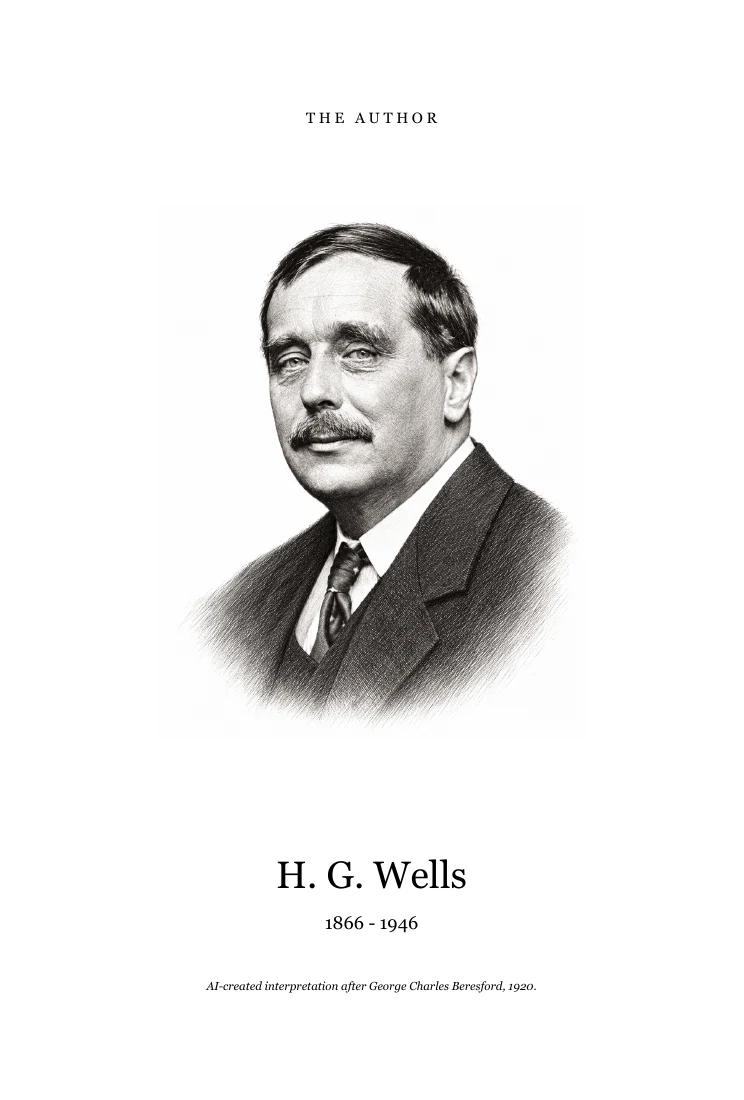
For sixteen of its twenty-eight chapters, the stranger at the Coach and Horses has no name. He is “the stranger”, then “the Invisible Man”, a bandaged lodger who smashes bottles and frightens the village of Iping. Only in chapter seventeen, pinning an old acquaintance to a bed, does he introduce himself: Griffin, of University College. The novel never gives him a first name at all.
That slow reveal is the clearest sign of how the book and the films differ. H. G. Wells built The Invisible Man (1897) as a mystery seen from the outside, told by the gossiping people around the man. The 1933 film puts Griffin at the centre, christens him Jack and gives him a fiancée. The 2020 film turns him into a different man entirely and hands the story to the woman he torments.
The stranger came early in February, one wintry day, through a biting wind and a driving snow, the last snowfall of the year, over the down, walking from Bramblehurst railway station, and carrying a little black portmanteau in his thickly gloved hand.
H. G. Wells, *The Invisible Man*, chapter I
What happens in the book?
The novel was serialised in Pearson’s Weekly and published as a book in the same year, with the subtitle A Grotesque Romance. Its first half is close to farce. The landlady, Mrs Hall, frets about her bill; the village clockmaker invents excuses to linger in the stranger’s room; a burglary at the vicarage baffles everyone; the furniture appears to go mad. Wells clearly enjoyed his gallery of English country types, and he lets them talk.
Then the tone darkens. Griffin press-gangs a tramp named Thomas Marvel, loses his temper in public, and finally seeks refuge with Dr Kemp, a former fellow student. Here, in a long confession, the reader learns how a gifted, embittered albino experimenter made himself invisible, burned down his lodgings to cover his tracks and discovered that invisibility is mostly misery: cold, hunger, and dogs that can smell you. His solution is a plan he calls a “Reign of Terror”, and Kemp quietly sends for the police.
The Invisible Man 1933: James Whale and Claude Rains
Universal bought the film rights in September 1931 for $10,000, with Wells demanding script approval. Several writers and directors came and went before James Whale, who had directed Frankenstein, took charge, and the playwright R. C. Sherriff wrote the screenplay. Boris Karloff was attached early on and dropped out. Whale cast Claude Rains, a stage actor Universal thought too little known, in what became his American film debut, and Rains’s face appears only in the final moments.
Sherriff’s biggest invention is a drug, monocane, which makes Griffin invisible and also drives him insane. Wells approved the script, change included; Sherriff recalled that Wells agreed an invisible lunatic would grip a cinema audience faster than a sane man. The film also adds Flora Cranley, played by Gloria Stuart, a fiancée in whose presence Griffin grows calm, and whom he asks to see on his deathbed. Nothing like her exists in the novel, and her presence makes this Griffin something Wells never intended: a man to be pitied.
What the film keeps is the village. The snowy arrival, the inn, the bandages, the unveiling and the comic villagers are lifted almost straight from the page, and John P. Fulton’s special effects, from bandages unwound from an empty collar to footprints appearing in snow, made the book’s stage business visible at last. The Library of Congress added the film to the National Film Registry in 2008.
The 2020 Invisible Man: Leigh Whannell and Elisabeth Moss
Universal tried for years to remake the story, including a plan to cast Johnny Depp as part of its shared “Dark Universe” of monsters, which collapsed after The Mummy in 2017. The version that reached cinemas in February 2020 was a small standalone film, written and directed by Leigh Whannell and made for about $7 million. It grossed more than $140 million worldwide, even though cinemas began closing for the pandemic within weeks of its release.
Whannell kept the surname and almost nothing else. Adrian Griffin, played by Oliver Jackson-Cohen, is a wealthy optics engineer whose invisibility comes from a technological suit, and the film is told by his former partner, Cecilia Kass, played by Elisabeth Moss, who escapes him in the opening sequence. Reviewers praised it as a film about domestic abuse and about not being believed.
Oddly, that makes the remake closer to Wells in one respect than the 1933 version. Wells’s novel is about what a man will do once no one can see him and hold him to account. Whannell takes that idea seriously and simply shifts the camera to the person it is done to.
Book vs. movie: the main differences
- *Narration:* the novel watches Griffin from outside for half its length; the 1933 film follows him from the start; the 2020 film follows his victim.
- *Madness:* in Wells, Griffin’s cruelty is his own. In 1933, a drug is to blame. In 2020, he is an abuser before any invisibility.
- *Romance:* the book has none. Whale’s film adds a fiancée; Whannell’s is built around a broken relationship.
- *Comedy:* Wells’s village farce survives most fully in 1933, which keeps the inn, the landlady and the bumbling locals.
- *Science:* Wells explains Griffin’s method through optics and refraction; the remake swaps it for a high-tech bodysuit.
For more of Wells’s inventions, see H. G. Wells’s best short stories and the science fiction firsts. Universal’s other monsters have their own comparisons in Frankenstein: the book vs. the films and Dracula on screen.
If you have only seen the bandages on screen, read The Invisible Man from the snowy first page. Wells takes his time revealing who is under the wrappings, and that patience is the pleasure.
Questions readers ask
Is The Invisible Man movie faithful to the book?
The 1933 film keeps the novel’s village setting and many of its scenes but adds a drug that drives Griffin mad and a fiancée who does not exist in the book. The 2020 film keeps only the idea and the surname Griffin.
Who played the Invisible Man in 1933?
Claude Rains played Dr Jack Griffin in James Whale’s 1933 film for Universal. It was his American film debut, and his face is seen only at the very end.
What is the first name of the Invisible Man in the book?
Wells never gives one. The novel calls him only Griffin, and he does not reveal even that until chapter seventeen. The name Jack comes from the 1933 film.
When was The Invisible Man by H. G. Wells published?
In 1897. It was serialised in Pearson’s Weekly and published as a book the same year, subtitled A Grotesque Romance.
 The Time Machine118 pages · $11.99
 The War of the Worlds156 pages · $12.99
 The Island of Doctor Moreau126 pages · $11.99
 The Wonderful Visit140 pages · $12.99