
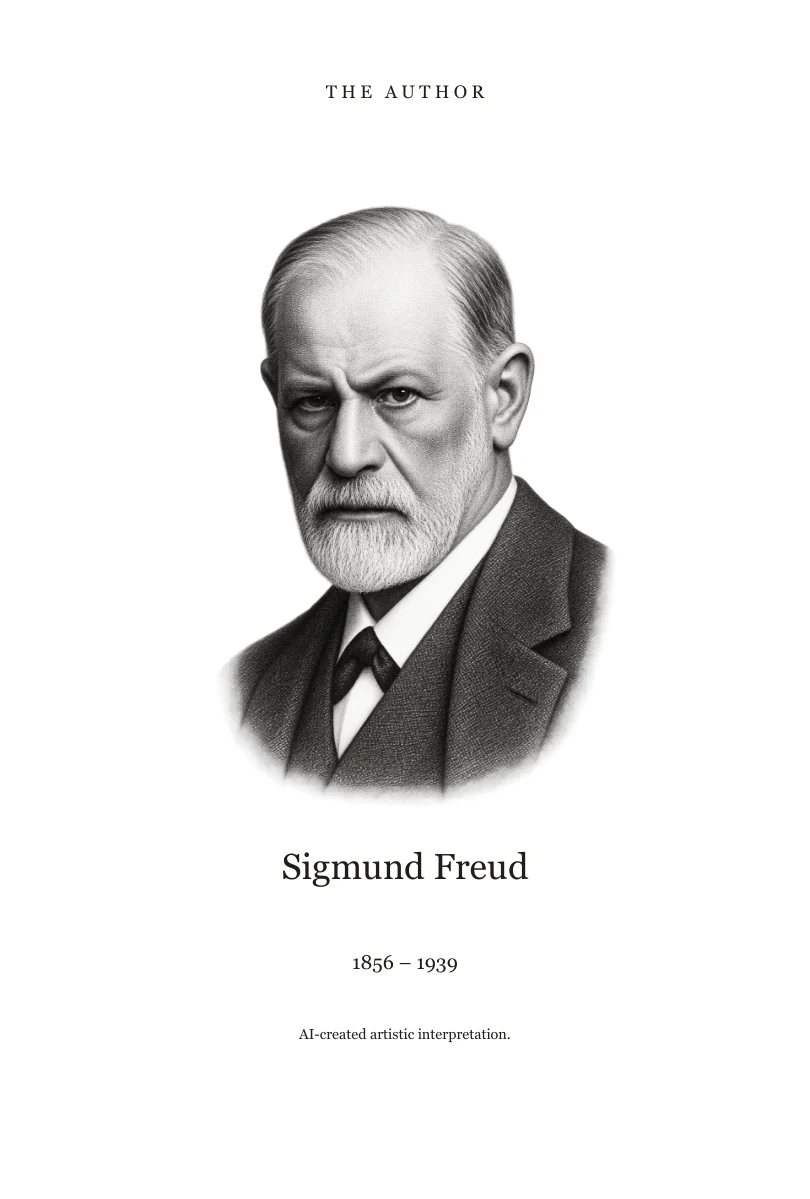
Look at the title page of the first edition of Die Traumdeutung and you will see the year 1900. But the book was actually published on 4 November 1899, by Franz Deuticke of Leipzig and Vienna. According to Ernest Jones, Freud’s colleague and biographer, it was the publisher who chose to put the new century’s date on it.
So The Interpretation of Dreams is a book from the nineteenth century dressed for the twentieth, which suits it rather well. Sigmund Freud built it from material gathered in the 1890s, and it became one of the founding texts of the next hundred years of thinking about the mind.
Why does The Interpretation of Dreams say 1900?
Jones records only that Deuticke chose the date, not why. It is tempting to read something grander into it — a new century, a new science — but Jones credits the choice to the publisher, not to Freud. Either way, the date stuck, and the book is still usually spoken of as Freud’s great work of 1900.

A slow start
If the date was meant to look forward, the sales did not. Deuticke printed 600 copies, and they took about eight years to sell. When a second edition was finally called for, Freud wrote a new preface in the summer of 1908 that is still a little sore.
The behaviour of the scientific critics could only justify the expectation that this work of mine was destined to be buried in oblivion.
Sigmund Freud, The Interpretation of Dreams, Preface to the Second Edition (trans. A. A. Brill)
He thanked not his medical colleagues, who had largely ignored the book, but a wider circle of curious readers. Over the following years he kept revising and expanding it, and there were eight German editions in his lifetime. The first English translation, by A. A. Brill, was made from the third edition and published in New York in 1913.
What is The Interpretation of Dreams about?
Freud’s central claim is that dreams are not random noise but have meaning, and that the meaning can be recovered. A dream, he argues, is the disguised fulfilment of a wish. The disguise is the interesting part: much of the book explains how the mind condenses, displaces and dramatises its material so that the dreamer does not recognise what he wants.
His key example is one of his own dreams, from the night of 23–24 July 1895, in which a patient he calls Irma appears among guests in a great hall. Freud analyses it phrase by phrase and finds, under the confusion, a wish to be cleared of blame for her illness.
the content of the dream is thus the fulfilment of a wish; its motive is a wish.
Sigmund Freud, The Interpretation of Dreams, Chapter II (trans. A. A. Brill)
A deeply personal book
What surprises many first-time readers is how much of Freud is in it. He uses his own dreams again and again, exposing his ambitions, rivalries and memories. In the 1908 preface he explained that he had only understood afterwards what the book meant to him: it was part of his self-analysis, a reaction to the death of his father, Jakob, who had died in October 1896.
That personal thread helps explain why the book still reads well, whatever one thinks of its theories. Freud’s ideas about the mind have been argued over, revised and in many respects rejected by later science. But the book is also a literary performance, the work of a fluent and persuasive writer who could make a muddled dream about a crowded reception feel like a detective story. Late in the book comes the line that became its most famous claim, calling the interpretation of dreams the via regia, the royal road, to a knowledge of the unconscious.
How should you read The Interpretation of Dreams?
Not necessarily from the beginning. The first chapter is a long review of what earlier writers said about dreams, and many readers find it heavy going. Try starting with the second chapter, where Freud sets out his method using the Irma dream, then come back to the survey once you are hooked. Read it as a historical document and a portrait of a remarkable mind at work, rather than as a manual.
For a gentler start in the history of ideas, see our philosophy books for beginners, or Did you know Marcus Aurelius never meant Meditations to be read? for another book that let readers into its author’s head.
Open it at the dream of Irma’s injection and follow Freud into his own night. Few great books begin so candidly, or so strangely.
Questions readers ask
When was The Interpretation of Dreams published?
It was published on 4 November 1899 by Franz Deuticke in Leipzig and Vienna, though the title page is dated 1900.
Why is The Interpretation of Dreams dated 1900?
Freud’s biographer Ernest Jones records that the publisher chose to put 1900 on the title page. He does not say why.
How many copies of The Interpretation of Dreams sold at first?
The first edition was a printing of 600 copies, and it took about eight years to sell out. A second edition followed in 1909.
Who translated The Interpretation of Dreams into English?
A. A. Brill’s translation of the third German edition was published in 1913. James Strachey’s later translation appeared in 1953 in the Standard Edition of Freud’s works.
 Civilization and Its Discontents86 pages · $10.99