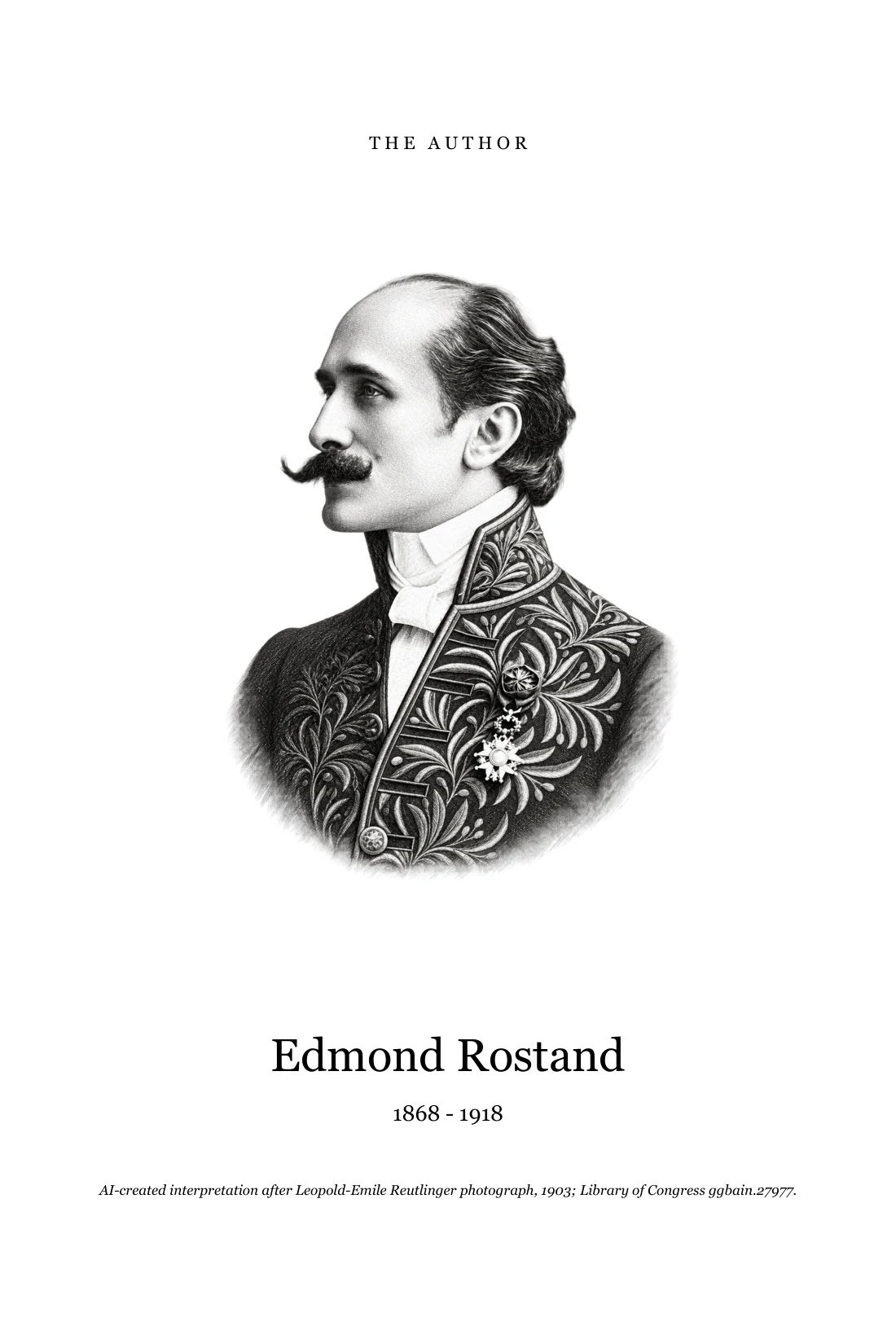
Was Cyrano real? He was. Savinien de Cyrano de Bergerac was born in Paris in 1619 and died at Sannois, just outside the city, in 1655, aged thirty-six. He was a soldier, a notorious duellist, a freethinker and a writer of satire, plays and fantastic voyages. When Edmond Rostand put him on the stage in 1897, he was reviving a figure who had been half forgotten for two centuries.
Rostand kept the outline of the life — the Gascon regiment, the wounds in battle, the quarrelsome pride, the gift for words — and built a love story around it that is almost entirely his own. Knowing where the line falls makes the play richer, not poorer.
Was Cyrano de Bergerac a real person?
The historical Cyrano joined a company of guards made up largely of Gascon noblemen around 1639, and according to his friend Henry Le Bret was wounded twice: by a musket shot at Mouzon and by a sword thrust to the throat at the siege of Arras in 1640. After that he left soldiering for Paris and letters. He fell in with the free-thinking circles of the day, and is said to have attended the lectures of the philosopher Pierre Gassendi.
His reputation as a swordsman also came largely from Le Bret, who published Cyrano’s work after his death and wrote a preface full of admiring stories. The most famous has him fighting off a large band of men at the Porte de Nesle to protect a friend. Rostand used it: his first act ends with Cyrano striding off to face a hundred men at the Porte de Nesle. Whether it happened quite as Le Bret told it is impossible to say, and historians treat it as legend shading into fact.
As for the nose, portraits and contemporary jokes suggest it really was prominent. Cyrano seems to have turned that into a theme of his own: his comic moon voyage includes a passage in which a large nose is held up as the sign of a witty, generous person.

The real Cyrano went to the moon
The real Cyrano’s best-known book is a fantasy now usually called The Other World or The States and Empires of the Moon, published in 1657, two years after his death, in a version softened by its editors. His narrator tries to reach the moon by strapping on bottles of dew that rise in the morning sun, and later succeeds by other means. Once there he meets a society that turns earthly customs upside down, a vehicle for satire on religion, philosophy and human vanity.
It is often listed among the ancestors of science fiction, alongside later moon voyages such as Jules Verne’s From the Earth to the Moon. Rostand clearly knew it. His Cyrano delays a rival in Act Three by pretending to have fallen from the moon and reeling off the ways he might have got there, a joke that only works fully if you know the real man wrote about it.
Cyrano also wrote for the theatre. His comedy Le Pédant joué has the distinction of having been borrowed from by Molière, who lifted a scene from it for Les Fourberies de Scapin. In 1654 Cyrano was badly hurt when a wooden beam fell on him — whether by accident or by design is still unclear — and he died the following year.
What Rostand invented
The love story is Rostand’s. There was a real cousin, Madeleine Robineau, whose husband, the Baron de Neuvillette, was killed at Arras, and Rostand borrowed both names for Roxane and Christian. But there is no evidence that Cyrano loved his cousin, still less that he wrote anyone’s love letters. The balcony scene, the letters and the long secret are the playwright’s invention, and they are the reason the play has never left the stage.
Cyrano de Bergerac
Rostand’s 1897 verse comedy: a soldier-poet with a brilliant tongue and an unfortunate nose, and the handsome friend whose love letters he secretly writes.
The Three Musketeers
Dumas’s Gascon hero comes from the same world of guardsmen, duels and Cardinal’s men. The real d’Artagnan and the real Cyrano were near-contemporaries.


What is Cyrano de Bergerac like to read today?
Better than its reputation as a costume piece suggests. The play opened in Paris in December 1897 and was a triumph from the first night, and it still moves at the pace of a good comedy: a riot in a theatre, a duel fought while composing a poem, a siege, a convent garden. It is written in rhyming verse, and English versions keep some of that bounce.
Read it in an evening and you will see why it has been adapted so often, from films to musicals; we follow it into the theatre in our guide to classic books that became musicals. It suits anyone who likes Shakespeare’s comedies, romantic tragedy with jokes in it, or simply a hero who would rather be magnificent than sensible.
If the real Cyrano’s world appeals, go next to Did you know d’Artagnan was a real musketeer?, which tells the true story of a real Gascon soldier made immortal by fiction, and to our guide to French classics in translation. Then start where most readers do, in the crowded theatre of Act One, with Cyrano de Bergerac about to stop the show.
Questions readers ask
Was Cyrano de Bergerac a real person?
Yes. Savinien de Cyrano de Bergerac (1619–1655) was a French soldier, duellist and writer. Edmond Rostand based his 1897 play on him, but invented the love story.
Did the real Cyrano have a big nose?
Portraits and contemporary jokes suggest he did, and his own writing appears to celebrate large noses. Rostand made it the centre of his hero’s pride and pain.
Was Roxane a real person?
Loosely. Rostand borrowed details from Cyrano’s cousin Madeleine Robineau, whose husband was the Baron de Neuvillette, but there is no evidence Cyrano loved her or wrote letters for anyone.
What did the real Cyrano de Bergerac write?
His best-known work is a satirical voyage to the moon, published after his death in 1657, along with plays and letters. It is often counted among the forerunners of science fiction.