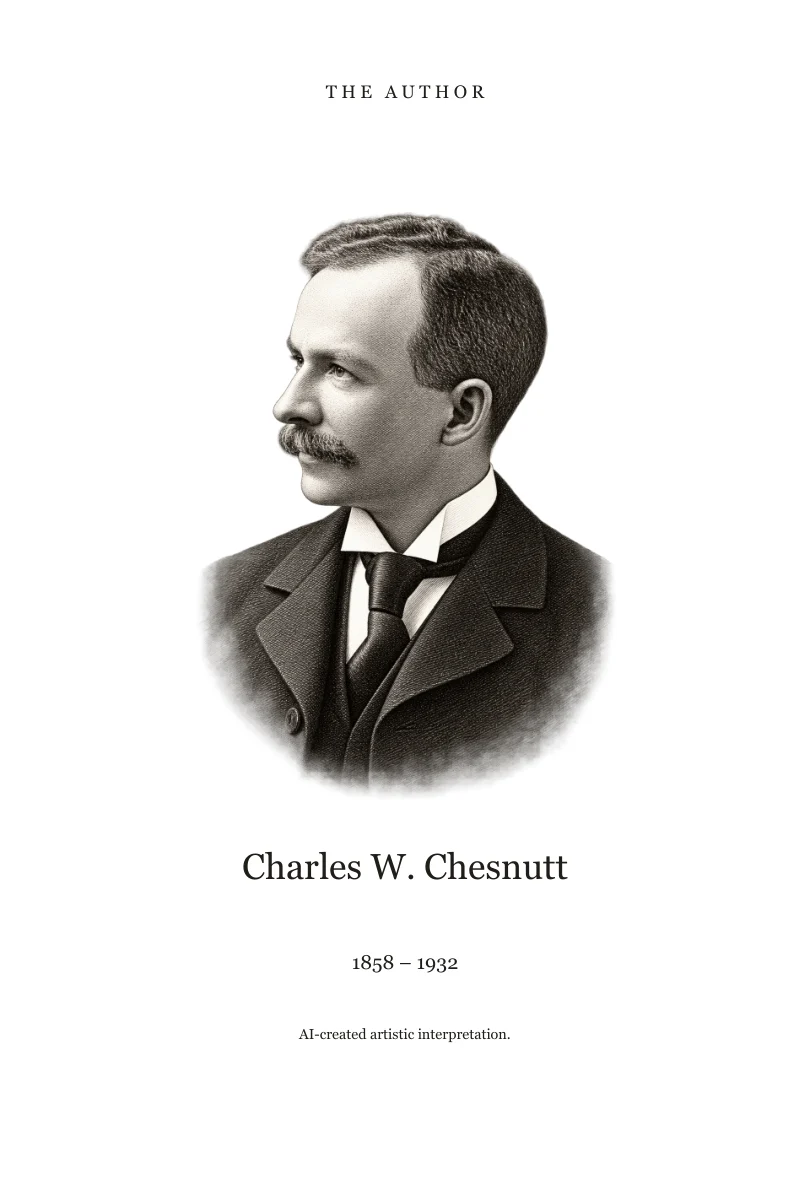
Charles W. Chesnutt said he would rather be neither praised nor shunned because of his colour. His publisher’s announcements said nothing on the subject, and readers who met the tales of Uncle Julius in 1899 could have taken their author for one of the many white writers then turning out plantation stories in dialect. Chesnutt’s Black friends, as he put it, saw to it that the fact was not overlooked; one sent a newspaper that had praised the book a portrait of the author, to make the point.
It mattered, because Charles W. Chesnutt was doing something the plantation tradition never did. His stories look like nostalgic sketches of the old South and turn out to be about slavery’s cruelty and the wit of the people who survived it. Of the Charles Chesnutt books, the one to read first is The Conjure Woman; after it come the novels, where the challenge becomes direct.
Who was Charles W. Chesnutt?
His parents were free people of colour from Fayetteville, North Carolina, who had moved north before the Civil War; after it, the family went home, and Chesnutt grew up in the Reconstruction South. He was teaching by fourteen and running a teacher-training school in Fayetteville by his early twenties. In 1883 he left for the North to write, settled in Cleveland, studied law and passed the Ohio bar, and built a prosperous court-reporting business that supported his family while he wrote.
In August 1887 The Atlantic Monthly published “The Goophered Grapevine”, often described as the first work by an African American writer to appear in the magazine. Over his career it published seven of his stories. Chesnutt was light-skinned enough to pass as white, and never chose to; questions of colour, ancestry and who counts as what run through nearly everything he wrote.
Start with The Conjure Woman
The Conjure Woman (1899) is a frame tale. A white businessman from Ohio buys a run-down vineyard in North Carolina for his wife’s health, and an old formerly enslaved man, Uncle Julius, tells them stories of the plantation days: a man turned into a tree, a cruel master transformed into a slave, a vineyard cursed by a conjure woman. The narrator thinks the stories are quaint. The reader slowly realises that Julius is cleverer than anyone else in the book, and that every tale serves a purpose of his own.
The narrator’s own voice is dry and amused. Describing the North Carolina town where they settle, he writes:
…we reached our destination, a quaint old town, which I shall call Patesville, because, for one reason, that is not its name.
Charles W. Chesnutt, The Conjure Woman (1899)
Julius speaks in a heavily rendered dialect, as was usual in Southern fiction of the time, and the stories use the racial language of their era. Both take a little getting used to, and both are part of what Chesnutt was turning inside out.
Charles W. Chesnutt’s books in reading order
- $12.99
The Conjure Woman
1899. Seven tales told by Uncle Julius to the Northern couple who have bought his old plantation. Comic on the surface, devastating underneath.
- $14.99
The House Behind the Cedars
1900. A brother and sister of mixed ancestry try to make new lives across the colour line in the post-war South. His first novel, and a story about the price of passing.
- $16.99
The Marrow of Tradition
1901. A Black doctor returns to a Southern town as white leaders plot to seize power by force. A fictional account of the Wilmington massacre of 1898, and his most powerful book.
- $15.99
The Colonel's Dream
1905. A former Confederate officer comes home from the North rich and full of plans to revive his sleepy town, and runs into everything that keeps it as it is. His last novel published in his lifetime.



The Marrow of Tradition and Wilmington
In November 1898, white supremacists in Wilmington, North Carolina, attacked the city’s Black residents, killed many of them, and forced the elected biracial government from office. Chesnutt had grown up in the state, and three years later he published a novel about it. The Marrow of Tradition is set in a fictional town called Wellington and follows a young Black physician, William Miller, trained in Paris and Vienna, as the town’s newspaper editor and his allies plan their takeover.
Chesnutt hoped it would reach readers the way Uncle Tom’s Cabin had. It did not. Many white reviewers condemned its politics, even his admirer William Dean Howells found it bitter, and it sold only a few thousand copies in its first year. Poor sales ended his hope of living by fiction, and he went back to his court-reporting business, though he kept writing; The Colonel’s Dream (1905) was the last novel he published.
Interest in Chesnutt revived from the 1960s, and he is now widely taught. Read him alongside the writers in Classics by Black writers to read this Black History Month, including Paul Laurence Dunbar and W. E. B. Du Bois. Then go back to the beginning of his book career. Sit on the old vineyard with Uncle Julius in The Conjure Woman, and listen carefully to what he is really saying.
Questions readers ask
What is Charles W. Chesnutt’s most famous book?
The Conjure Woman (1899), his collection of Uncle Julius stories, is his best-known book. The Marrow of Tradition (1901), about the Wilmington massacre of 1898, is often considered his most important novel.
Which Charles Chesnutt book should I read first?
Start with The Conjure Woman, then The House Behind the Cedars (1900) and The Marrow of Tradition (1901).
What is The Marrow of Tradition about?
It is a novel based on the Wilmington massacre and coup of 1898 in North Carolina, following a Black doctor and a white newspaper editor in a fictional Southern town as white supremacists plot to take power.