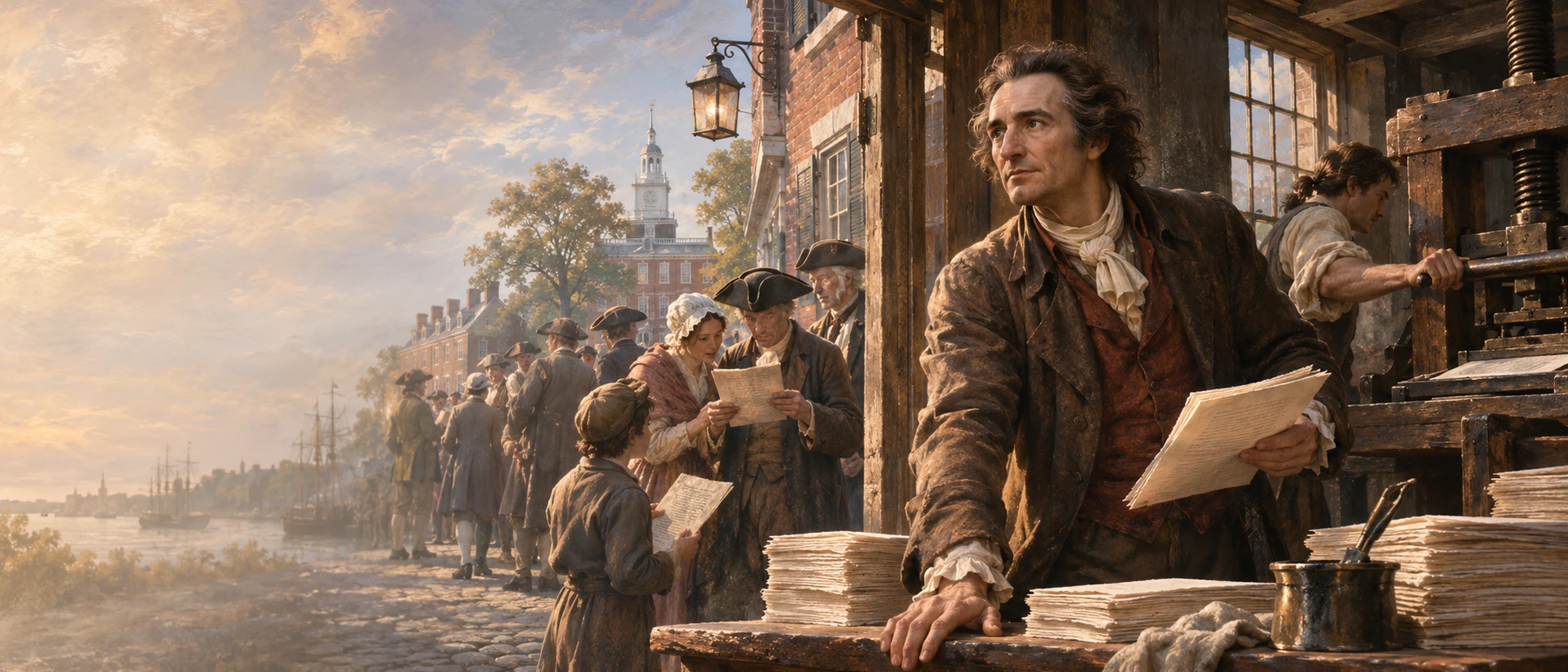
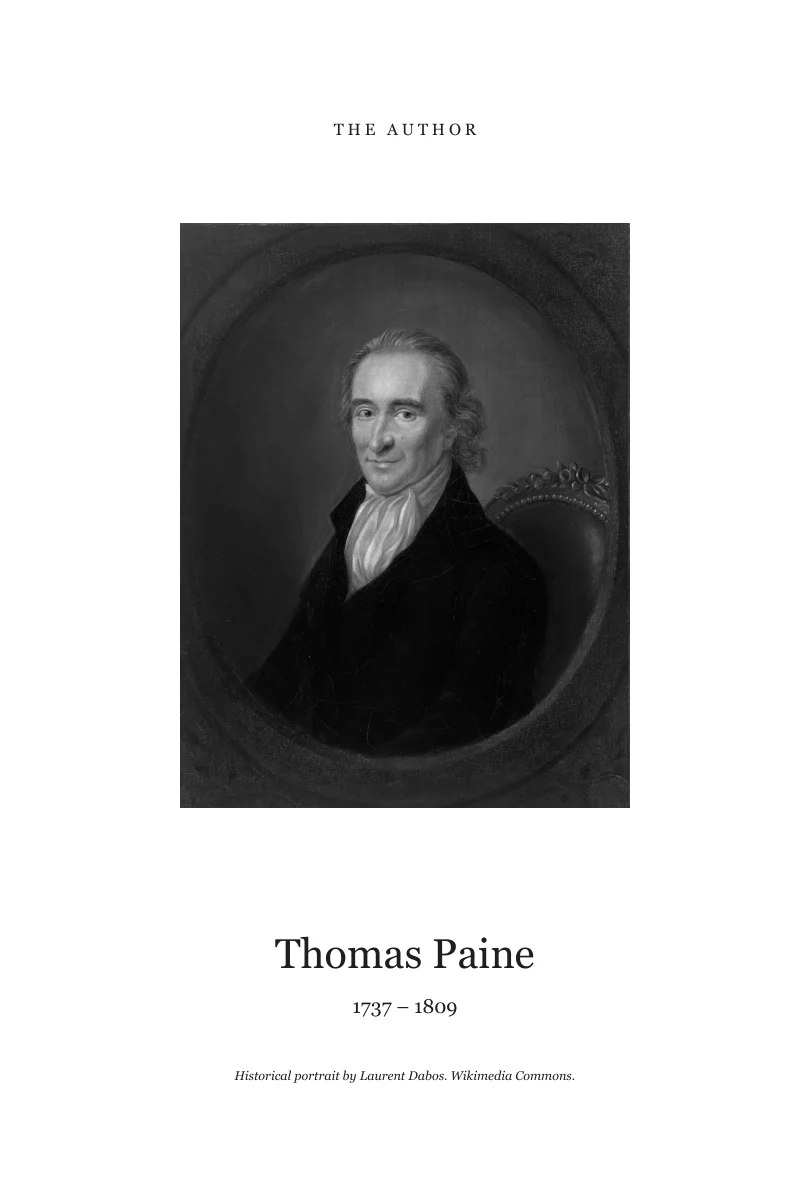
On 10 January 1776 a Philadelphia printer named Robert Bell put on sale a pamphlet with no author’s name on it. It argued, in plain words that anyone could follow when read aloud in a tavern, that the colonies should stop asking the king for justice and declare themselves independent. Its author had been in America for fourteen months. His name, Thomas Paine, was not publicly linked to it until the end of March.
Common Sense is the most famous of the books behind the American Revolution, but it did not stand alone. Behind it lay an English philosopher’s theory of government written nearly a century earlier; after it came the essays that argued the new Constitution into existence. And alongside the whole story runs the memoir of the one founder who seems to have been everywhere.
- 1689
John Locke’s Two Treatises of Government is published anonymously
- 1771
Benjamin Franklin begins his memoir, in England
- 10 Jan 1776
Thomas Paine’s Common Sense is published anonymously in Philadelphia
- 4 Jul 1776
Congress adopts the Declaration of Independence, drafted by a committee that includes Franklin
- 27 Oct 1787
The first Federalist essay appears in a New York newspaper
- 21 Jun 1788
The ninth state ratifies the Constitution
- Aug 1788
The last of the 85 Federalist essays appears
- 1791
Franklin’s memoir is first published, in French
John Locke and the Declaration of Independence
John Locke’s Second Treatise of Government argued that people form governments to protect their lives, liberties and estates, and that a government which betrays that trust may be replaced. That is recognisably the logic of the Declaration of Independence, and scholars have long noted echoes of Locke in Jefferson’s drafts. Jefferson himself called Bacon, Locke and Newton the three greatest men who had ever lived.
How much Locke actually drove the Revolution is another matter, and historians disagree. Some have stressed classical ideas of republican virtue, others Scottish moral philosophy, and the colonists also cited Blackstone’s legal commentaries frequently. The fair summary is that Locke supplied a vocabulary many Americans already spoke. We set his argument beside Hobbes and Rousseau in what is the social contract?.

Common Sense: the pamphlet that made independence thinkable
Before Paine, even many angry colonists still hoped for reconciliation with Britain. Thomas Paine attacked not just a policy but monarchy itself, mocking hereditary succession and insisting that an island could not sensibly rule a continent. He wrote for ordinary readers, not lawyers, and structured the argument almost like a sermon.
The cause of America is in a great measure the cause of all mankind.
Thomas Paine, *Common Sense*, introduction
How many copies it sold is disputed. Paine claimed 120,000 in the first three months; some historians think 75,000 the realistic upper limit for the whole period. Either way it was copied, reprinted and read aloud across the colonies, and contemporaries credited it with swinging opinion towards independence in the six months before July 1776. John Adams, himself a leading advocate of independence, thought its plan of government far too democratic.
The Federalist Papers: arguing for the Constitution
Winning independence left a weak confederation, and in 1787 a convention in Philadelphia proposed a new Constitution. In New York, where critics writing as “Cato” were already attacking it in the press, Alexander Hamilton recruited James Madison and John Jay to write in its defence under the shared pen name Publius. Between October 1787 and August 1788 they produced 85 essays, later collected as The Federalist.
Hamilton wrote most of them, Madison some 29, and Jay, who fell ill, only five. For a long time the authorship of twelve was disputed, until statistical studies of word choice, most famously by Frederick Mosteller and David Wallace in the 1960s, pointed to Madison. Among the papers he is now credited with is the most quoted line in the collection.
If men were angels, no government would be necessary.
*The Federalist*, No. 51

Benjamin Franklin’s Autobiography
Benjamin Franklin sat on the committee that drafted the Declaration, but his memoir never reaches the Revolution. He began it in 1771, addressing his son, and wrote it in four bursts over nearly twenty years; the story stops in 1758. What it gives you instead is the colonial world the founders grew out of: a runaway printer’s apprentice who becomes a newspaper owner, founds clubs and a library, experiments with electricity and drafts a plan for uniting the colonies decades before they united. It was first published in French, in Paris, in 1791, the year after his death.
Second Treatise of Government
1689. Locke’s case that government rests on consent and exists to guard what he called men’s lives, liberties and estates. Short, clear and endlessly quoted.
Common Sense
1776. Paine’s blunt, brilliant case for independence and against kings. A short pamphlet in 1776, and it still reads like a call to arms.
The Federalist Papers
1787–88. Eighty-five essays by Hamilton, Madison and Jay on how the new republic should work. Dip in at Nos. 10 and 51.
The Autobiography of Benjamin Franklin
1771–90. Franklin’s wry, self-improving account of his rise from Boston apprentice to Philadelphia printer and public man.


If the Federalist looks forbidding, how long are the Federalist Papers? breaks the 85 essays into a reading plan. For more on Franklin’s genre, see classic autobiographies and memoirs, and for the wider shelf, essential American classics.
Start where the colonists did, with Common Sense. It takes an hour, and by the end you understand why so many readers in 1776 put it down convinced.
Questions readers ask
What books influenced the American Revolution?
Among the most important were John Locke’s Second Treatise of Government (1689), whose ideas echo in the Declaration of Independence, and Thomas Paine’s Common Sense (1776), which made the popular case for independence. The Federalist Papers (1787–88) then argued for the new Constitution.
Why was Common Sense so important?
Published in January 1776, it argued in plain language for full independence and against monarchy itself, at a time when many colonists still hoped for reconciliation. It was widely reprinted and read aloud, and helped turn opinion towards independence.
Who wrote the Federalist Papers?
Alexander Hamilton, James Madison and John Jay, writing together as Publius. Hamilton wrote the majority, Madison about 29 and Jay five, with statistical studies attributing the disputed essays to Madison.
Did John Locke influence the Declaration of Independence?
Many scholars see Locke’s ideas about natural rights and government by consent echoed in the Declaration, and Jefferson admired him greatly. How far Locke shaped the Revolution as a whole is still debated by historians.