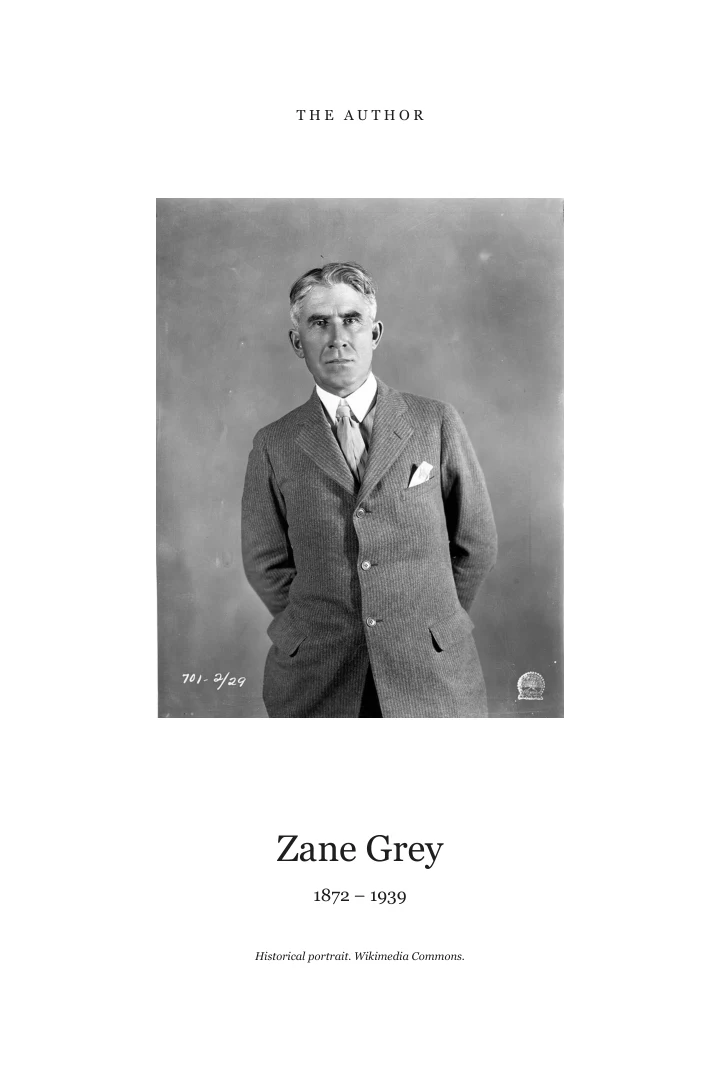
Was Zane Grey really a dentist? He was. He graduated in dentistry from the University of Pennsylvania in 1896 and set up in practice in New York City under the name “Dr. Zane Grey”, and for several years that is how he earned his living. He hated it.
Sixteen years after graduating, Zane Grey published Riders of the Purple Sage (1912), the novel that became his best-selling book and is still often called the most popular western ever written. The road from one to the other ran through baseball, a canoe trip, a determined wife and a lot of rejection letters.
Why did Zane Grey become a dentist?
Partly because it ran in the family: his father, Lewis Gray, was a dentist. The family later changed the spelling of the surname to Grey, and their son dropped his first name, Pearl, and became simply Zane.
The other reason was baseball. Grey was a gifted player, and his skill won him a scholarship to the University of Pennsylvania, where he studied dentistry. He had wanted to write, or to play ball for a living, but he concluded unhappily that dentistry was the practical choice. Even after he qualified he kept playing, for amateur and minor-league teams, while he practised on and off.
From the dentist’s chair to the desert
Grey set up as a dentist in New York in the late 1890s. To relieve the monotony he began writing in the evenings, and on fishing trips out of the city he discovered Lackawaxen, in Pennsylvania, where the Lackawaxen River meets the Delaware. Canoeing there in 1900 he met Lina Roth, known as Dolly, and in 1905 they married and moved into a farmhouse at Lackawaxen. Grey gave up dentistry to write full time.
It did not go smoothly. His first novel, Betty Zane (1903), about a heroine of the 1782 siege of Fort Henry who was his great-grandaunt, had been turned down by Harper & Brothers, and it reached print with family money behind it. Dolly’s encouragement kept him going through years of disappointment.
The turning point came in 1907, when Grey heard a lecture by Charles “Buffalo” Jones and arranged a mountain-lion hunting trip with him to the North Rim of the Grand Canyon. The canyon country of Arizona and Utah gave him his subject. The Heritage of the Desert (1910) became a bestseller, and two years later came Riders of the Purple Sage.
What is Riders of the Purple Sage about?
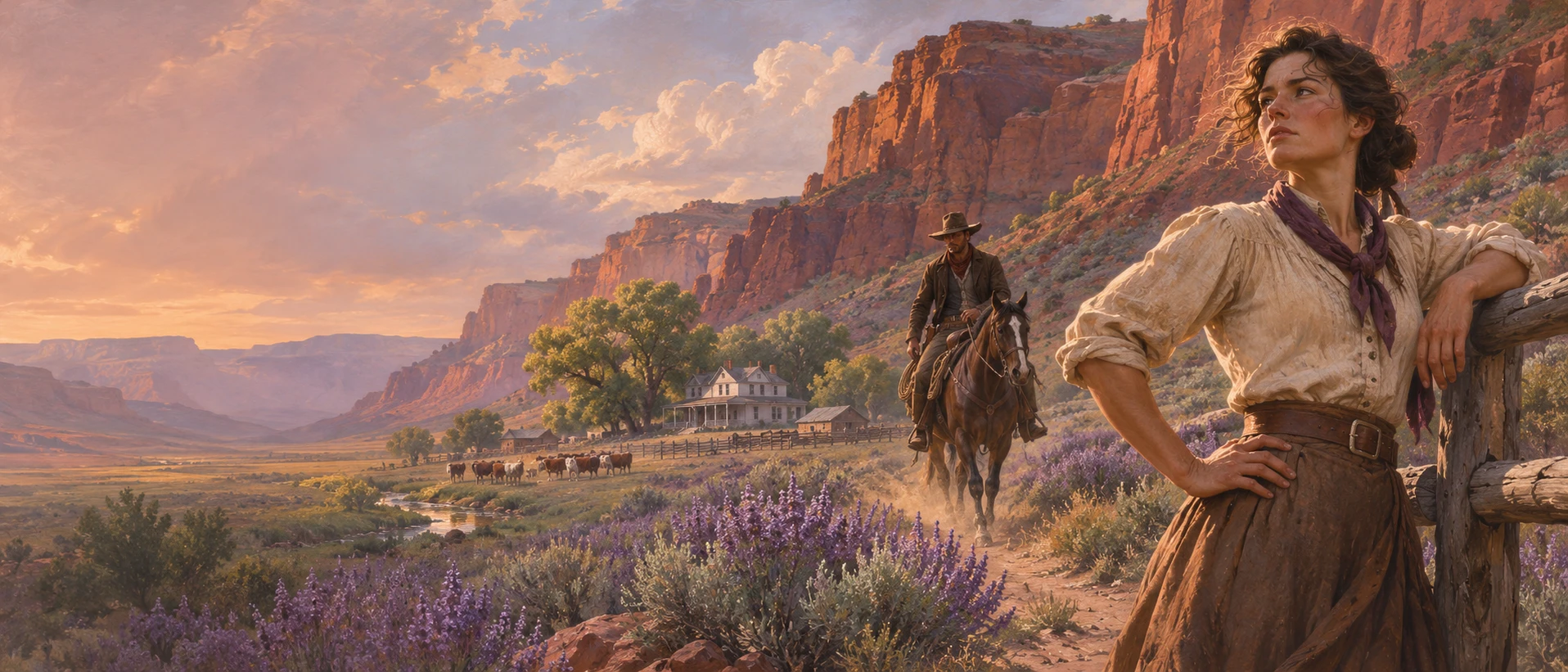
It is set in 1871 in the southern Utah canyon country, in a remote Mormon village called Cottonwoods. Jane Withersteen, who has inherited her father’s ranch, springs and cattle, is being pressured by the church elders to marry Elder Tull as one of his wives, and to stop befriending a Gentile rider named Venters. Into this standoff rides Lassiter, a gunman in black leather whose reputation has travelled ahead of him, and who has a private mission of his own.
Meanwhile Venters, out on the range, shoots a mysterious masked rider who works with a band of cattle rustlers, and makes a discovery that sends the story into a hidden valley. Grey interweaves the two plots with mounting suspense, and keeps several of his best surprises for the last chapters.
A sharp clip-clop of iron-shod hoofs deadened and died away, and clouds of yellow dust drifted from under the cottonwoods out over the sage.
Zane Grey, Riders of the Purple Sage (1912)
The novel’s treatment of the Mormon church is its most dated feature. Its villains are elders who use religious authority to seize property and force plural marriages, and during the Second World War it was turned down for the Armed Services Editions given to American soldiers, reportedly because of its perceived bias against Mormons. Readers should take its picture of Mormon Utah as melodrama, not history.
What happened next?
Grey became one of the best-selling authors of his time. He wrote more than ninety books, his sales are said to have passed forty million copies, and well over a hundred films were made from his stories. Riders of the Purple Sage alone was filmed several times, with William Farnum in 1918, Tom Mix in 1925 and George O’Brien in 1931, and it returned as a television film in 1996. Its sequel, The Rainbow Trail, appeared in 1915.
He also became a celebrated sea angler, credited with a string of world records. He died at his home in Altadena, California, in 1939, and he and Dolly are buried near their old house at Lackawaxen, where the dentist had first turned writer.
For more stories of the open range, see classic westerns and The Virginian on screen. Then ride into Cottonwoods with Riders of the Purple Sage. It is a long book, but the first chapter alone, with Lassiter appearing out of the sage at exactly the wrong moment for the elders, will tell you why readers in 1912 could not put it down.
Questions readers ask
Was Zane Grey a dentist?
Yes. He graduated in dentistry from the University of Pennsylvania in 1896 and practised in New York City as “Dr. Zane Grey” before giving it up to write full time after his marriage in 1905.
When was Riders of the Purple Sage published?
Harper & Brothers published it in 1912. It is set in southern Utah in 1871 and became Zane Grey’s best-selling book.
Is there a sequel to Riders of the Purple Sage?
Yes. The Rainbow Trail (1915) continues the story and reveals what became of its main characters.
What was Zane Grey’s first book?
Betty Zane (1903), a novel about a frontier heroine from his own family’s history. It was rejected by Harper & Brothers and published with family money.
 Betty Zane238 pages · $15.99