
On a hot afternoon beside a brook, the narrator of What Katy Did hears two small voices quarrelling in the rushes. They say the same words over and over, perhaps a hundred times: “Katy did.” “Katy didn’t.” “She did.” “She didn’t.” The speakers turn out to be two pale-green insects on a bulrush, and walking home she starts thinking about “another Katy”.
That is the story behind the title. The insects are katydids, the North American bush crickets whose name imitates their loud, three-beat song, usually written “ka-ty-did”. Susan Coolidge named her book, she says, “in memory of my two little friends on the bulrush”, and early Roberts Brothers editions put a line of dancing katydids on the cover in case anyone missed the joke.
What is the meaning of the title What Katy Did?
There is a second layer under the pun. The Katy the narrator remembers is one “who planned to do a great many wonderful things, and in the end did none of them, but something quite different”. The title promises deeds, and the book is about a girl whose deeds turn out not to be the ones she imagined. The katydids’ argument, did she or didn’t she, is the argument of the novel.
I mean to do something grand. I don’t know what, yet; but when I’m grown up I shall find out.
Susan Coolidge, What Katy Did, chapter II
Katy Carr is twelve, the eldest of six motherless children in the small town of Burnet. She is the tallest girl anyone has seen, tears her dresses daily, invents elaborate games in the loft and in a marshy thicket the children call Paradise, and is always sorry afterwards. She means to paint famous pictures, or row out to sea and save lives. What she actually does, for the first half of the book, is get into scrapes.
Then she disobeys her aunt, sits in a new swing in the woodshed, and the swing breaks. The second half of the novel is about the years she spends unable to walk, and what she makes of them.

Was Katy Carr a real person?
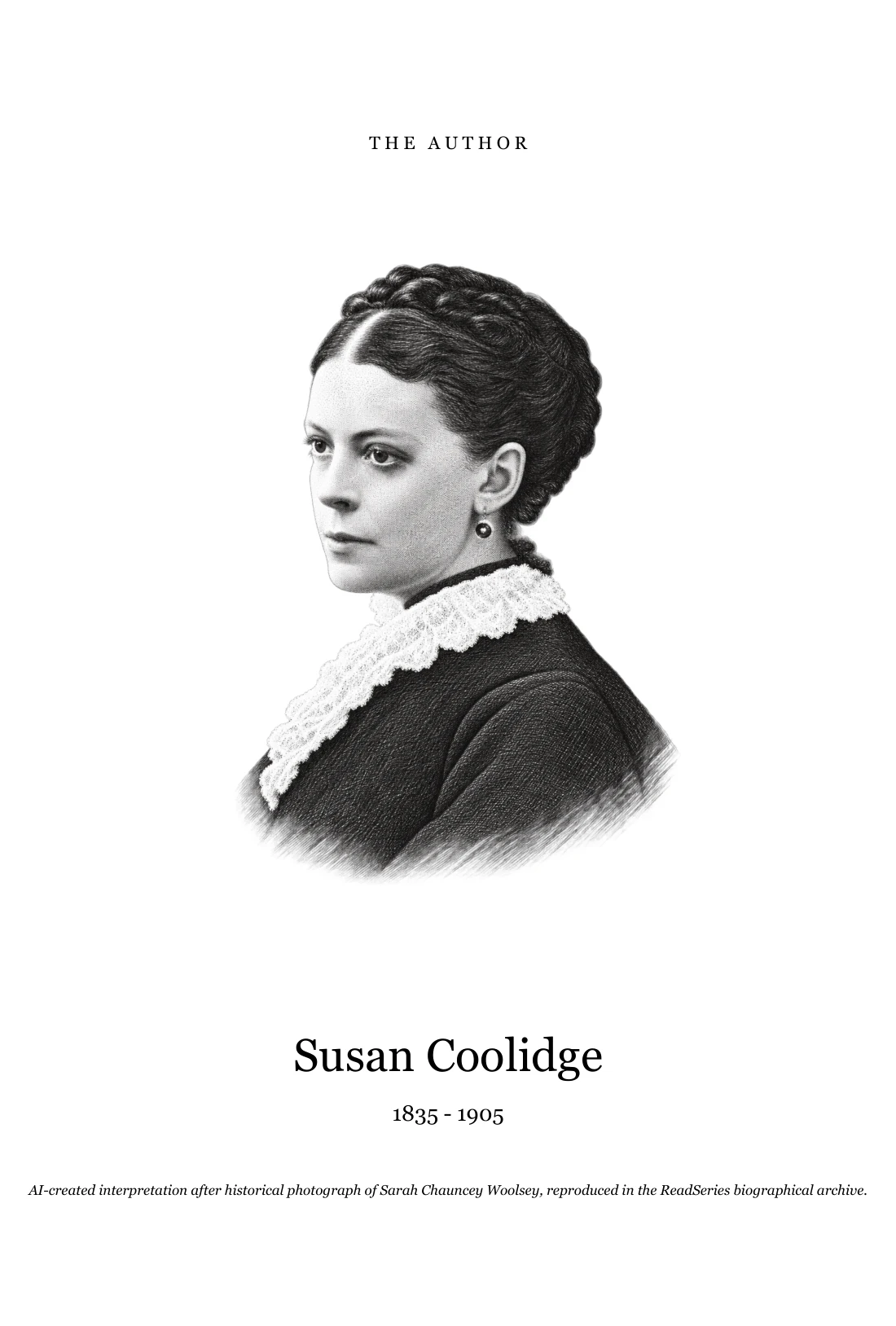
Very nearly. Susan Coolidge was the pen name of Sarah Chauncey Woolsey, born in Cleveland in 1835, and she modelled Katy on her own childhood self and the other Carr children on her brothers and sisters. The book is dedicated “To Five” and opens with a poem that begins “Six of us once, my darlings, played together”, written for siblings who were by then “grave men of business” with children of their own.
She had nursed in hospitals during the Civil War before she began writing for children. What Katy Did came out in 1872 from Roberts Brothers in Boston, the publisher of Louisa May Alcott, and it fed the appetite for true-to-life stories of girlhood that Little Women had opened up a few years earlier.
Cousin Helen and the School of Pain
The turn in the book comes from Cousin Helen, an invalid relation whose cheerfulness Katy has worshipped from a distance. Visiting the bedridden Katy, Helen tells her she has been enrolled in “The School of Pain”, with lessons in Patience, Cheerfulness, Hopefulness, Neatness and Making the Best of Things. Katy turns her darkened sickroom into the place the whole family wants to be, and by the end she has quietly become the heart of the house.
Modern readers sometimes balk at this. The novel can seem to say that a lively girl must be broken before she can be good, and the idea that suffering is a school has not aged well. But Coolidge is shrewder than the summary sounds. The early chapters are some of the funniest in American children’s fiction, the adults are often wrong (Aunt Izzie never explains why the swing is unsafe), and Katy’s wildness is plainly loved. The book is on her side even while it is teaching her.

What Katy Did books in order
Coolidge followed Katy out of the sickroom and into the world. Read in order, the series runs:
- What Katy Did (1872): the Carr children at home in Burnet, and the accident.
- What Katy Did at School (1873): Katy and Clover go away to a New England boarding school.
- What Katy Did Next (1886): Katy travels to Europe as a young woman.
- Clover (1888): the family’s second daughter takes centre stage, in Colorado.
- In the High Valley (1890): the younger Carrs grown up, in the same Colorado valley.
What Katy Did
1872. Katy Carr, five siblings, one broken swing and a sickroom that becomes the busiest room in the house. The scrapes in the opening chapters are worth the price alone.
A Little Country Girl
1885. Candace Arden, a shy girl raised in the country, spends a summer with fashionable cousins in Newport, the seaside town where Coolidge herself lived. A gentler, little-known companion to the Katy books.


The novel has never gone out of print for long. Jacqueline Wilson retold it for a new generation as Katy in 2015. For more from the same shelf, try Books like Little Women, Did you know Little Women has two sequels? and Forgotten classic stories for girls.
Start with chapter I and the quarrel in the bulrushes, then follow the Carrs into the loft. What Katy Did is short, and by the time Katy finds out what grand thing she was going to do, you may well find you agree with the insects.
Questions readers ask
Why is it called What Katy Did?
The title is a pun on the katydid, an insect whose song sounds like “Katy did, Katy didn’t”. Susan Coolidge explains on the first page that she named the book after two katydids she heard arguing on a bulrush.
What happens to Katy in What Katy Did?
After disobeying her aunt, Katy falls from a broken swing and cannot walk for several years. With the help of her Cousin Helen she learns patience and kindness, and she walks again in the final chapter.
How many What Katy Did books are there?
There are five: What Katy Did, What Katy Did at School, What Katy Did Next, Clover and In the High Valley, published between 1872 and 1890.
Who wrote What Katy Did?
Susan Coolidge, the pen name of the American writer Sarah Chauncey Woolsey (1835–1905), who based Katy on herself and the Carr children on her own brothers and sisters.