Scott tells the story himself in a preface written in 1829. About the year 1805, by his own account, he wrote the opening chapters of Waverley and showed them to “a critical friend, whose opinion was unfavourable”. Already famous as a poet, he did not want to risk his reputation on prose, and the pages were forgotten in a writing desk. Then a guest needed fishing gear.
I happened to want some fishing-tackle for the use of a guest, when it occurred to me to search the old writing-desk already mentioned, in which I used to keep articles of that nature. I got access to it with some difficulty; and, in looking for lines and flies, the long-lost manuscript presented itself.
Walter Scott, General Preface to the Waverley Novels (1829)
He finished it quickly, and Waverley was published anonymously in 1814. It was a sensation, and it began a run of novels that made Walter Scott one of the most widely read novelists in Europe for much of the nineteenth century.
Did Walter Scott really invent the historical novel?
Not single-handedly. Writers had set stories in the past long before 1814, and Scott himself mentions predecessors in that same preface. But Waverley did something new. It placed an ordinary, rather impressionable young Englishman in the middle of a real historical upheaval, the Jacobite rising of 1745, and let the reader experience the clash of two societies, Highland and Lowland, old and new, through his eyes. History was not a backdrop; it was the force acting on the characters.
That is why critics have long dated the modern historical novel from Scott. The Hungarian critic Georg Lukács, in the twentieth century, called Waverley the first major historical novel of modern times, and Scott’s imitators across Europe and America, from Alessandro Manzoni to James Fenimore Cooper and Honoré de Balzac, show how quickly the form spread. “Credited with inventing” is fair, as long as the credit is for turning it into the form we know.
- 1771
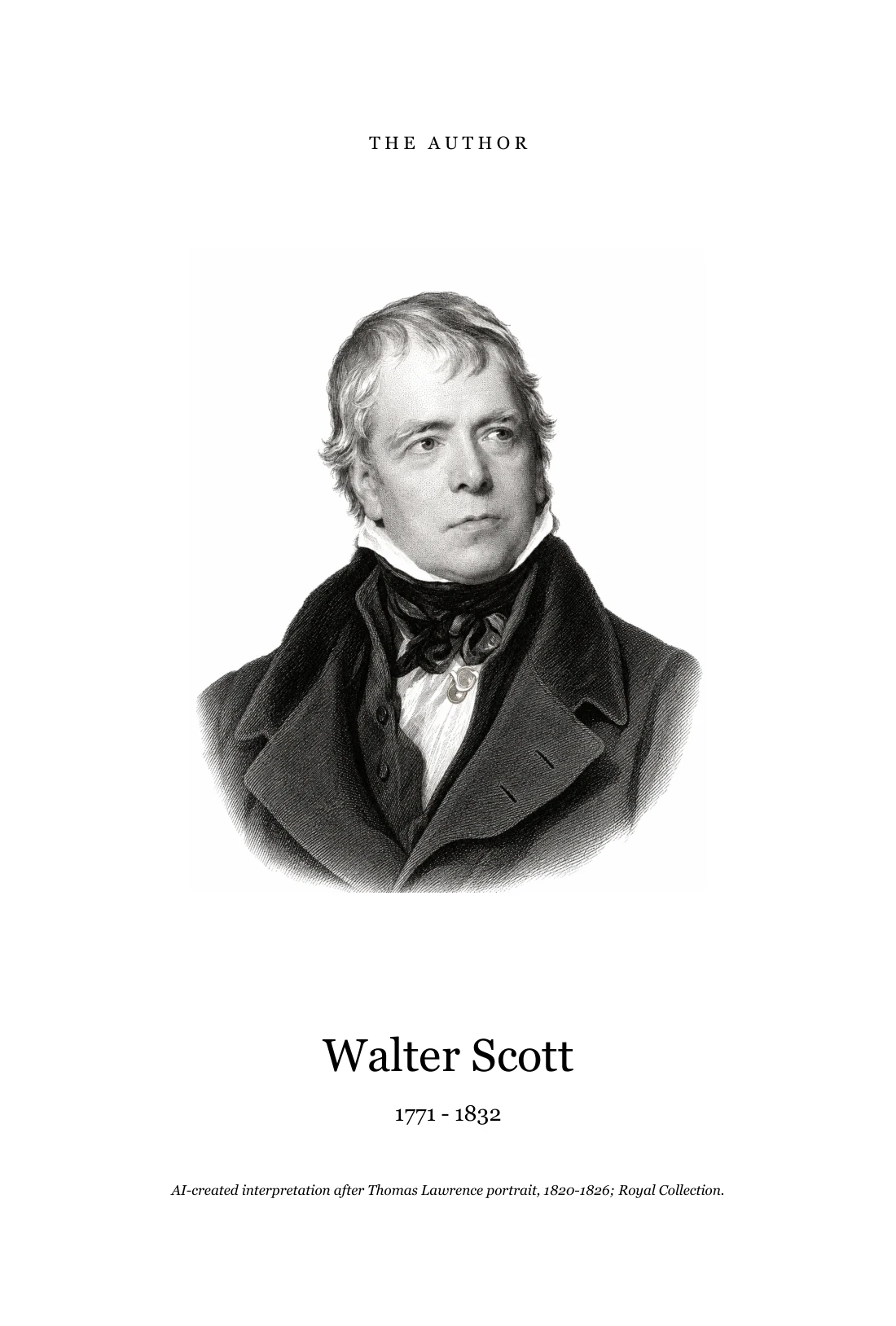
Walter Scott is born in Edinburgh on 15 August.
- c. 1805
By his own account, he begins Waverley and abandons it after a few chapters.
- 1808–10
Fame as a poet with Marmion and The Lady of the Lake.
- 1814
Waverley is published anonymously.
- 1819
The Bride of Lammermoor appears in June and Ivanhoe in December, both partly dictated while he was ill.
- 1821
The Pirate, set in Shetland, is published at the end of the year.
- 1826
The collapse of the Ballantyne printing business leaves him liable for huge debts.
- 1827
He publicly acknowledges that he is the Author of Waverley.
- 1832
Dies at Abbotsford on 21 September, aged sixty-one.
Which Walter Scott novel should you read first?
Start with Ivanhoe. It is not typical Scott, since most of his novels are set in Scotland, but it is the most exciting and the easiest to enter: a disinherited knight, Richard the Lionheart in disguise, a great tournament, Robin Hood under the name of Locksley, and one of Scott’s most admired heroines, Rebecca. It shaped how the Victorians imagined the Middle Ages, and how most of us still picture Robin Hood.
- $23.99
Ivanhoe
1819. Saxons and Normans in twelfth-century England, with tournaments, outlaws, a siege and a trial for witchcraft. The best first Scott, and the most influential.
- $18.99
The Bride of Lammermoor
1819. A Lowland tragedy of feuding families and a forced marriage, which Scott said drew on a real seventeenth-century case. The source of Donizetti’s opera Lucia di Lammermoor.
- $24.99
The Pirate
Published December 1821. A charming, dangerous stranger washes up in seventeenth-century Shetland and divides two sisters. Based loosely on the career of the real Orkney pirate John Gow.


Read The Bride of Lammermoor next. It is short for Scott and very dark, closer to Gothic tragedy than adventure, and its doomed lovers, Lucy Ashton and the Master of Ravenswood, became famous across Europe through Donizetti’s 1835 opera. Scott dictated its final chapters in 1819 while recovering from an agonising illness, and began Ivanhoe the same way.
The Author of Waverley
Scott kept his authorship officially secret for years, though it was an open secret, and the novels appeared “by the Author of Waverley”. The secret ended with the financial crash of 1825–26, which exposed his publishers’ account books and brought down the printing firm in which he was a partner, with debts of around £130,000. Rather than declare himself bankrupt, he put his income in trust for his creditors and set out to write his way clear, working at a pace that is often thought to have shortened his life.
Not everyone admired his influence. Mark Twain, surveying the American South in Life on the Mississippi (1883), blamed Scott’s romantic medievalism for its love of titles, duels and caste, and went further still: “Sir Walter had so large a hand in making Southern character, as it existed before the war, that he is in great measure responsible for the war.” It is an exaggeration, as Twain half-admits, but it shows how far Scott’s novels had travelled.
For more of Scotland’s classics, see Scottish classics for Burns Night, and for Scott’s seafaring heir, Where to start with Robert Louis Stevenson. Most readers still enter Scott through a forest between Sheffield and Doncaster, where a swineherd and a jester set Ivanhoe in motion. There is no better way in.
Questions readers ask
What was the first historical novel?
Historical settings appear in fiction long before 1814, but Walter Scott’s Waverley (1814) is widely regarded as the first modern historical novel, the book that established the genre in Europe.
What is Walter Scott’s most famous novel?
Ivanhoe (1819), set in twelfth-century England and featuring Richard the Lionheart and Robin Hood, is his best-known novel worldwide.
Which Walter Scott novel should I read first?
Ivanhoe is the most accessible. If you prefer something shorter and darker, try The Bride of Lammermoor, which inspired Donizetti’s opera Lucia di Lammermoor.
 Waverley520 pages · $23.99