
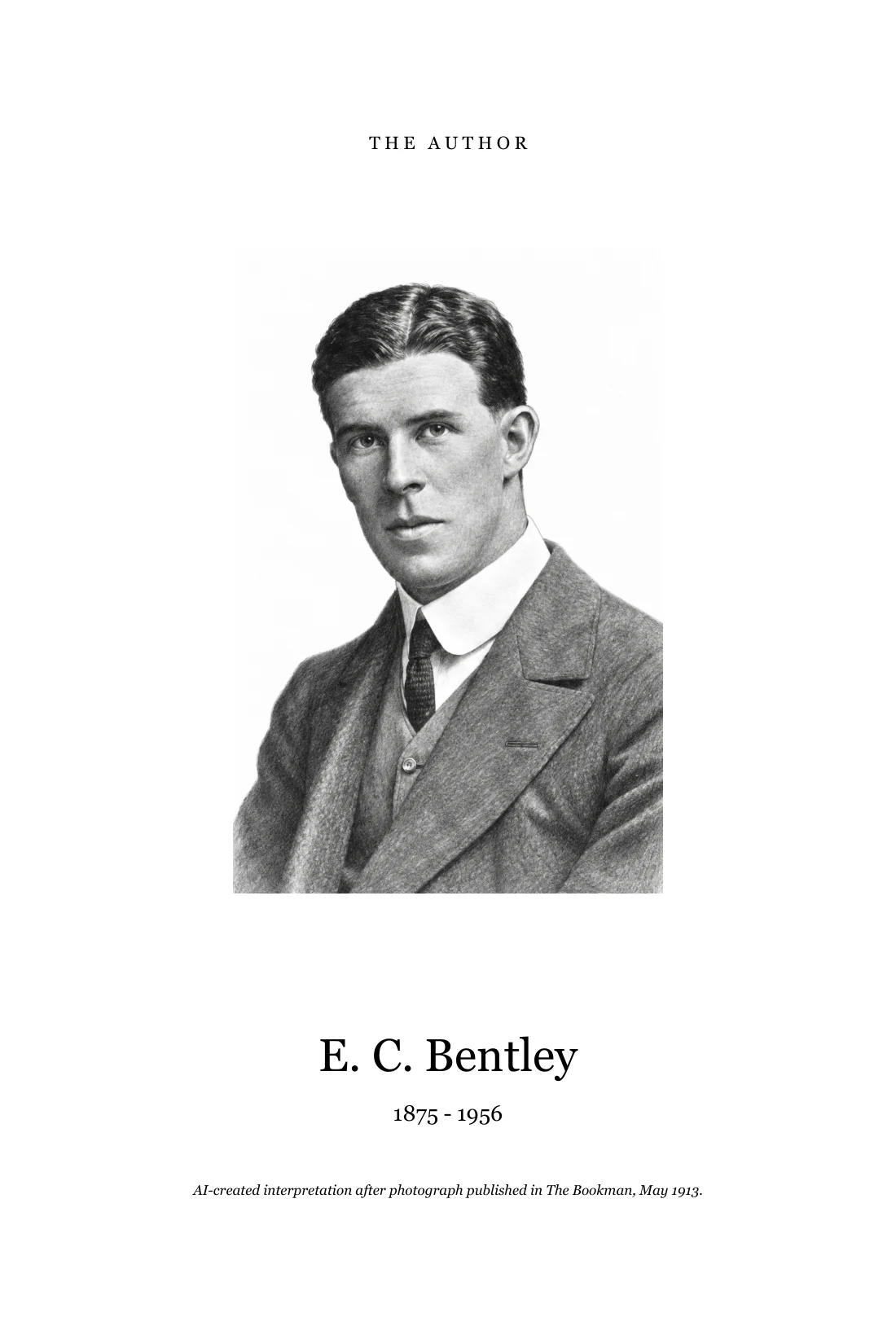
There is a joke in the title before you open the book. Trent’s Last Case was the first appearance of its detective, Philip Trent. Most series heroes begin with a first case; E. C. Bentley introduced his with a last one, and readers of 1913 would have had to wait until the final chapters to understand why.
Bentley meant the book to tease. Looking back in his autobiography, Those Days (1940), he described Trent’s Last Case as not so much a detective story as an exposure of detective stories. He was tired, above all, of the infallible genius in the Sherlock Holmes mould: the reasoning machine who never laughs, never doubts and is never wrong. He wanted a detective who could be recognised as a real human being.
What is Trent’s Last Case about?
Sigsbee Manderson, an American financier of enormous wealth and no friends, is found shot dead in the grounds of his English country house at Marlstone. The news shakes the markets on both sides of the Atlantic. Sir James Molloy, owner of a London morning paper, sends for Philip Trent, a painter who has made a sideline of solving crimes as a special correspondent, and Trent goes down to investigate where he finds that the Scotland Yard man on the case, Inspector Murch, is an old friend.
Bentley opens with a line that tells you this will not be an ordinary whodunit.
Between what matters and what seems to matter, how should the world we know judge wisely?
E. C. Bentley, Trent’s Last Case, Chapter I
From there the novel plays fair, with clues, suspects, an inquest and a brilliant chain of deductions. It also complicates things in ways the genre was not used to. Trent is clever, but he is also young, impulsive and prone to feeling, and Manderson’s widow is very much part of the case. We will say no more about the plot. The pleasure of the book is in watching Bentley build a detective story properly and then quietly turn it inside out.

Why is Trent’s Last Case called a parody?
It is not a spoof, and it never winks at the reader. Bentley takes the mystery seriously, which is exactly how the satire works. The target is not crime fiction itself but its central fantasy: that the clever man always reaches the truth, and that the truth always arrives neat. Bentley’s detective is allowed to be human, and the story asks what that means for the reasoning on which the whole genre depends.
This was a man with a gift for affectionate mockery. Bentley’s first claim to fame was the clerihew, the four-line comic verse biography named after his middle name, popularised by his Biography for Beginners in 1905. The same instinct for puncturing grand reputations runs through Trent’s Last Case. Britannica describes it as written in exasperation at the infallibility of Sherlock Holmes.
How was Trent’s Last Case received?
Very well, and for a long time. It appeared in 1913 from Nelson in Britain, and in the United States the same year as The Woman in Black. It is often seen as closing the Holmes era and pointing towards the Golden Age of the 1920s and 1930s, when writers like Agatha Christie and Dorothy L. Sayers would make playing with readers’ expectations part of the game. Despite the title, Trent returned: in Trent’s Own Case (1936) and the short stories of Trent Intervenes (1938).
- 1905
Bentley’s Biography for Beginners launches the clerihew
- 1913
Trent’s Last Case is published; in America it is titled The Woman in Black
- 1920
A British silent film version
- 1929
Howard Hawks directs a Hollywood adaptation
- 1936
Trent returns in Trent’s Own Case
- 1938
Trent Intervenes collects Trent short stories
- 1952
Herbert Wilcox’s film, with Michael Wilding, Margaret Lockwood and Orson Welles as Manderson
Should you read Trent’s Last Case?
If you love classic detective fiction, yes, and ideally after you have read a few Sherlock Holmes stories, so you can feel what Bentley is pushing against. It is a compact 190 pages, and it moves briskly once Trent reaches Marlstone. The romance may feel old-fashioned, but it is essential to the design, not decoration. Be warned that the opening chapter, describing the panic on the world’s stock exchanges, includes a casually antisemitic phrase of the kind common in its time.
For the wider family tree, see Golden Age detective novels to start with and the Golden Age of detective fiction. If you want the Holmes stories Bentley was reacting to, start with Sherlock Holmes in order.
Begin in the newspaper office, as the telephone buzzes on Sir James Molloy’s desk with news that will knock the town endways. Then follow Trent to Marlstone, and keep an eye on the detective as closely as on the suspects.
Questions readers ask
Is Trent’s Last Case a parody?
In part. E. C. Bentley later called it not so much a detective story as an exposure of detective stories, written against the idea of the infallible Sherlock Holmes-style detective. It is also a fully fledged mystery in its own right.
When was Trent’s Last Case published?
It was published in 1913 in Britain by Nelson. In the United States it first appeared the same year as The Woman in Black.
Are there other Philip Trent books?
Yes. Despite the title, Trent returned in the novel Trent’s Own Case (1936) and the short story collection Trent Intervenes (1938).