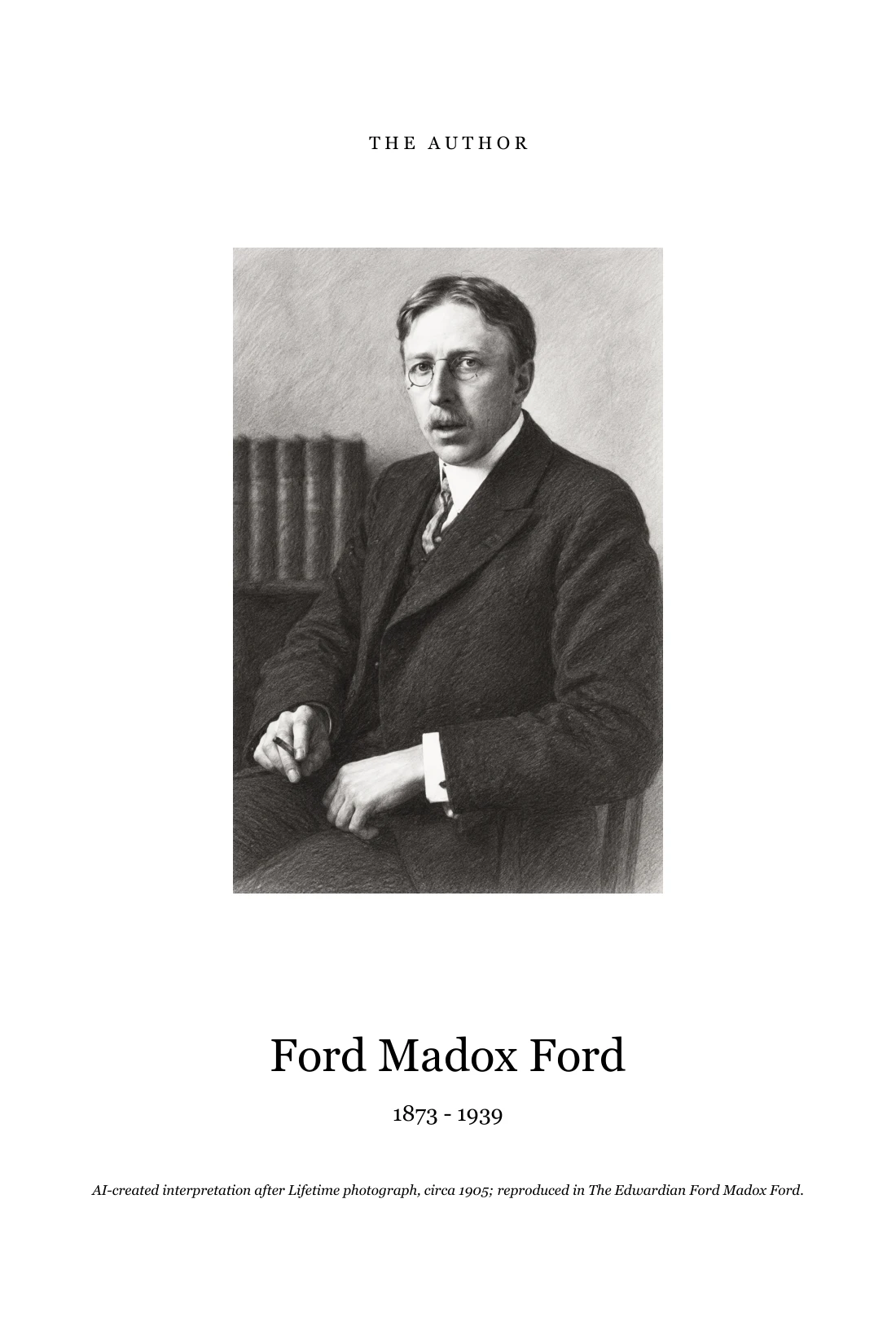
The telegram was reply-paid, which turned out to matter. By Ford Madox Ford’s own account, his publisher John Lane had been bombarding him with letters and wires, begging him to change the title of his new novel. The book was called The Saddest Story, and with the country at war Lane thought nobody would buy it. When one last appeal arrived, Ford seized the reply form and wrote, in what he called “hasty irony”, a suggestion he never expected anyone to take seriously.
“Dear Lane, Why not The Good Soldier?” . . . To my horror six months later the book appeared under that title.
Ford Madox Ford, dedicatory letter to the 1927 edition
The Good Soldier was written as The Saddest Story, and the novel still carries the original title in its first sentence. The name it ended up with began as sarcasm.
Why was The Good Soldier renamed?
Because of the war. Ford sat down to write the book on 17 December 1913, his fortieth birthday, meaning it to be the novel by which he would be judged. An early section appeared in the summer of 1914 in Blast, Wyndham Lewis’s magenta-covered Vorticist magazine, under the original title. A month later Britain was at war with Germany.
When the novel came out from John Lane at the Bodley Head in March 1915, the war was in its eighth month. In 1927 Ford recalled that Lane thought The Saddest Story would make the book unsaleable at such a time. A novel whose title sounded patriotic was another matter, even if its “good soldier”, Captain Edward Ashburnham, turns out to be anything but a hero.
- 17 Dec 1913
Ford, still writing as Ford Madox Hueffer, begins the novel on his fortieth birthday
- July 1914
An extract appears in Blast under the title The Saddest Story
- 4 Aug 1914
Britain enters the First World War
- March 1915
John Lane publishes the novel as The Good Soldier: A Tale of Passion
- 30 July 1915
Ford enlists in the Welsh Regiment, aged forty-one
- 1919
Hueffer changes his name by deed poll to Ford Madox Ford
- 1927
A new edition carries Ford’s dedicatory letter telling the story of the title
Is Ford’s story about the title true?
Mostly, though it has been polished in the retelling. Ford said the final telegram reached him while he was on parade, but he did not join the army until July 1915, four months after the book was published, and he was writing twelve years after the event. What is not in doubt is the original title, the publisher’s wartime nerves and Ford’s lasting regret. He wrote that he had never ceased to regret the change, and kept the new name only because readers had come to know the book by it.
He told two jokes against himself on the subject. An adjutant in his regiment came back from leave looking ill and explained that he had got engaged two days earlier and had spent the day reading The Good Soldier. Later, during a nervous drill examination, an officer murmured in his ear, “Did you say, The Good Soldier?” Ford concluded that irony could be a two-edged sword.
This is the saddest story I have ever heard
The old title survives where Ford put it first, in one of the most famous opening lines in English fiction: “This is the saddest story I have ever heard.” The speaker is John Dowell, a wealthy American who for nine seasons has taken the waters at Nauheim in Germany with his wife Florence and an English couple, Edward and Leonora Ashburnham. He believed the four of them were the closest of friends. He is now trying to work out what was really going on.
Dowell returns to the phrase like a man pressing a bruise. Later he explains why he calls it a sad story rather than “The Ashburnham Tragedy”: there was no nemesis and no destiny in it, only people drifting towards disaster. Read with that in mind, the original title is less a label than a key to how he wants you to understand him, which is one reason readers have argued for a century about whether to believe him.
Ford’s method is to tell events out of order, the way memory delivers them. A detail dropped in the first chapter may only make sense much later, and each return to an old scene changes what you thought you knew. Ford said that when he translated the book into French he was astonished by its tangle of references and cross-references.
Is The Good Soldier worth reading today?
It is short, and it rewards a second reading more than almost any novel of its time. The Modern Library placed it thirtieth on its 1998 list of the best English-language novels of the twentieth century. Granada adapted it for television in 1981, with Jeremy Brett as Ashburnham.
Ford himself thought it his best book. In the same 1927 letter he recalled a young admirer calling it the finest novel in the English language, and his friend John Rodker correcting him: the finest French novel in the English language. If you enjoy narrators who know less than they think, read it alongside the openings collected in the best opening lines in classic fiction, and see what else the war years produced in novels published during the First World War. For the movement Ford helped to make, try modernism explained.
Then begin where Ford began, with Dowell’s first sentence. Open The Good Soldier and notice how often the old title comes back to you as you read.
Questions readers ask
What was the original title of The Good Soldier?
Ford Madox Ford called it The Saddest Story. An extract appeared under that title in the magazine Blast in 1914 before the novel was renamed for publication in 1915.
Why is it called The Good Soldier?
Ford said his publisher, John Lane, wanted a new title once the First World War began. Ford sarcastically suggested The Good Soldier in a telegram, and to his dismay Lane used it.
What is the first line of The Good Soldier?
“This is the saddest story I have ever heard.” The narrator, John Dowell, repeats the phrase at several points in the novel.
Who is the good soldier in The Good Soldier?
Captain Edward Ashburnham, the English officer at the centre of the story, though the title is ironic and the narrator’s view of him keeps shifting.
 The Fifth Queen Crowned150 pages · $12.99