Two boys pool their savings, put up five dollars in a bucket shop on shares of the Burlington railroad, and cash in two days later. The narrator’s share of the profit is $3.12. That trade comes in the first chapter of Reminiscences of a Stock Operator, and it is also, to the cent, the first profit recorded in accounts of the real life of Jesse Livermore.
That is the book’s secret, though it was never much of a secret. Edwin Lefèvre’s Reminiscences of a Stock Operator (1923) is a roman à clef: a fictionalised account of Livermore’s career, narrated by a trader named Larry Livingston. Names are changed, events are arranged and the voice is Lefèvre’s construction, but the shape of the life is Livermore’s. Read it as a novel built on a real man, not as a memoir.
Who was Jesse Livermore?
Livermore was born in Shrewsbury, Massachusetts, in 1877. At fourteen he was working as a board boy in a Boston brokerage, chalking up prices as they came off the ticker, and he began to notice that stocks moved in patterns. At fifteen he made that first bet in a bucket shop, a kind of betting parlour where customers wagered on price changes without actually buying shares. In the novel’s telling, he was so consistently right that the shops began to refuse his business.
The book then takes him to New York and the real brokerage houses, where his bucket-shop system fails and he loses everything before learning to trade again. Traders called him the Boy Plunger, a nickname the novel keeps. He is reported to have profited heavily from short-selling before the San Francisco earthquake of 1906 and during the Panic of 1907, and to have lost much of it on cotton the following year. He went broke more than once in those years, and each time he rebuilt his fortune.
What is true in Reminiscences of a Stock Operator?
A great deal of the outline. Livingston’s apprenticeship in the bucket shops, his nickname, his trading through the 1906 earthquake, his disastrous cotton campaign and his debts all line up with the record of Livermore’s career up to the early 1920s. The cotton episode, in which Livingston is talked out of his own judgement by a persuasive expert called Percy Thomas, matches what biographers say about Livermore’s dealings with the cotton speculator Theodore Price.
Livingston tells us that his creditors released him from debts of more than a million dollars, and that he paid every cent back when he returned to New York early in 1917. Livermore had filed for bankruptcy in 1915. The novel keeps the arc and trims the paperwork.
What did Lefèvre change?
The names, first of all. Brokers, rivals and tipsters wear invented names, and the narrator’s own is a thin veil over Livermore’s. Lefèvre also shapes the material the way a novelist would, compressing years into scenes and giving each episode a lesson to close on. How much of the wording is Livermore’s talk and how much is Lefèvre’s craft has never been settled, and the book does not say.
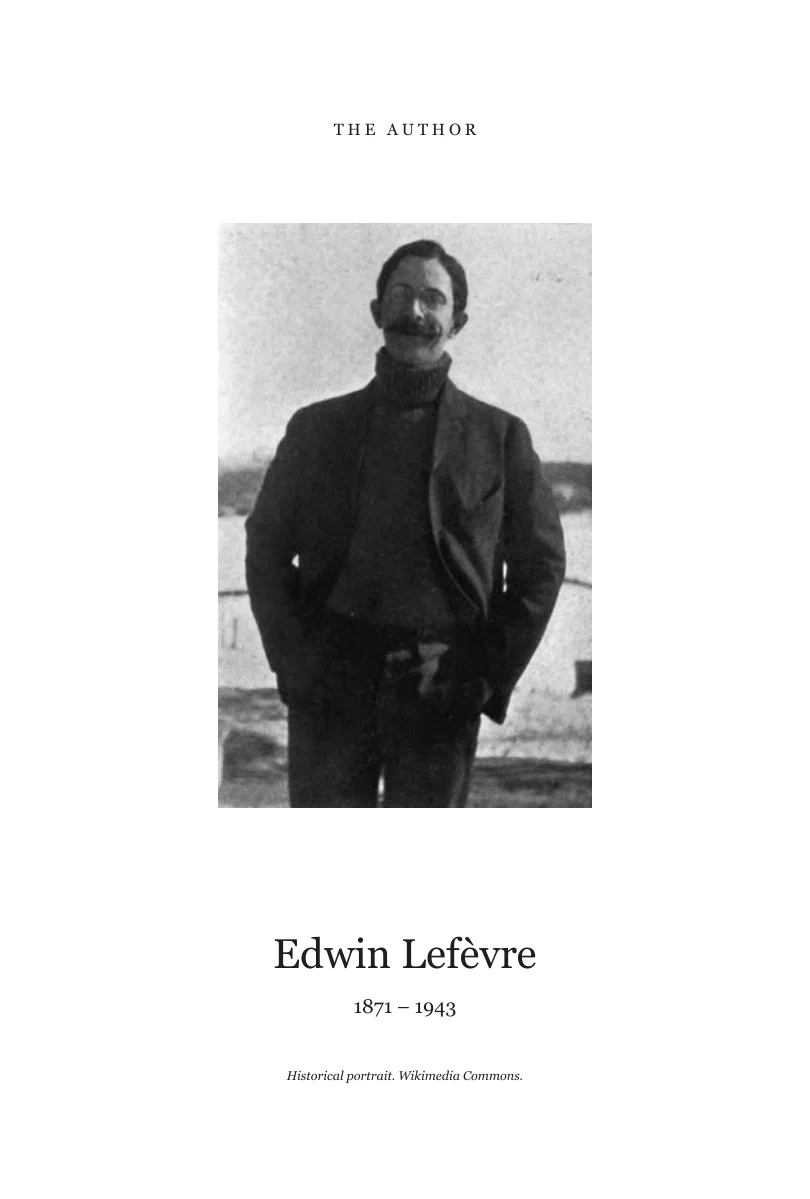
Lefèvre knew the territory. Born in 1871 in Colón, then part of Colombia, he worked as a journalist and a stockbroker, wrote on finance for the New York Sun, and published Wall Street Stories in 1901. His great gift in this book is the voice: plain, cocky, self-mocking and very quotable.
After spending many years in Wall Street and after making and losing millions of dollars I want to tell you this: It never was my thinking that made the big money for me. It was always my sitting.
Edwin Lefèvre, Reminiscences of a Stock Operator (1923)
Why do traders still read it?
Because the lessons are about people rather than prices. Livingston’s mistakes are hope, impatience, taking tips and refusing to admit he is wrong, and none of those has been abolished by computers. “There is nothing new in Wall Street,” he says early on, and the book has been proving him right for a century. Alan Greenspan praised it in his memoir, and it turns up on reading lists for new traders to this day.
It is also simply good storytelling. The bucket-shop chapters have the energy of a confidence-trick novel, with shop owners trying to fleece a teenage prodigy who keeps fleecing them. The later chapters, on corners, pools and market manipulation, are a vivid portrait of Wall Street before regulation, when fortunes were made and lost on rumour.
How the real story ended
The book stops in the early 1920s, which spares Livingston what came later. Livermore is said to have made an enormous fortune by selling short in the crash of 1929, and newspapers called him the Great Bear of Wall Street. But he lost most of it again, filed for bankruptcy for a third time in 1934, and died by suicide in New York in 1940. His own book, How to Trade in Stocks, came out earlier that year and sold poorly.
Knowing that ending lends the novel’s cheerful self-assurance a shadow. Livingston keeps insisting that he has learned his lessons at last, and the reader who knows what happened to Livermore cannot quite believe him.
For more fiction about fortunes, see classic novels about money, and for another Wall Street story with a very different hero, Bartleby, the Scrivener. Then open Reminiscences of a Stock Operator at the quotation board, where a teenage office boy is filling a notebook with prices and is about to make his first $3.12.
Questions readers ask
Is Reminiscences of a Stock Operator a true story?
It is fiction based on a real life. Edwin Lefèvre’s narrator, Larry Livingston, is a thinly disguised Jesse Livermore, and the main events follow Livermore’s career, but names are changed and the material is shaped like a novel.
Who is Larry Livingston?
Larry Livingston is the fictional narrator of Reminiscences of a Stock Operator (1923). He is modelled on the speculator Jesse Livermore, and shares his nickname, the Boy Plunger.
Did Jesse Livermore write Reminiscences of a Stock Operator?
No. The book was written by the financial journalist Edwin Lefèvre and first appeared as a magazine series before being published as a book in 1923. Livermore’s own book, How to Trade in Stocks, appeared in 1940.
Why is Reminiscences of a Stock Operator so famous?
It describes the psychology of speculation, the hope, fear and stubbornness that cost traders money, in a lively first-person voice. Those lessons have not dated, so traders and investors still recommend it.