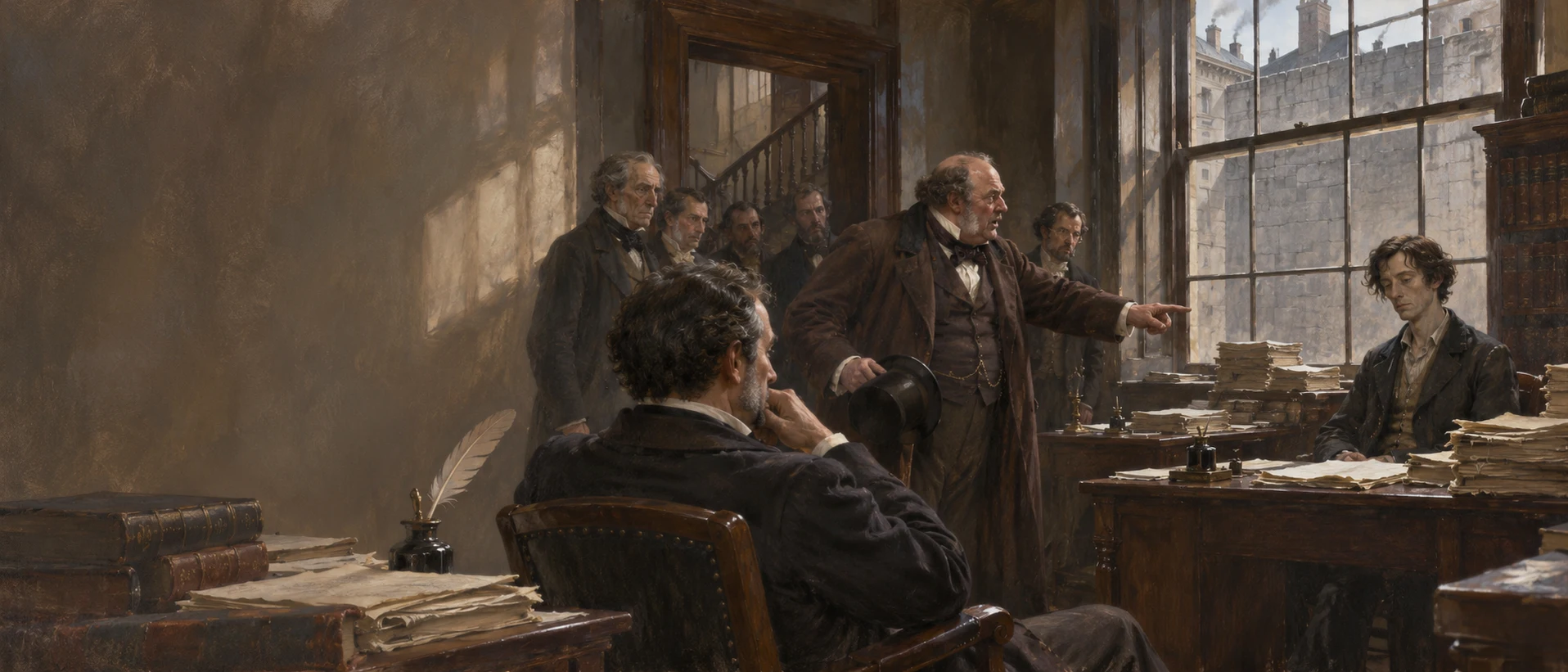
A lawyer asks his new copyist to help check a document. It is a routine request, the kind every clerk in the office answers a dozen times a day. Bartleby, without looking up, replies: “I would prefer not to.”
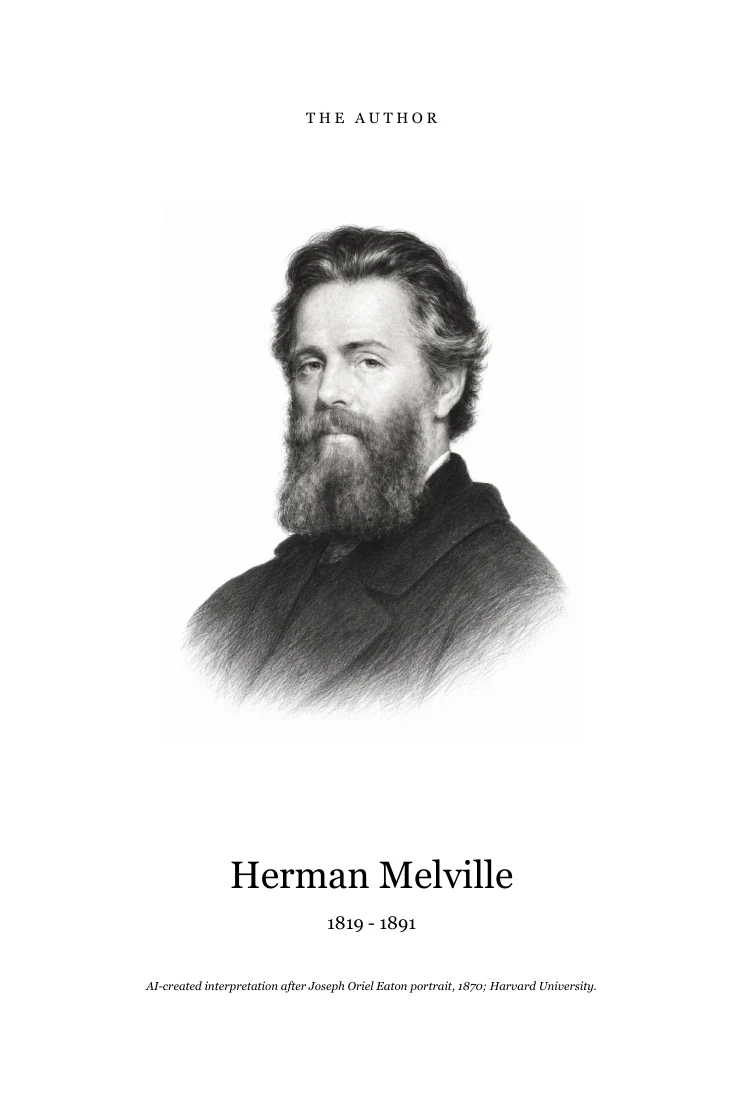
That is the origin of the phrase. It comes from Herman Melville’s Bartleby, the Scrivener: A Story of Wall-Street, published anonymously in two parts in Putnam’s Monthly Magazine in November and December 1853. Bartleby goes on saying it, in one form or another, to almost everything he is asked, and the story is about what happens to the man who has to hear it.
What happens in Bartleby, the Scrivener?
The narrator is an elderly lawyer who describes himself as a man of prudence and method, and who is a little too proud of having done work for John Jacob Astor. His office already holds two odd copyists, nicknamed Turkey and Nippers, whose tempers take turns to go wrong, morning and afternoon, plus a twelve-year-old errand boy called Ginger Nut. Into this comic little world comes a new scrivener, a pale, quiet young man who copies documents by hand with tireless care.
Then he stops cooperating. First he declines to check his copies. Later he declines to run errands, to answer questions about himself, and finally to copy at all. He never argues and never raises his voice. He simply prefers not to, and stays exactly where he is.
The lawyer tries everything a reasonable man can think of: patience, bribery, charity, logic, threats. Each attempt fails against the same mild sentence. The comedy darkens steadily, and by the last pages Melville has turned a farce about office manners into one of the saddest stories in American literature. The ending is best met unwarned.
Why does Bartleby say “I would prefer not to”?
He never explains. That is the point, and it is why the story has attracted so many readings. Critics have seen Bartleby as a study of depression, as a protest against the deadening labour of the Wall Street office, as a portrait of the narrator’s own buried conscience, and as Melville’s comment on his own position as a writer who no longer wished to produce what the market wanted.
That last reading has a basis in the dates. Moby-Dick (1851) and Pierre (1852) had both disappointed, and Melville was in debt to his publisher, Harper & Brothers. After the hostile reviews of Pierre he turned to short fiction for the magazines, and Bartleby was one of the first results. Scholars have also pointed to a newspaper advertisement for James A. Maitland’s The Lawyer’s Story, printed in New York in February 1853, as a likely spark: its opening chapter begins with a lawyer who has an unusual quantity of deeds to copy.
Somehow, of late I had got into the way of involuntarily using this word ‘prefer’ upon all sorts of not exactly suitable occasions.
Herman Melville, Bartleby, the Scrivener (1853)
Is it “I would prefer not to” or “I prefer not to”?
Both. Bartleby’s first refusals use the conditional, “I would prefer not to”, and that is the version everyone remembers. As the story goes on he sometimes drops the “would”, and the shorter form sounds harder, like a door closing. He also produces variations, such as “At present I would prefer not to be a little reasonable”, which is either a joke or the most melancholy sentence in the book, depending on your mood.
The politeness is what makes the line so unsettling. A shouted “I won’t” could be met with discipline. A soft preference, repeated without heat, leaves the employer with nothing to push against, and Melville lets us watch him flail.
Why it still feels modern
Very little in the story has dated. The narrator’s office has been converted into a world of open-plan desks and screens, but the situation is instantly recognisable: an employee who quietly withdraws, a manager whose kindness is mixed with self-interest, and colleagues who make jokes until the jokes stop being funny. Melville’s lawyer is never a villain. He is decent, anxious, a little vain, and completely unequipped for a man who will not play by the rules of exchange.
Bartleby is also Melville at his most controlled. Readers who struggled with the digressions of Moby-Dick often find this a surprise: it is a long short story, told by one voice, with not a wasted scene. If you want the whale afterwards, start with the real whale attack behind Moby-Dick and how to read Moby-Dick.
For other books of the city, see classic novels set in New York, where Bartleby sits beside Edith Wharton and O. Henry, and for fiction that counts the cost of making a living, classic novels about money.
But begin with Bartleby, the Scrivener. It takes an evening. Read the first refusal, notice how quickly you start rooting for the lawyer, and then notice how hard Melville makes it to keep doing so.
Questions readers ask
Who said “I would prefer not to”?
Bartleby, the copyist in Herman Melville’s story Bartleby, the Scrivener: A Story of Wall-Street (1853). He says it, or a version of it, whenever his employer asks him to do something.
When was Bartleby, the Scrivener published?
It appeared anonymously in Putnam’s Monthly Magazine in two parts, in November and December 1853. Melville reprinted it in his collection The Piazza Tales in 1856.
What is the meaning of Bartleby, the Scrivener?
Melville never explains Bartleby’s refusals, so the story is open to many readings: a portrait of depression, a criticism of office work on Wall Street, a study of the narrator’s conscience, or a reflection of Melville’s own refusal to write what the market wanted.
How long is Bartleby, the Scrivener?
It is a long short story, often called a novella, and most readers finish it in an hour or two.
 Moby-Dick560 pages · $24.99