
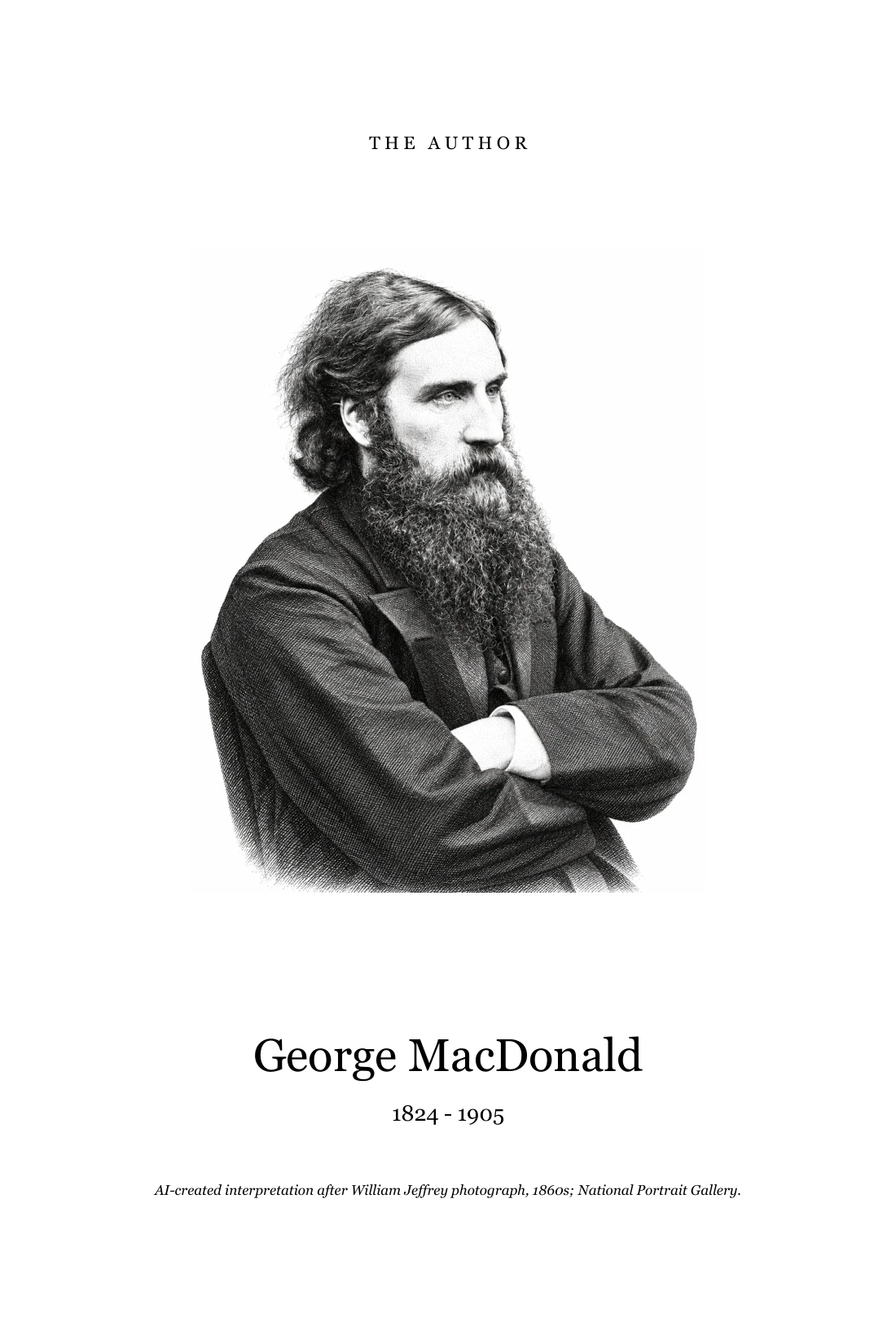
His father is Sir George Galbraith, a baronet by descent from a grant of King James VI, and a drunken cobbler in the back lanes of a granite city very like the Aberdeen where George MacDonald went to college. His son Gibbie runs the streets barefoot, sleeps where he can and helps anyone he finds in trouble. He is mute, and one of the happiest people in the book. Once, standing at a tavern window, he heard his father say two words, “Up Daurside”. Later, orphaned and in danger, Gibbie remembers them, and up the river he goes, towards the mountains.
That is how Sir Gibbie (1879) begins, and it is the first of a pair. George MacDonald’s Donal Grant (1883) is its sequel, following the herd-boy who befriends Gibbie in the hills and pays him for his help in poetry. Read them in that order: Sir Gibbie, then Donal Grant.
What happens in Sir Gibbie?
The first part is a city novel, as close to Dickens as MacDonald ever came. Gibbie lives among drinkers, beggars and a few kind women, and MacDonald makes him almost unbearably good: a child who will go hungry so that someone else can eat and never seems to notice that he is owed anything. Then the book moves to the hills. On Daurside, Gibbie is taken in by a crofter couple, Robert and Janet Grant, whose son Donal works as a herd on a neighbouring farm and is beginning to write poetry.
The first of the three original volumes ends at exactly that point, with Janet nursing the weals of a whipping the laird has ordered, and the Grants’ six grown-up children coming home for the evening to find a seventh asleep in their parents’ bed.
The second half is a story of inheritance, as lawyers and relations discover who Gibbie really is, and of his devotion to Ginevra Galbraith, daughter of the laird of Glashruach. MacDonald was a minister before he was a novelist, and the religious purpose of the book is plain; Gibbie is a kind of holy innocent. But the comedy is real, the landscape is beautifully done, and the dialogue, in the Scots of the north-east, gives the whole thing a voice of its own.

Is Donal Grant a sequel to Sir Gibbie?
Yes, though it is a different kind of book. Donal, now a graduate, walks out into the world looking for work and finds a post as tutor to the youngest son of Lord Morven at Castle Graham. The castle has talk of ghosts, unexplained music in the night and a family with secrets, and the novel shifts towards the Gothic, with Donal as the steady, plain-spoken outsider in a house full of fear. His pupil Davie and the young Lady Arctura become the centre of his life there.
MacDonald ties the two books together lightly. Early in Donal Grant, a cobbler asks Donal about himself, and Donal, in broad Scots, gives the credit for his education to his old friend under his full name.
A freen’--ye may a’ h’ard his name--sir Gilbert Galbraith--made the beginnin’ o’ a scholar o’ me, an’ noo I hae my degree frae the auld university o’ Inverdaur.
George MacDonald, Donal Grant (1883)
Gibbie writes to him, sends help and is talked about, but stays mostly offstage. Anyone who loved him in the first book will be glad of the glimpses.
Sir Gibbie and Donal Grant in order
- $22.99
Sir Gibbie
1879. A mute street child, a drunken baronet, a flight up the river and a life among the shepherds. MacDonald’s best-loved Scottish novel, and the one to start with.
- $23.99
Donal Grant
1883. Donal grown up, tutoring in a castle with a past. More mysterious and more grown-up than its predecessor, and the natural next step.


How do they fit with MacDonald’s other books?
Most readers now know MacDonald for his fantasies: Phantastes, At the Back of the North Wind and the Curdie books, covered in The Princess and the Goblin has a sequel. In his lifetime, though, much of his living came from novels like these, long, earnest and set in the Scotland he grew up in, which sold well on both sides of the Atlantic. C. S. Lewis, whose admiration did much to revive MacDonald in the twentieth century, is part of that story; see Did you know George MacDonald inspired both Tolkien and C. S. Lewis?
Both books are long, over five hundred pages each in our editions, and the Scots can take a chapter or two to tune into. Reading the dialogue aloud helps. For more novels from north of the border, see Scottish classics.
The first chapter of Sir Gibbie finds a small boy raking in the gutter of a granite city. Follow him up Daurside, and when his story is done, Donal is waiting on the road in Donal Grant.
Questions readers ask
Is Donal Grant a sequel to Sir Gibbie?
Yes. Donal Grant (1883) follows Gibbie’s friend Donal, the herd-boy of Sir Gibbie (1879), as he becomes a tutor at a Scottish castle. Gibbie is mentioned and helps from a distance.
Which should I read first, Sir Gibbie or Donal Grant?
Read Sir Gibbie first. Donal Grant stands alone as a story, but it assumes you know who Donal is and why he owes so much to Gibbie.
Why can’t Sir Gibbie speak?
Gibbie is mute from childhood. MacDonald never makes it a tragedy; Gibbie communicates through gesture and action, and Janet Grant later teaches him to read by writing words down for him.
What is Sir Gibbie about?
It follows Gilbert Galbraith, a mute and destitute boy in a Scottish city who is heir to a baronetcy, from the streets to the hills and on to his inheritance.
 The Princess and the Goblin142 pages · $12.99
 Phantastes190 pages · $13.99
 The Princess and Curdie144 pages · $12.99
 The Light Princess50 pages · $9.99