
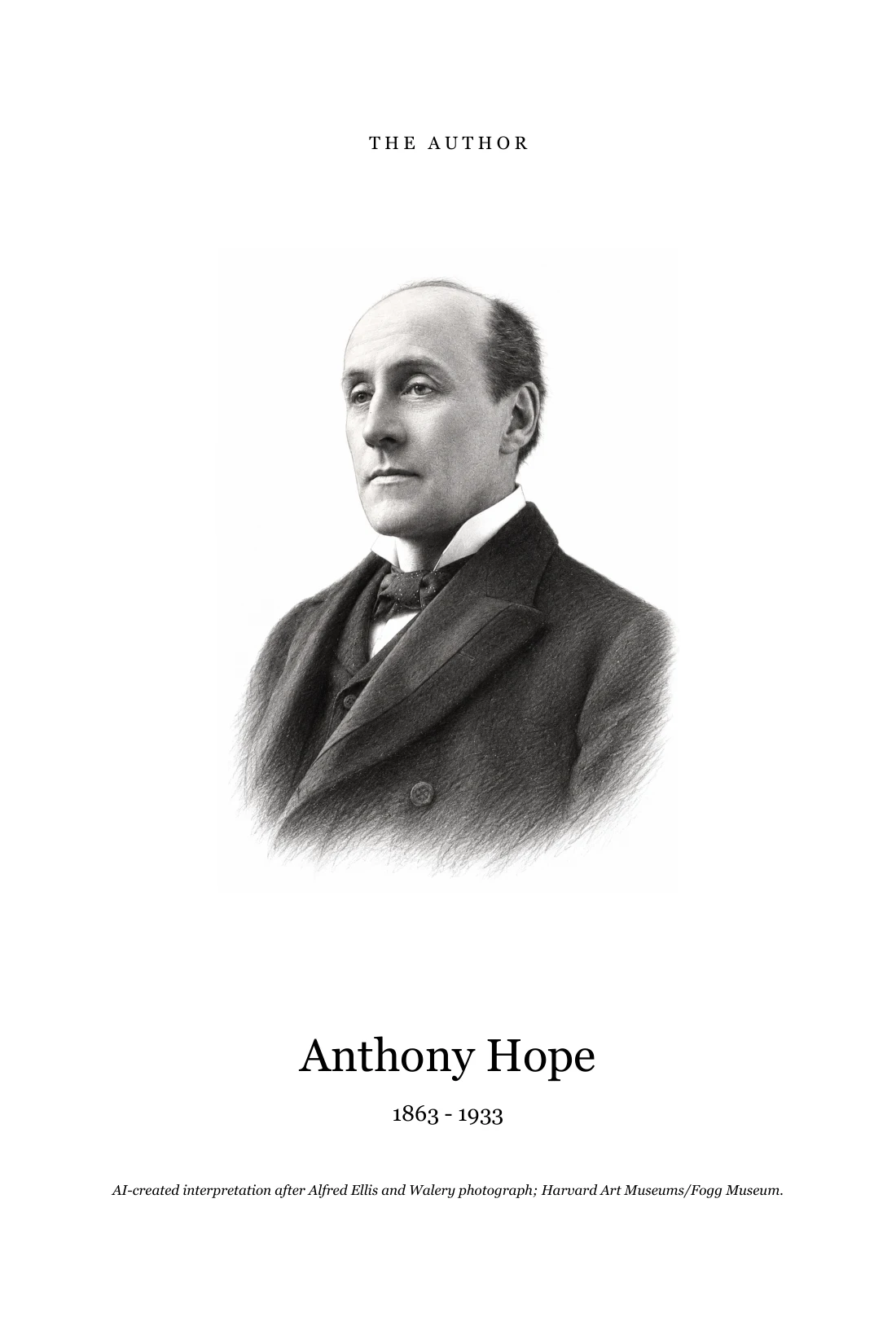
Anthony Hope wrote Rupert of Hentzau in 1895, barely a year after The Prisoner of Zenda had made him famous, and then readers had to wait. The sequel did not appear until 1898, after a run in The Pall Mall Magazine and McClure’s that began in December 1897. By then Ruritania was already a byword, and the man in the title had become the character everyone wanted more of.
The Prisoner of Zenda sequel is Rupert of Hentzau (1898), set three years after the first book. Anthony Hope also wrote The Heart of Princess Osra (1896), linked stories set in Ruritania’s past. Read Zenda first and Rupert second; Osra can be read at any point, though it means most once you know the Elphberg family.
The Ruritania books in order
- $12.99
The Prisoner of Zenda
1894. An idle English gentleman who happens to look exactly like the King of Ruritania is persuaded to take his place at the coronation. Swordplay, a castle with a moat and the beginning of Rupert’s career.
- $14.99
Rupert of Hentzau
1898. A letter from the queen falls into Rupert’s hands, and Rassendyll returns to Ruritania to get it back. Faster, more dangerous and more grown-up than Zenda.


The Heart of Princess Osra stands slightly apart. Its stories begin in the 1730s, under the old King Henry the Lion and then his son Rudolf the Third, and follow Rudolf’s red-haired sister Osra and the men who fall in love with her. It is also the century in which the Rassendyll family acquired its royal resemblance, which Zenda explains in its first chapter.

What happens in Rupert of Hentzau?
A small warning first: you cannot describe the sequel without revealing something of where Zenda leaves its characters. If you have not read the first book, skip to the next heading.
The story is told not by Rudolf Rassendyll but by his loyal friend Fritz von Tarlenheim, and the book is subtitled as his memoirs. Every year Fritz quietly meets Rassendyll to carry a message between him and the queen, and every year the secret holds. Then the queen writes one letter too many. Fritz sets out with it, his servant betrays him, and the letter ends up with Rupert of Hentzau, the exiled young nobleman who was the most dangerous of Black Michael’s men. Rupert means to use it to buy his way back into royal favour, and to wreck several lives in the process.
Head and hand were soon busy in turning the knowledge to account; scruples of the heart never stood in Rupert’s way.
Anthony Hope, Rupert of Hentzau (1898)
Rassendyll comes back to Ruritania, and the chase across Strelsau and Zenda that follows is as quick and brilliantly staged as anything in the first book. But the mood has changed. Zenda is a romance with a bittersweet ending. Rupert is a book about the cost of keeping secrets, and its last chapters are among the most affecting Hope ever wrote. The rest you should discover for yourself.
Is Rupert of Hentzau better than The Prisoner of Zenda?
Zenda is the purer adventure, and the one that invented a genre; we tell that story in Did you know “Ruritania” comes from The Prisoner of Zenda?. Rupert is the more interesting novel. Seen through Fritz’s eyes, Rassendyll is no longer just a dashing impostor but a man torn between love and honour, and the queen is far more than a prize to be won. Rupert himself is wittier and more reckless than ever, and his scenes crackle.
Many readers who come to the sequel expecting a lighter second helping find it the book that stays with them.

Rupert on screen
Rupert is a gift to actors, and the best ones have played him in film versions of Zenda: Ramon Novarro in Rex Ingram’s 1922 silent, Douglas Fairbanks Jr. opposite Ronald Colman in 1937, and James Mason opposite Stewart Granger in 1952, a remake that used the 1937 shooting script. The sequel itself was filmed in 1915 and again in 1923, when the Selznick version, with Lew Cody as Rupert, changed Hope’s ending.
Who was Anthony Hope?
Anthony Hope was the pen name of Anthony Hope Hawkins (1863–1933), a London barrister who conceived The Prisoner of Zenda while walking through London at the end of 1893 and finished a first draft in about a month. Its success let him give up the law for writing. He was knighted in 1918 for his work on wartime propaganda.
For more sword-and-cloak adventure, try Swashbuckling classics or the tangled sequels of What comes after The Three Musketeers?
Read The Prisoner of Zenda first, for the coronation, the castle and the first meeting with a villain who laughs at everyone. Then, three years on, let Fritz tell you what became of them all in Rupert of Hentzau.
Questions readers ask
Is there a sequel to The Prisoner of Zenda?
Yes. Rupert of Hentzau (1898) is the sequel, set three years later and narrated by Fritz von Tarlenheim. Anthony Hope also wrote a book of Ruritanian stories set earlier, The Heart of Princess Osra (1896).
What order should I read the Ruritania books in?
Read The Prisoner of Zenda (1894), then Rupert of Hentzau (1898). The Heart of Princess Osra, set in the 1730s, can be read before or after.
Who is Rupert of Hentzau?
He is the charming, ruthless young nobleman who serves Black Michael in The Prisoner of Zenda and returns as the title character of the sequel.