Robert Louis Stevenson kept a short list of the books he could not stop rereading. Shakespeare was on it, and Montaigne, and Molière. So was the third and last part of Alexandre Dumas’s musketeer saga, a book he admitted he had read “either five or six” times and which he thought the world had treated with baffling coldness. He first met it, he said, on some illustrated dessert plates in a hotel at Nice.
“No part of the world has ever seemed to me so charming as these pages, and not even my friends are quite so real, perhaps quite so dear, as d’Artagnan.”
Robert Louis Stevenson, “A Gossip on a Novel of Dumas’s”, Memories and Portraits (1887)
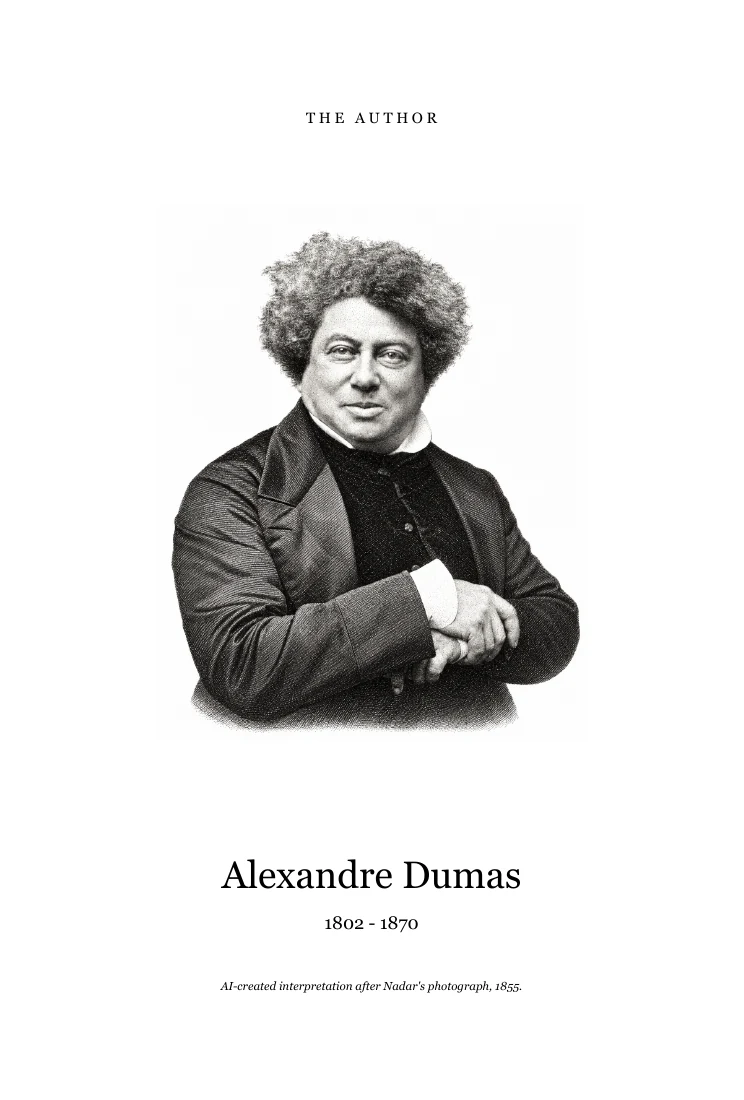
That book was Le Vicomte de Bragelonne, and it is the reason the question “what comes after The Three Musketeers?” has a complicated answer. Alexandre Dumas wrote two sequels. The first is a single novel. The second is so enormous that English publishers have nearly always cut it into pieces, and one of those pieces became famous under its own name: The Man in the Iron Mask.
The Three Musketeers sequels in order
Together the three novels are known as the d’Artagnan Romances, and they follow Dumas’s Gascon from his arrival in Paris as an eager eighteen-year-old to the last years of his career under Louis XIV.
Twenty Years After: the first sequel
Twenty Years After opens in 1648, in the regency of Anne of Austria. Richelieu is dead and his successor, Cardinal Mazarin, is loathed by Paris. D’Artagnan, despite everything he did for the queen, is still a lieutenant of musketeers, and his three friends have gone their separate ways: Athos to his estate near Blois, Porthos into a rich marriage, Aramis into the Church.
Mazarin sends d’Artagnan to round them up, and the old comrades find themselves on opposite sides of the uprising known as the Fronde. Then the story crosses the Channel, where the four become entangled in the last days of Charles I. Waiting for them in England is Mordaunt, the son of Milady, who knows exactly who took part in his mother’s death twenty years before. Many readers think it the best-plotted of the three books, and it is certainly the darkest.
The Vicomte de Bragelonne and The Man in the Iron Mask
The third novel, The Vicomte de Bragelonne, or Ten Years Later, ran in instalments for more than two years. It covers the early reign of Louis XIV: the restoration of Charles II, the fall of the king’s superintendent of finances, Nicolas Fouquet, the king’s love affair with Louise de la Vallière, and the plot that gives the final part its English title.
In English it is usually divided like this:
- Three-volume editions: The Vicomte de Bragelonne, Louise de la Vallière, The Man in the Iron Mask.
- Four-volume editions: The Vicomte de Bragelonne, Ten Years Later, Louise de la Vallière, The Man in the Iron Mask.
- Some editions split it into five or six volumes without separate titles.
Read in sequence, they are one continuous story, so The Man in the Iron Mask makes little sense on its own. The title character, Raoul, is Athos’s son, and even Stevenson admitted to finding him “so dreary a cavalier”. The real hero is still d’Artagnan, older, cannier and more alone, serving a young king he does not always admire.
Should you read the sequels?
You don’t have to. The Three Musketeers is complete in itself, and the ending is satisfying as it stands. But if you finish it wanting more of Athos’s melancholy and Porthos’s appetite, Twenty Years After gives you the four friends at their best and a plot as good as the original. The Bragelonne volumes are a longer commitment and a slower, more autumnal book, the one Stevenson loved precisely because it shows his heroes growing old.
Be warned that the later volumes are not cheerful at the end. Dumas brings the saga to a close, and he does not spare his heroes.
Film versions of the sequels
Most screen versions take liberties. The best known is Randall Wallace’s The Man in the Iron Mask (1998), with Leonardo DiCaprio in a dual role, Jeremy Irons as Aramis, John Malkovich as Athos, Gérard Depardieu as Porthos and Gabriel Byrne as d’Artagnan. It borrows the premise and characters but rewrites much of the plot.
For the real man behind the hero, see Did you know d’Artagnan was real?; for the time commitment, How long is The Three Musketeers?; and for the writer who worked with Dumas on all three novels, Alexandre Dumas’s collaborator.
But everything starts on a spring morning in 1625, in a market town on the road to Paris, with a young man on a yellow horse looking for a fight. Begin with The Three Musketeers, and decide at the end whether you are ready for the next fifty years.
Questions readers ask
What is the sequel to The Three Musketeers?
Twenty Years After (1845). It is followed by The Vicomte de Bragelonne (1847–1850), which completes Dumas’s d’Artagnan Romances.
What order should I read the Three Musketeers books in?
The Three Musketeers, Twenty Years After, then The Vicomte de Bragelonne. In English the last is usually split into The Vicomte de Bragelonne, (sometimes) Ten Years Later, Louise de la Vallière and The Man in the Iron Mask.
Is The Man in the Iron Mask a sequel to The Three Musketeers?
Yes. It is the final part of The Vicomte de Bragelonne, the second sequel, published in English as a separate volume. It follows on directly from the earlier parts of that novel.
Was there a fourth Three Musketeers book?
Not by Dumas with the musketeers in it. He began The Red Sphinx, set in the same period, but left it unfinished, and later sequels such as The Son of Porthos were written by other authors.
 The Count of Monte Cristo — Volume 1338 pages · $17.99
 The Count of Monte Cristo — Volume 2362 pages · $18.99
 The Count of Monte Cristo — Volume 3354 pages · $18.99
 The Count of Monte Cristo — Volume 4286 pages · $16.99