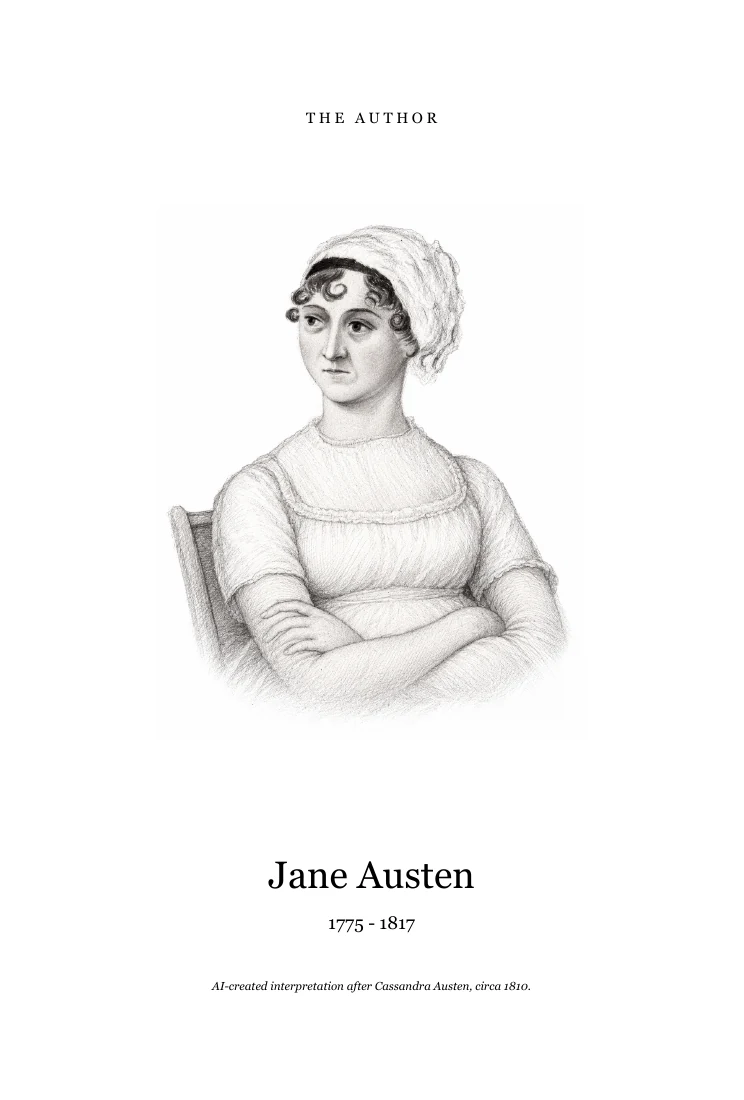
Jane Austen began the novel we know as Pride and Prejudice in October 1796, when she was twenty, and finished a first version the following August. She called it First Impressions, and it was read and loved within her family long before anyone else saw it.
In November 1797 her father, the Reverend George Austen, wrote to the London publisher Thomas Cadell offering a manuscript novel in three volumes, comparing its length to Fanny Burney’s Evelina. Cadell declined by return of post, apparently without reading it. The book went back into a drawer, and it would be 1813 before the public read a word of it.
Why was First Impressions renamed Pride and Prejudice?
Austen never explained the change, but two reasons are usually given. First, the title had been taken: another novel called First Impressions, by Margaret Holford, came out in 1800 or 1801 (bibliographies differ), and Austen would not have wanted to be confused with it. Second, the new title had a pedigree. The phrase “pride and prejudice” appears, in capitals, near the end of Burney’s Cecilia, a novel Austen admired, and many scholars think she borrowed it from there.
The new title also suits the revised book better. First Impressions points at the plot, Elizabeth Bennet’s instant dislike of Mr Darcy and her instant liking for Mr Wickham. Pride and Prejudice points at the characters, and leaves you to decide which of the two is proud and which prejudiced. The answer, of course, is both.

How Pride and Prejudice was finally published
Success came by a roundabout route. Austen’s first published novel was Sense and Sensibility, which itself is believed to have begun life in the 1790s as a story in letters called Elinor and Marianne. It appeared in 1811, “By a Lady”, from the publisher Thomas Egerton, and did well enough that Egerton bought the copyright of her next book outright.
Pride and Prejudice was published on 28 January 1813, “By the Author of Sense and Sensibility”. When her own copy arrived, Austen wrote to Cassandra in delight:
I have got my own darling child from London.
Jane Austen, letter to Cassandra Austen, January 1813
It sold well and was widely praised, though her name never appeared on any of her novels in her lifetime.
What is Pride and Prejudice like to read today?
Wonderfully quick and funny. Much of the novel is dialogue, and Austen’s narrator is dry, sharp and constantly amused by her characters, beginning with one of the most quoted first lines in English fiction:
It is a truth universally acknowledged, that a single man in possession of a good fortune, must be in want of a wife.
Jane Austen, Pride and Prejudice (1813)
If you have only seen adaptations, the book gives you far more of Elizabeth’s mind: her quick judgements, her pleasure in her own cleverness, and the slow, uncomfortable process of realising she has been wrong. It is the ideal first Austen for almost any reader, from teenagers upwards. And it is worth remembering, as you laugh, that most of it was first imagined by a young woman in a country rectory in Hampshire, whose family were its first and most delighted readers.
The supporting cast is half the fun: Mr Collins, the pompous clergyman who proposes with a prepared speech; Lady Catherine de Bourgh, who expects to be obeyed by everyone; and Mr Bennet, whose dry wit hides a real failure as a father. Austen lets you laugh at all of them while never forgetting the pressure on five daughters without fortunes, in a world where marriage was the only secure future most young women could hope for.
Pride and Prejudice
1813. Elizabeth Bennet and Mr Darcy get off to a very bad start. Austen’s most famous novel, first drafted as First Impressions.
Sense and Sensibility
1811. Austen’s first published novel, about two sisters, one all sense and one all feeling. It too began in the 1790s under another title.


Where to go next
Austen’s working titles are a game in themselves: Northanger Abbey was first called Susan, sold to a publisher in 1803 and then left unpublished for years. Find all six novels in Did you know Jane Austen published only six novels? Every one, in order, and read about Northanger Abbey’s gothic jokes in Did you know Northanger Abbey pokes fun at The Mysteries of Udolpho?. If it is the sparring you love, try the best enemies-to-lovers classics.
But if you have never read it, begin here. Open Pride and Prejudice, and see how long your own first impressions last.
Questions readers ask
What was the original title of Pride and Prejudice?
First Impressions. Jane Austen wrote the first version under that title between 1796 and 1797, and renamed it before publication in 1813.
Why did Jane Austen change the title from First Impressions?
She did not say, but another novel called First Impressions appeared in 1800 or 1801, and the phrase “pride and prejudice” had been used prominently in Fanny Burney’s Cecilia, which she admired.
How old was Jane Austen when she wrote Pride and Prejudice?
She was twenty when she began it in 1796 and twenty-one when she finished the first draft. She revised it in her mid-thirties before it was published in 1813.
 Emma390 pages · $19.99
 Persuasion202 pages · $14.99
 Northanger Abbey196 pages · $13.99
 Mansfield Park376 pages · $19.99