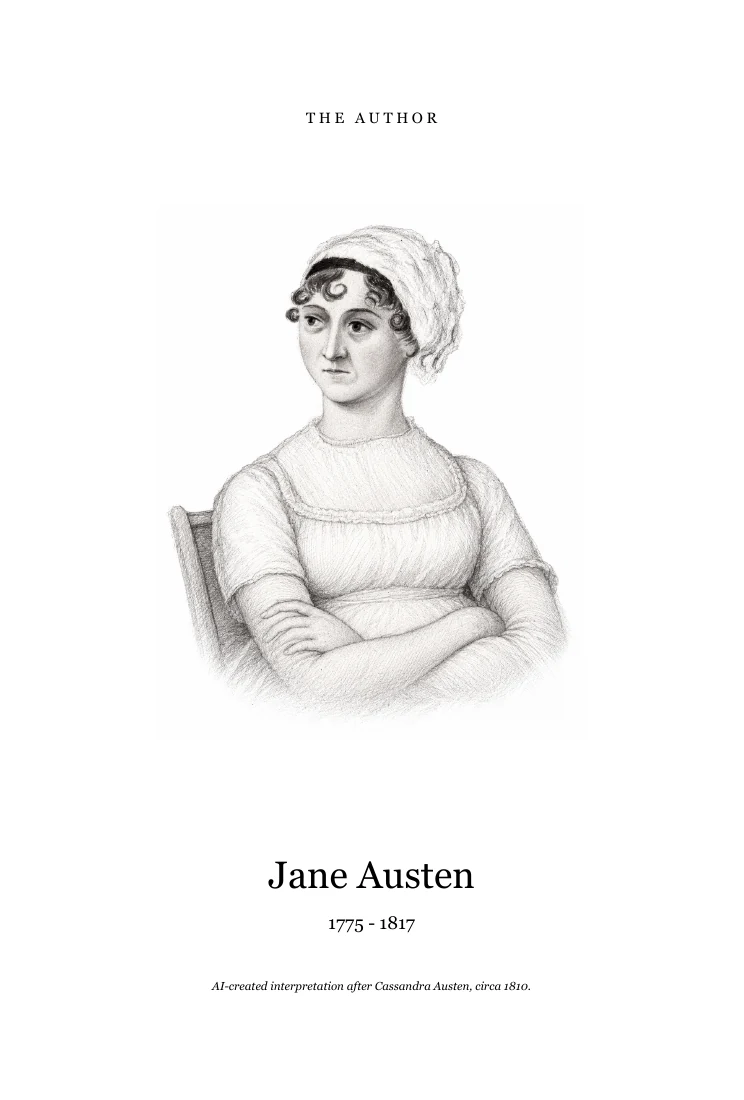
When her first copy of Pride and Prejudice arrived from London in January 1813, Jane Austen wrote to her sister Cassandra about the editing. “I have lop’t and crop’t so successfully, however,” she said, “that I imagine it must be rather shorter than ‘Sense and Sensibility’ altogether.”
She was not far off. In our edition Pride and Prejudice runs to 372 pages, which the book card estimates at about seven hours of reading. By our count of the Project Gutenberg texts the novel is about 122,000 words long, only around 3,000 words more than Sense and Sensibility. Either way it is a book most people can read in a week of evenings: six to ten hours, depending on your pace.
How long does it take to read Pride and Prejudice?
Nobody reads at a standard speed, so take these as estimates rather than rules. The card simply allows an hour for every fifty pages. The psychologist Marc Brysbaert, reviewing almost two hundred studies in 2019, put the average adult’s silent reading speed for fiction at about 260 words a minute, with most people between 200 and 320. For Pride and Prejudice that comes to about 6¼ hours for a fast reader, 7¾ for an average one and 10 for a slow one.
Austen tends to read quickly. Much of the novel is dialogue, the chapters are short and the jokes come thick and fast. An hour a day finishes it in about a week; a long weekend with nothing else to do will do the same.

How many chapters are in Pride and Prejudice?
Sixty-one, and they are brisk. By our count they average about 2,000 words, roughly eight minutes each, and the shortest are barely 800 words. That makes the novel ideal for reading in small pieces: a chapter on the bus, a couple at lunch, three or four before bed. The longest chapter, chapter 18, is the Netherfield ball, where much of the book’s early tension comes to a head, and it still takes only about twenty minutes.
Austen’s own letter explains part of the speed. She admitted that a “said he” or a “said she” would sometimes make the dialogue clearer, then waved the point away: she did not write, she said, for “such dull elves” as lacked ingenuity themselves. The conversations run on with very little stage direction, and readers move through them almost as fast as they would listen to them. She also conceded that the second of the three volumes was “shorter than I could wish”, though she thought the difference more in look than in reality.
Did Austen think it was too short?
A few days after her first letter she wrote to Cassandra again, half pleased and half teasing herself. Having heard the book read aloud, she decided it was perhaps too bright for its own good:
The work is rather too light and bright and sparkling: it wants shade; it wants to be stretched out here and there with a long chapter of sense, if it could be had
Jane Austen, letter to Cassandra Austen, 4 February 1813
She went on to suggest, tongue in cheek, that it might have been padded out with “an essay on writing, a critique on Walter Scott, or the history of Buonaparte”. Readers have been grateful ever since that she didn’t. The lightness is the point, and it is a large part of why the book is so quick to read.
How does it compare with Austen’s other novels?
It sits in the middle of her six. In our editions, Northanger Abbey (196 pages) and Persuasion (202) are the shortest, then Sense and Sensibility (300), Pride and Prejudice (372), Mansfield Park (376) and Emma, the longest at 390. Page counts depend on layout as well as length, which is why Sense and Sensibility looks so much shorter here than the word counts suggest. Our guide to Jane Austen’s novels in order explains where to go next.
Pride and Prejudice
372 pages, 61 short chapters. The Bennet sisters, Mr Darcy, Mr Collins and Lady Catherine, in Austen’s quickest and funniest novel. A week of evenings.
Sense and Sensibility
Austen’s first published novel, which she thought would be the longer of the two. Elinor and Marianne Dashwood, sense and sensibility in two sisters.
Emma
At 390 pages, the longest of the six, and the one with the most self-deceived heroine. Read it after Pride and Prejudice to see how far Austen pushed her art.


Before you begin
The story of the book’s first title is in Did you know Pride and Prejudice was first called First Impressions?, and if you have only seen it on screen, Pride and Prejudice on screen compares the versions. For a novel twice the size, try How long is Jane Eyre?
But you don’t need a plan for this one. Open Pride and Prejudice on a free evening, read the first chapter, in which Mrs Bennet cannot stop talking about Mr Bingley, and you will probably still be reading at midnight.
Questions readers ask
How many pages is Pride and Prejudice?
Our edition runs to 372 pages. Other editions vary with type size, notes and illustrations.
How many words are in Pride and Prejudice?
About 122,000 words, by our count of the Project Gutenberg text. That makes it a little longer than Sense and Sensibility, and much shorter than most Victorian classics.
How long does it take to read Pride and Prejudice?
Most readers need about six to ten hours. At an average fiction reading speed of 260 words a minute it takes around eight hours, or about a week at an hour a day.
How many chapters are in Pride and Prejudice?
There are 61 chapters, originally published across three volumes. Most are short, averaging around 2,000 words.
 Persuasion202 pages · $14.99
 Northanger Abbey196 pages · $13.99
 Mansfield Park376 pages · $19.99
 Lady Susan88 pages · $10.99