

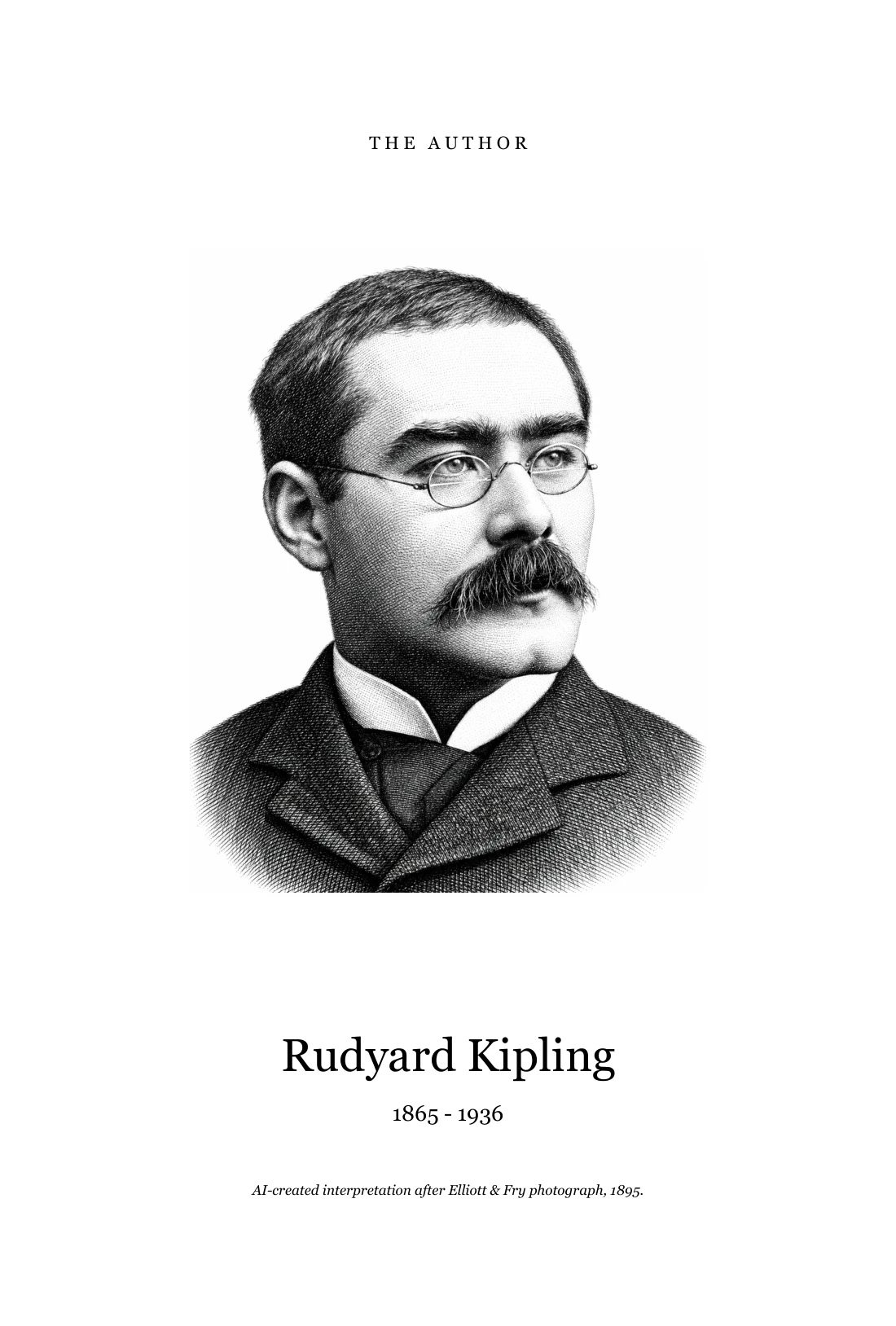
Where did Mowgli come from? Rudyard Kipling answered the question himself, late in life, in his memoir Something of Myself. In the winter of 1892, he recalled, three things came together in his head: a story he had already written about a forest officer in India who meets a wolf-boy, a memory of a magazine tale from his childhood about a hunter who falls among a society of lions, and “a phrase” in H. Rider Haggard’s Nada the Lily. Out of the mixture came the Mowgli stories.
Nada the Lily had been published earlier that year, in 1892. Kipling was more specific in a letter to Haggard himself, pointing to a particular passage about wolves: that, he said, was where he “got the notion”. The two men had been friends since Kipling arrived in London in 1889, and remained friends for life.
What is the wolf passage in Nada the Lily?
Nada the Lily is a story within a story. A traveller sheltering from snow in Natal, the winter before the Zulu War, listens to an ancient witch-doctor named Mopo tell the tale of his life at the court of the Zulu king Chaka. Its hero is Umslopogaas, a fierce young warrior, and in the middle of the book he meets Galazi the Wolf, who lives on a haunted peak called Ghost Mountain and rules a pack of ghost-wolves.
Galazi explains how he came to be their king. As a young man he climbed into a cave on the mountain and found, sitting in a high niche in the wall, the withered body of a man who had died there. Below him, two great wolves, a grey-streaked old dog and a she-wolf, were leaping again and again at the dead man’s hanging foot.
From month to month and year to year the wolves had ravened there, seeking to devour the bones of him who sat above. Night upon night they had leaped thus against the wall of the cave, but never might their clashing jaws close upon his foot.
Galazi the Wolf, in H. Rider Haggard’s *Nada the Lily* (1892)
Galazi kills the wolves and takes the pack for his own, and later he and Umslopogaas become the Wolf-Brethren, running at night at the head of the wolves. What struck Kipling is plain enough: a human being who belongs to a wolf pack, and wolves with a life, a law and a leader of their own.

How different are Haggard’s wolves from Kipling’s?
Almost opposite, which is the interesting part. Haggard’s pack is supernatural, said to be the spirits of wicked men, and Galazi rules it by magic. Kipling’s wolves are animals with a code: the Seeonee pack meets at the Council Rock under its old leader Akela, debates whether to accept the naked man-cub who has toddled into a wolf’s cave, and lives by the Law of the Jungle. The idea that set Kipling going came from a ghost story; what he made of it was something closer to natural history.
The timing fits. Kipling wrote the first Mowgli story, “Mowgli’s Brothers”, in November 1892 in Brattleboro, Vermont, a few months after Nada the Lily appeared. The Jungle Book followed in 1894. Our post on Kipling’s Vermont years tells that side of the story, and Did you know there are two Jungle Books? covers the rest of Mowgli’s life, including that first forest-officer story, “In the Rukh”.
Is Nada the Lily worth reading for its own sake?
Yes, and some of Haggard’s admirers rank it as his finest book. The critic E. F. Bleiler called it generally considered his best work, a sustained and tragic story. It was also unusual for a Victorian novel: apart from the listener in the frame story its whole cast is African, and the real Zulu kings Chaka and Dingane are at the centre of it, along with real events such as the assassination of Chaka. Umslopogaas, Galazi and Nada herself are invented. Umslopogaas had already appeared, as an old warrior, in Allan Quatermain (1887), and Nada the Lily tells the story of his youth.
Haggard knew South Africa from years in colonial service there, and he dedicated the book to “Sompseu”, the Zulu name of Sir Theophilus Shepstone, on whose staff he had worked. That background gives the novel its detail and its limits. It is a British imperial writer’s imagining of Zulu history, full of admiration and violence, and readers will meet attitudes of its time. Taken on those terms, it is a powerful, strange and often moving book.
Nada the Lily
1892. The rise of Chaka, the love of Umslopogaas for Nada, and the Wolf-Brethren of Ghost Mountain, told by an old witch-doctor. Haggard’s darkest African romance.
The Jungle Book
1894. Mowgli, Baloo, Bagheera and the Seeonee wolves, with “Rikki-Tikki-Tavi” and “The White Seal” besides. The book Haggard’s ghost-wolves helped set in motion.
Allan Quatermain
1887. The sequel to King Solomon’s Mines, in which the aged Umslopogaas fights beside Allan Quatermain. Read it to meet the old warrior whose youth Nada the Lily describes.


For more on Haggard, start with Was King Solomon’s Mines really written on a bet?, or work through the Allan Quatermain books in order.
Then read the two books together. Open Nada the Lily at the chapters on Ghost Mountain, and The Jungle Book at “Mowgli’s Brothers”, and watch one writer’s idea turn into another’s.
Questions readers ask
Did Nada the Lily inspire The Jungle Book?
In part. Kipling said that a phrase in Nada the Lily was one of the things that started him on the Mowgli stories, and he told Haggard in a letter that a passage about Galazi and his wolves was where he got the idea.
What is Nada the Lily about?
It is a historical romance set in the Zulu kingdom of Chaka, telling the story of the warrior Umslopogaas, his love for the beautiful Nada, and his brotherhood with Galazi, king of a pack of ghost-wolves.
When was Nada the Lily published?
In 1892. Kipling wrote the first Mowgli story later the same year, and The Jungle Book was published in 1894.
 King Solomon's Mines222 pages · $14.99
 She284 pages · $16.99
 Eric Brighteyes292 pages · $16.99
 The People of the Mist388 pages · $19.99