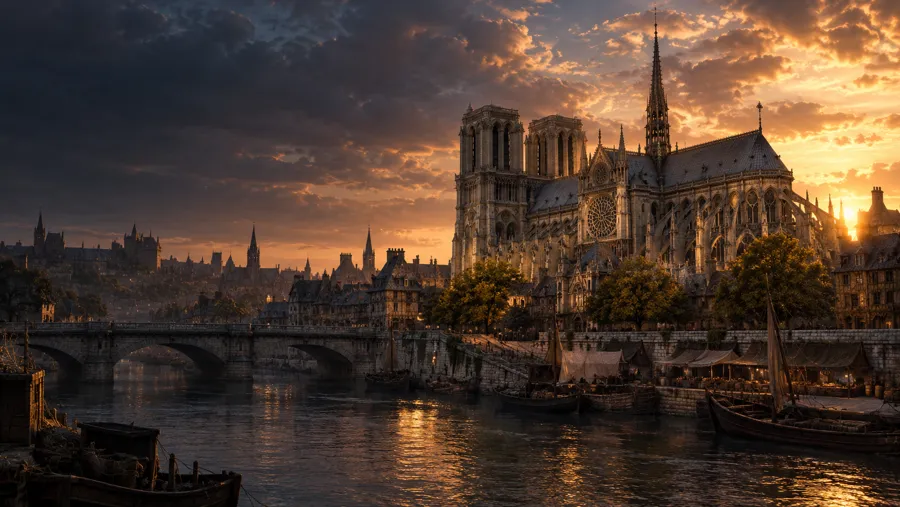
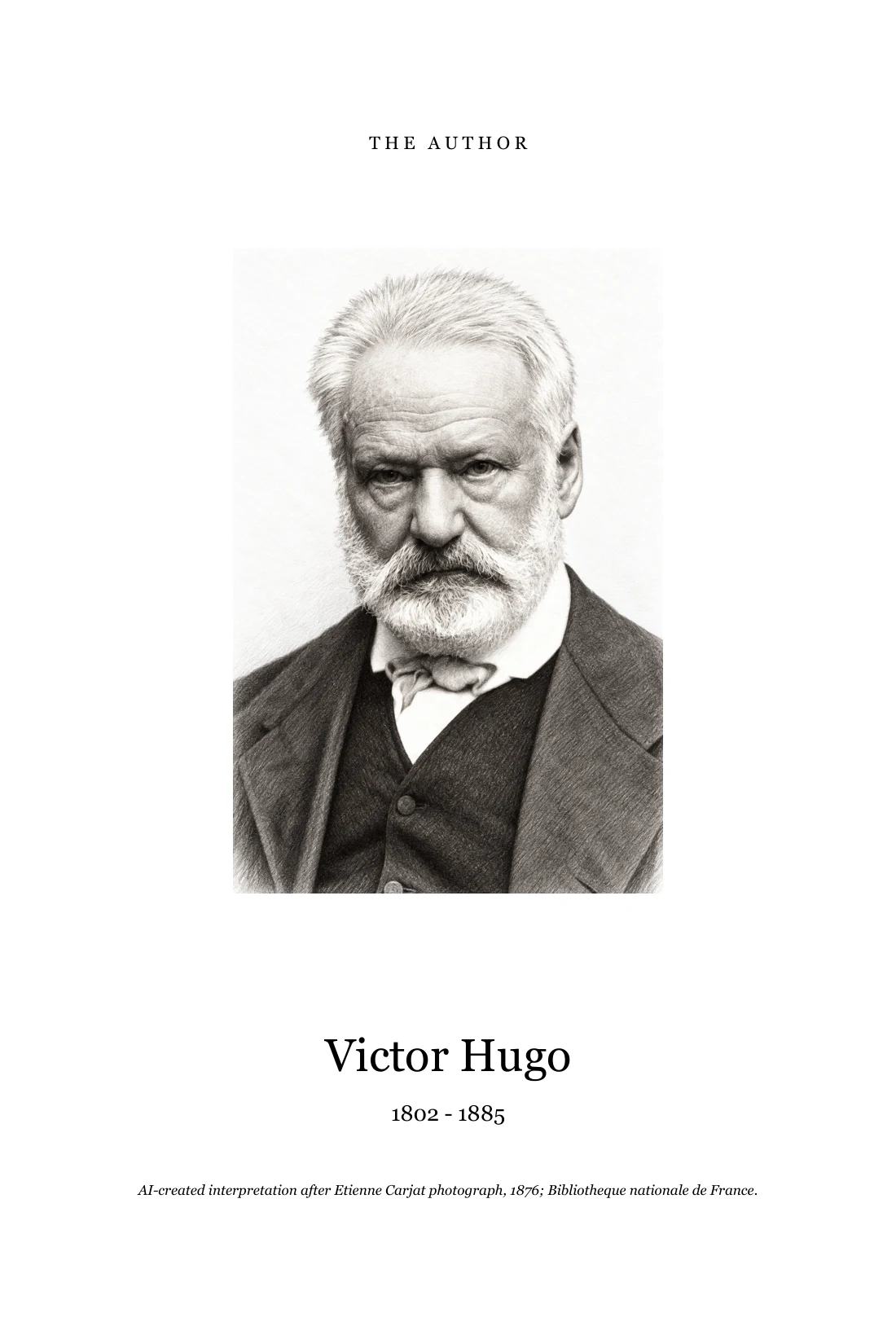
Rummaging about one of the towers of Notre-Dame a few years before he wrote his novel, Victor Hugo found a single Greek word cut into the stone of an obscure nook: Ananke, “fate”. Afterwards the wall was whitewashed or scraped down, and the word was gone. That small loss is the first thing he tells us in the preface to Notre-Dame de Paris, and he ends the thought with a warning that the whole building might follow.
the word, in its turn, has been effaced from the wall of the church; the church will, perhaps, itself soon disappear from the face of the earth.
Victor Hugo, Notre-Dame de Paris, Preface (trans. Isabel F. Hapgood)
It did not. The novel was published in March 1831, became a huge success, and is widely credited with rousing the French public to the state of its medieval buildings. By 1844 the king, Louis-Philippe, had ordered it restored. No single book saves a cathedral on its own, but this one changed how a country looked at it.
What state was Notre-Dame in before Hugo’s novel?
Poor, and getting worse. During the Revolution the cathedral was rededicated in 1793 to the Cult of Reason, its treasures were looted, and the statues of biblical kings across the west front were beheaded by crowds who took them for kings of France. Its medieval spire had already been taken down in 1786. In the decades after Napoleon the fabric decayed, and by some accounts there was even talk of pulling the building down.
Hugo blamed people more than time. In the chapter he devotes to the cathedral he lists the damage done by revolution, by fashion and above all by architects who “improved” Gothic churches with classical additions.
On the face of this aged queen of our cathedrals, by the side of a wrinkle, one always finds a scar.
Victor Hugo, Notre-Dame de Paris, Book Third, Chapter I
A novel with a building for its hero
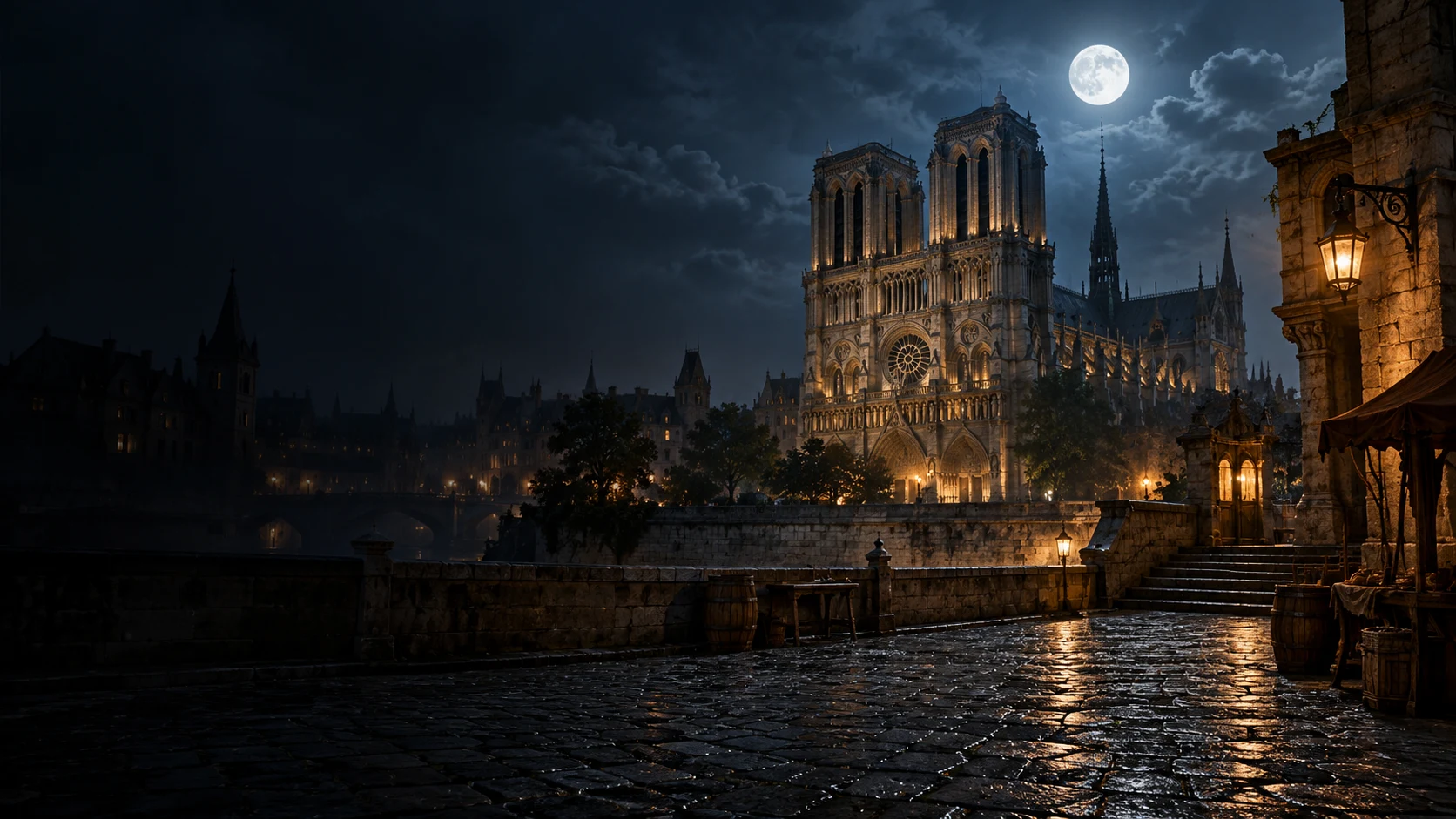
The English title, The Hunchback of Notre-Dame, comes from Frederic Shoberl’s translation of 1833, and it has steered readers towards Quasimodo ever since. Hugo’s own title points elsewhere. The story is set in 1482, and the cathedral is its true centre: the place where Quasimodo rings the bells, where Esmeralda seeks sanctuary, and from whose towers the city is laid out for the reader street by street.
Hugo even stops the plot to argue about architecture. In the chapter called “This Will Kill That”, the archdeacon looks from a printed book to the cathedral and predicts that the book will kill the building — that print will replace stone as the way a civilisation records its ideas. It is a strange, brilliant digression in a melodrama, and it explains why Hugo cared so much. To him, Notre-Dame was a book in stone that could not be reprinted once it was gone.
How did Notre-Dame get restored?
The novel’s popularity helped feed a growing movement to protect France’s historic buildings, and with it a new enthusiasm for Gothic architecture. In 1844 Louis-Philippe ordered the restoration of the cathedral, and two architects, Jean-Baptiste Lassus and Eugène Viollet-le-Duc, took charge. Lassus died in 1857 and Viollet-le-Duc carried on alone.
- 1786
The cathedral’s 13th-century spire is removed
- 1793
Notre-Dame is rededicated to the Cult of Reason, and the west front statues are beheaded
- 1825
Hugo writes his first “Guerre aux démolisseurs”
- Mar 1831
Notre-Dame de Paris is published
- 1833
Frederic Shoberl’s English translation appears as The Hunchback of Notre-Dame
- 1844
Louis-Philippe orders the restoration; Lassus and Viollet-le-Duc are appointed
- 1864
The main restoration work is completed
- Apr 2019
Fire destroys the roof and Viollet-le-Duc’s spire
- Dec 2024
The cathedral reopens
The restoration was ambitious and sometimes inventive. Viollet-le-Duc replaced the long-lost medieval spire with a taller, more ornate one of his own design, and it was this spire that collapsed in the fire of 15 April 2019. When the cathedral reopened in December 2024, the building Hugo feared for had come through a second near-disaster.
Should you read the book if you know the film?
Yes, though expect a shock. Hugo’s novel is darker than any of the screen versions, funnier in its crowd scenes, and far more interested in Paris itself. It takes its time: a whole chapter is a bird’s-eye tour of the medieval city. If that sounds like a detour, it is the detour Hugo wrote the novel to make.
For more of the city, see Classic novels set in Paris, or Did you know there really is water under the Paris Opera? for another Paris landmark that became a novel. Our guide to Disney films based on classic books compares Hugo’s tragedy with the 1996 animated film.
Read the preface, then turn to the chapter on the cathedral itself. By the time Quasimodo climbs to his bells, you will understand why a nation went back and looked at Notre-Dame again.
Questions readers ask
Did Victor Hugo save Notre-Dame?
Hugo’s 1831 novel is widely credited with raising public concern for the decaying cathedral and for France’s medieval buildings generally. The restoration itself was ordered in 1844 and led by Lassus and Viollet-le-Duc.
When was The Hunchback of Notre-Dame written?
Victor Hugo’s novel was published in Paris in March 1831 as Notre-Dame de Paris. The English title The Hunchback of Notre-Dame comes from Frederic Shoberl’s 1833 translation.
When is The Hunchback of Notre-Dame set?
The novel is set in Paris in 1482, during the reign of Louis XI, and opens on 6 January of that year.
 Toilers of the Sea470 pages · $21.99