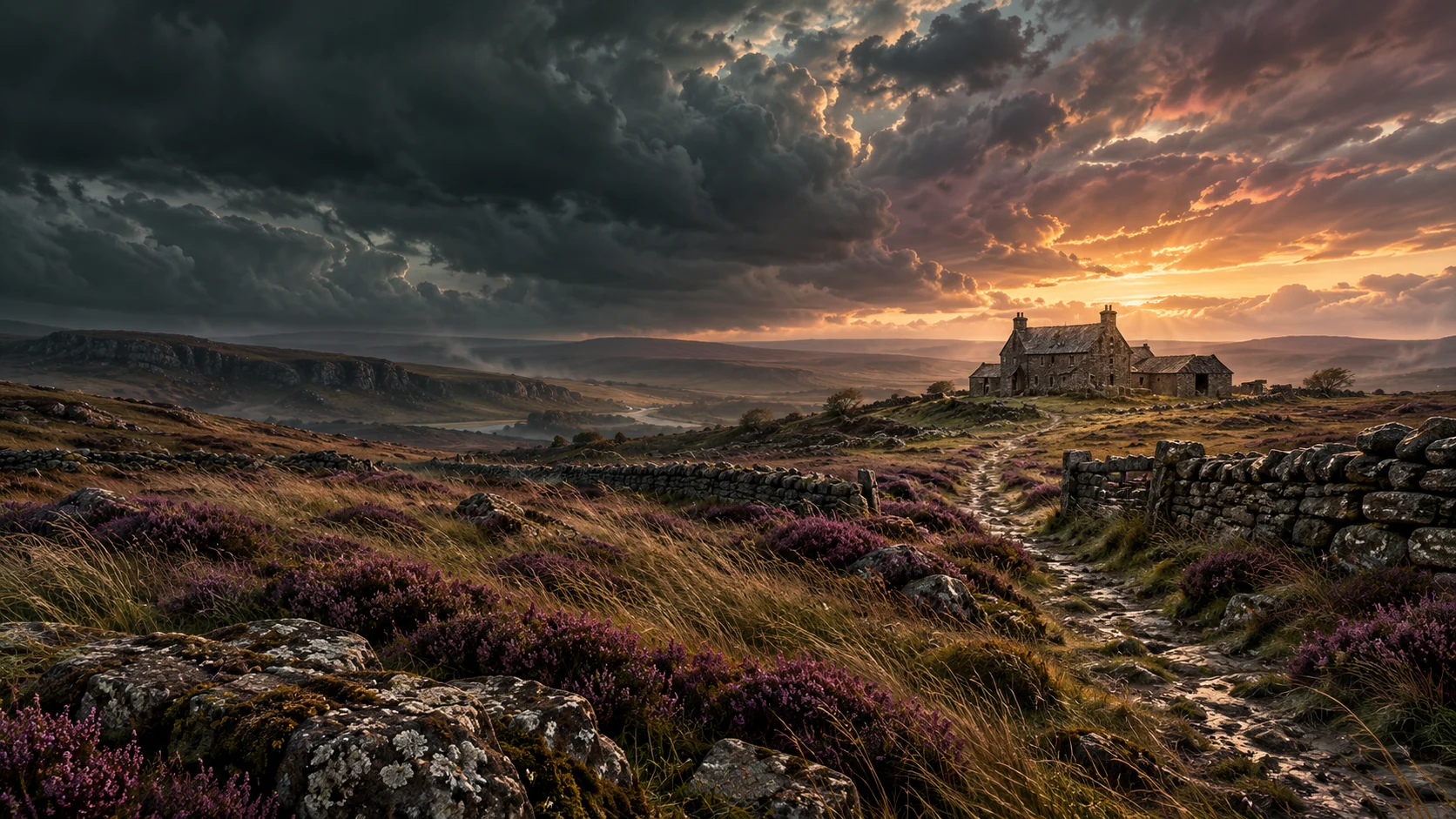
A self-declared misanthrope rents a lonely house on the Yorkshire moors in the winter of 1801. He walks over to visit his landlord, is stranded by snow, and stumbles home the next morning benumbed to the heart. Soon he is ill, and the doctor tells him he will not be out of doors until spring. And so, through the long evenings, the housekeeper sits with him and tells him the history of the family at Wuthering Heights, a little at a time.
That is the frame of Emily Brontë’s only novel, and it is also the best answer to how long the book takes. Our edition of Wuthering Heights runs to 330 pages; budget an hour per fifty, as our book cards do, and that is a little under seven hours. Like Mr Lockwood, you are unlikely to take it in one go, and the novel shows you where to stop.
I have now heard all my neighbour’s history, at different sittings, as the housekeeper could spare time from more important occupations.
Emily Brontë, Wuthering Heights (1847)
How many chapters are in Wuthering Heights?
Thirty-four. They were first published in late 1847 in two volumes, with Anne Brontë’s Agnes Grey making up a third, by the London publisher Thomas Cautley Newby. The first volume held chapters 1 to 14 and the second chapters 15 to 34. When Charlotte Brontë prepared a new edition in 1850, after Emily’s death, the chapters were renumbered as a single run, which is how most editions present them today.
That old volume break still matters. The first volume ends with Lockwood alone again, the housekeeper gone downstairs to fetch the doctor, and him resolving to beware of the eyes of the young woman at the Heights. The second begins a week later, with the line quoted above. The pause in the printing is a pause in the telling too.
Where are the natural stopping points?
Brontë marks them herself. Each time the story breaks off, Lockwood steps back in, and those moments make the best places to close the book. Read it in four sittings, none of them much over two hours:
- Chapters 1–9: Lockwood’s two disastrous visits, the night in the panelled bed, and the start of Nelly Dean’s story, the arrival of a dark-haired foundling from Liverpool and the childhood that follows. It ends when Nelly glances at the clock.
- Chapters 10–14: Lockwood’s illness, Heathcliff’s return after three years away, and a household coming apart. This was the end of the first volume.
- Chapters 15–24: the second volume’s most famous scenes, and then a new generation, led by the daughter Lockwood met at the Heights and the cousins around her.
- Chapters 25–34: Nelly’s tale catches up with the present, Lockwood leaves, and a final visit in 1802 shows him how it ends.
Why does Wuthering Heights feel hard to follow?
Partly because of the names. Brontë gives two generations very similar ones: there are two Catherines, a Linton who is a surname and a Linton who is a first name, and a Hareton whose name is carved over the door. Readers who sketch a small family tree after the first few chapters usually find the second volume much easier going.
The other difficulty is Joseph, the old servant, whose thick Yorkshire dialect Brontë spelled out phonetically. Charlotte toned his speeches down for the 1850 edition, worried that southern readers would find them unintelligible. If he slows you, read his lines aloud; the sense usually comes through. Neither problem makes the book long. At 330 pages it would fit into our Bleak House more than twice over, and its pace, once Nelly gets going, is fierce.
Wuthering Heights
1847. Two houses on the moors, two generations and a love that will not stay buried, told by a housekeeper who was there for most of it.
Agnes Grey
1847. The novel bound in alongside Wuthering Heights as its third volume: Anne Brontë’s quiet, sharp account of a governess and the families who employ her. At 186 pages, a short companion.
Jane Eyre
1847. Charlotte’s novel, published a few weeks before her sisters’ books and a success from the start. Longer than Wuthering Heights by about 130 pages in our editions.


Readers did not know what to make of it in 1847, and you can read their verdicts in how Wuthering Heights was first reviewed. The pen names under which all three sisters published are explained in the Brontë sisters’ pen names, and if you want to compare it with Charlotte’s most famous book, see how long is Jane Eyre.
Find a dark evening and knock at the door with Lockwood. Wuthering Heights begins with a date, 1801, and four sittings later you will understand why the house never lets anyone go.
Questions readers ask
How long does it take to read Wuthering Heights?
Six to seven hours is a fair guess. Our 330 pages, at fifty an hour, come to just under seven.
How many chapters does Wuthering Heights have?
Thirty-four. In the first edition of 1847 they were split across two volumes, chapters 1 to 14 and 15 to 34.
Who narrates Wuthering Heights?
Mr Lockwood, a tenant at Thrushcross Grange, tells the frame story, but most of the novel is the housekeeper Nelly Dean’s account of the families, as she tells it to him.