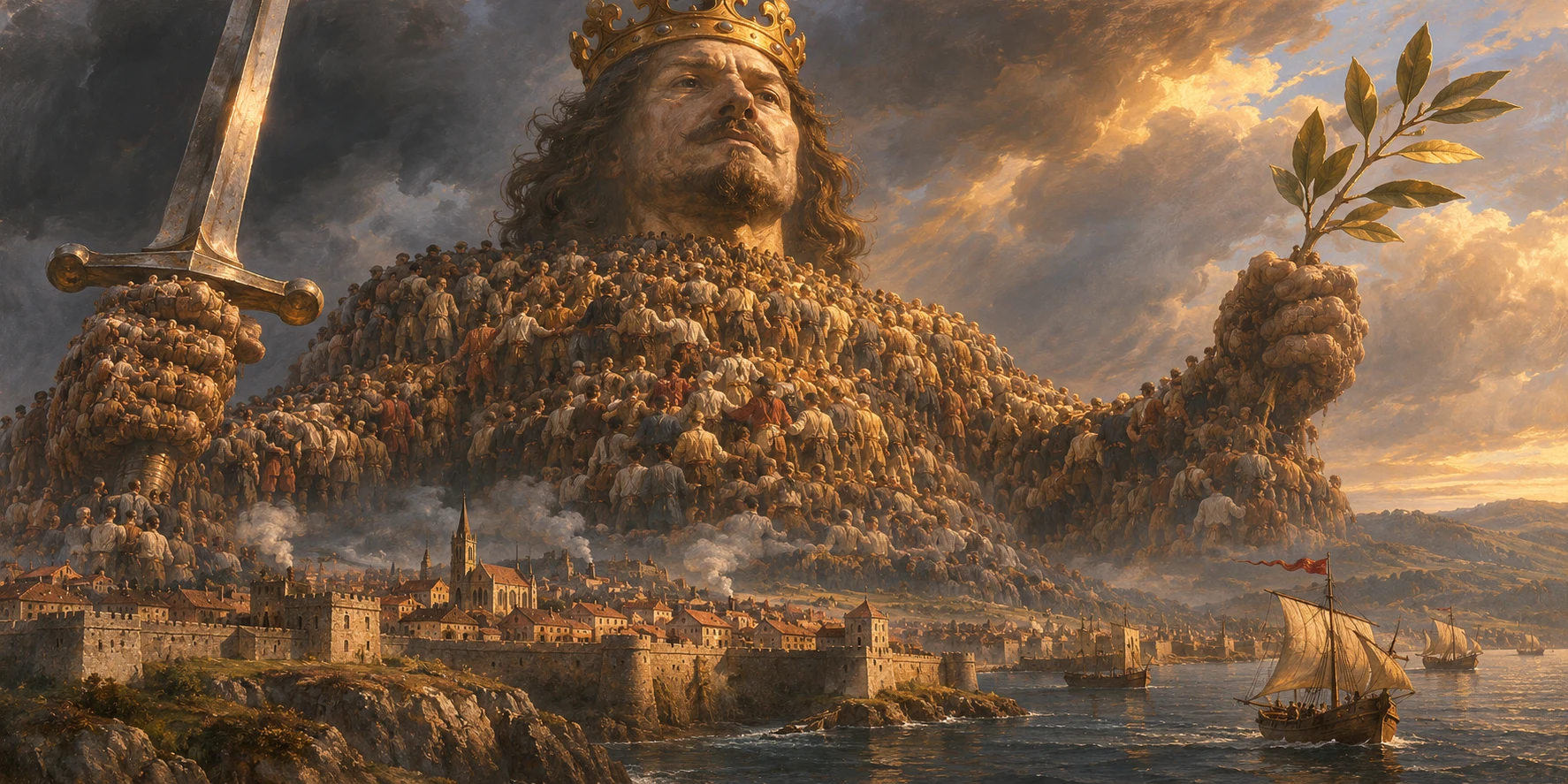
The giant on the title page of Leviathan is made of people. Etched by the Parisian artist Abraham Bosse after long discussion with Thomas Hobbes, he rises over a landscape with a sword in one hand and a bishop’s crozier in the other, and his body is built from more than three hundred tiny human figures, all with their backs to us, facing his crowned head. It is the whole argument of the book in one picture: a state is an artificial person, made out of the people who agree to obey it.
So how long is Leviathan? Six hundred and twenty-four pages in our edition: about twelve hours, if you read at the fifty-pages-an-hour pace our book cards assume. By our count the Project Gutenberg text, with its short front matter, is about 213,000 words. Everyone reads at a different pace, and Hobbes’s seventeenth-century prose is slower than a modern novel for most of us, so plan for more time rather than less.
How is Leviathan divided?
Into four parts of very different lengths. Most people who have read Leviathan have read the first two, which contain the famous material: the state of nature, the social contract and the powers of the sovereign. They make up almost exactly half the book. The second half, on religion, is the part many readers skip, and it is longer than people expect.
- Part I, Of Man (chapters 1–16), about 44,000 words: sense, imagination, language, reason, the passions, and the state of nature in chapter 13.
- Part II, Of Common-wealth (chapters 17–31), about 60,000 words: how a commonwealth is made, the rights of sovereigns, the liberty of subjects, law and punishment.
- Part III, Of a Christian Common-wealth (chapters 32–43), about 74,000 words: what Scripture says about prophecy, miracles and the kingdom of God, and who has authority to interpret it.
- Part IV, Of the Kingdome of Darknesse (chapters 44–47), about 29,000 words: an attack on the errors, superstitions and clerical power Hobbes blamed for political disorder.
- A Review and Conclusion, about 4,000 words, in which Hobbes answers objections and sums up.
A plan for reading Leviathan in a month
Thirty days at about 21 pages a day will take you through our edition. In words, that is a little over 7,000 a day, around half an hour at 250 words a minute. The parts fall neatly into four weeks if you let the long ones spill over a little:
- Week one: the Introduction and Part I. Hobbes builds his picture of human nature from the ground up, starting with the senses. Don’t skip the early chapters; the definitions do real work later.
- Week two: Part II. The commonwealth, the sovereign and the subject. This is the core of Hobbes’s political theory, and the week most likely to start arguments at dinner.
- Week three: Part III. The longest part, and the most unexpected. Hobbes reads the Bible with a lawyer’s eye to show that religion gives no one the right to defy the sovereign. Chapter 42 alone needs two or three days.
- Week four: Part IV and the Review and Conclusion. A polemic against the “Kingdome of Darknesse”, then Hobbes’s own summing-up.
If you only have a week, read Part I and Part II. You will miss the strangest half of the book, but you will have the argument most people mean when they say “Hobbes”.
Chapter 13, in the original spelling
Chapter 13 is the one to read first if you only read one. It describes people living without government, and many editions, including the Project Gutenberg text, keep Hobbes’s 1651 spelling, which looks odd for a page and then becomes part of the pleasure:
Hereby it is manifest, that during the time men live without a common Power to keep them all in awe, they are in that condition which is called Warre; and such a warre, as is of every man, against every man.
Thomas Hobbes, Leviathan (1651), chapter 13
A few paragraphs later comes the sentence everyone knows, that life in such a condition is “solitary, poore, nasty, brutish, and short.” Read the whole chapter rather than just the line. It is short, and its argument, that rough equality and mutual fear drive people into war, is the foundation of everything that follows.
Why is Leviathan so long?
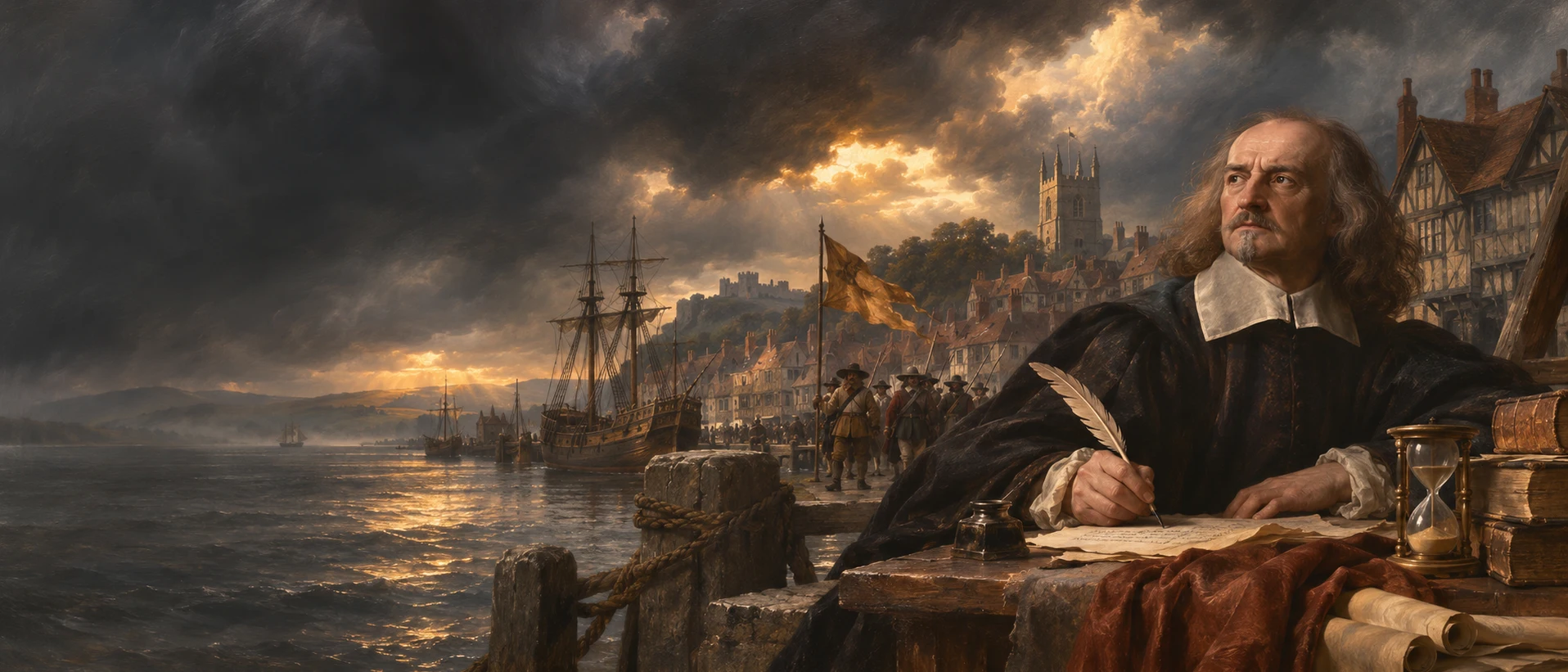
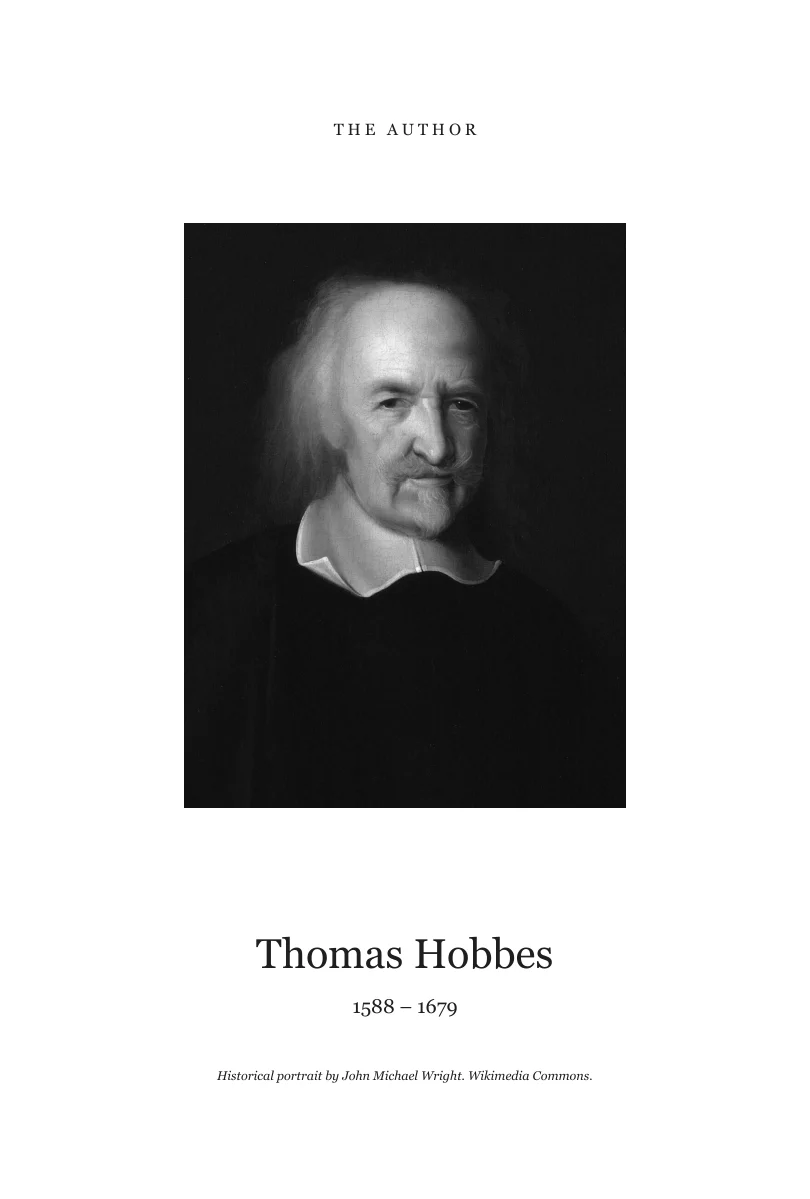
Partly because Hobbes was trying to settle everything at once. He wrote it in exile in Paris, where he had fled in 1640 fearing that his views would get him into trouble with the Long Parliament. He stayed for eleven years, taught mathematics to the young Prince of Wales, the future Charles II, for a time in 1647 and 1648, and finished Leviathan by 1650 while England fought its civil war. A book meant to prove that only an undivided sovereign could end such a war had to answer every rival claim to authority, and in the seventeenth century the strongest of those claims were religious. Hence Parts III and IV.
Hobbes signed the dedication in Paris in April 1651, and the book was printed in London for the bookseller Andrew Crooke later that year. A revised Latin version followed in 1668.
For the bigger picture, read What is the social contract? Hobbes, Locke and Rousseau explained, and if the prose defeats you, How to read philosophy without a degree has practical help. The Thomas Hobbes page has more on the man, and for another long work of political argument timed, see How long are the Federalist Papers?.
Pick the first of a month and turn to the Introduction to Leviathan, where Hobbes compares living bodies to clockwork automata and calls the commonwealth “an Artificiall Man”.
Questions readers ask
How long does it take to read Leviathan?
About twelve hours for our 624-page edition at 50 pages an hour, though many readers take longer because of the seventeenth-century prose. Around 21 pages a day will take you through it in a month.
How many parts and chapters does Leviathan have?
Four parts and 47 chapters, plus an Introduction and a Review and Conclusion. Parts I and II, on man and the commonwealth, are the best known and make up about half the book.
Do I need to read all of Leviathan?
For Hobbes’s political theory, Parts I and II are enough. Parts III and IV, on religion and the Church, are essential to his whole argument, but many readers skip them.