In the autumn of 2005, the BBC did something unusual with Bleak House. Instead of the usual hour-long episodes, its new adaptation opened with an hour and then ran half-hour instalments twice a week, on Thursday and Friday evenings, straight after EastEnders. Fifteen episodes and a cast of famous faces: the idea was to give a Victorian novel the pace and pull of a soap opera.
It was a fitting choice, because that is close to how the novel first appeared. Charles Dickens published Bleak House in monthly parts, from March 1852 to September 1853, and readers waited a month between each one. You need not wait. Our edition of Bleak House runs to 754 pages. Our book cards assume a reader gets through about fifty pages in an hour, which makes this roughly fifteen hours. Fast readers will do better; anyone who stops to untangle the lawsuit will take longer.
How many chapters are in Bleak House?
Sixty-seven, and they alternate between two quite different voices. One is an unnamed narrator who speaks in the present tense and ranges across London, from the fog of the Court of Chancery to the slum called Tom-all-Alone’s. The other is Esther Summerson, a young woman of unknown parents, who tells her own story in the past tense and begins in chapter 3. By our count she narrates 33 of the 67 chapters. She is the only female narrator in any of Dickens’s novels.
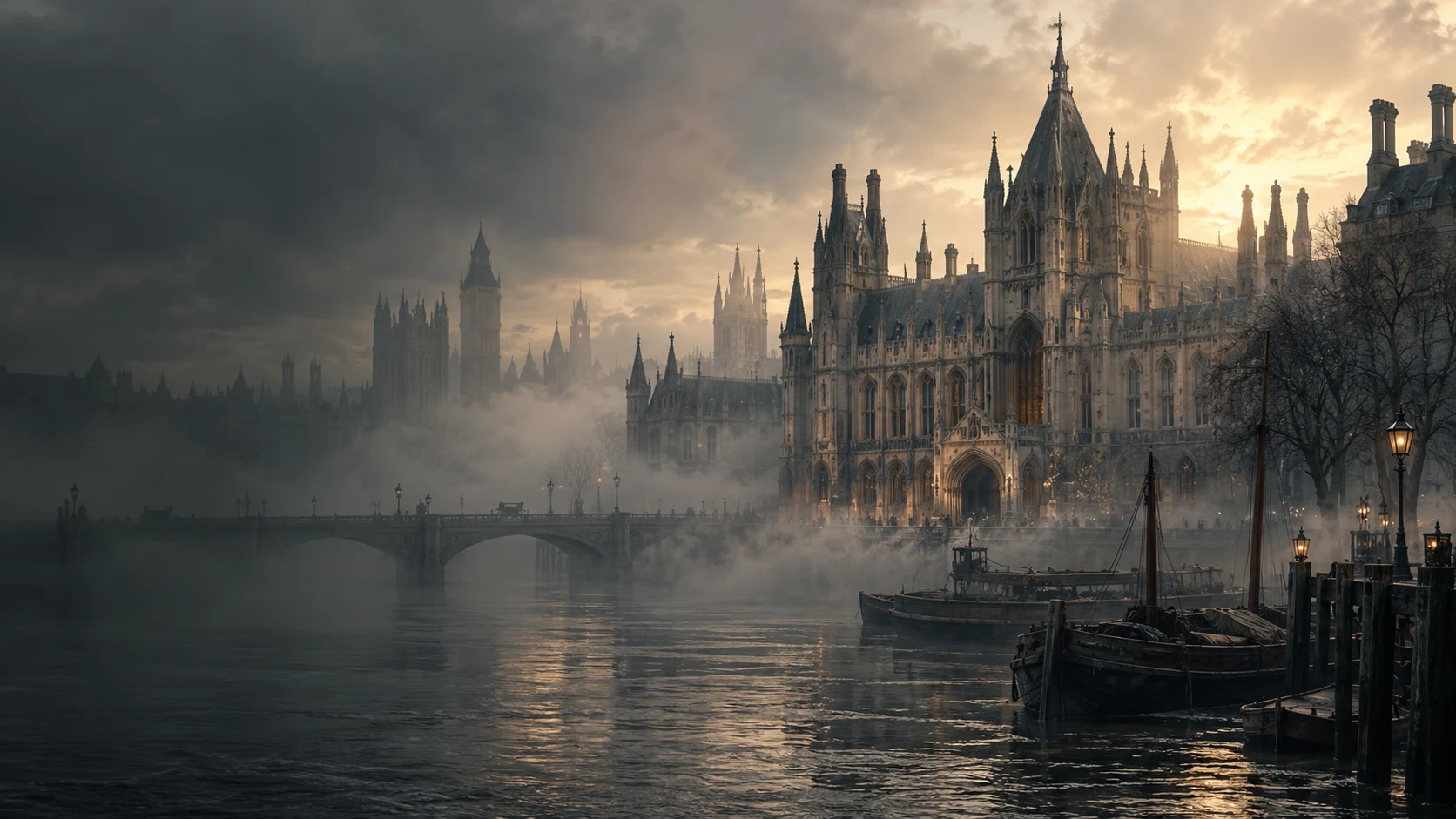
London. Michaelmas term lately over, and the Lord Chancellor sitting in Lincoln’s Inn Hall. Implacable November weather.
Charles Dickens, Bleak House (1853)
The switching takes a little getting used to, and it is the main reason people find the opening chapters slow. Give it until Esther arrives. Once you know whose voice you are in, the two strands start to pull against each other, and the book speeds up.
Reading Bleak House in its monthly parts
Each monthly number held three or four chapters and about thirty-two pages of print. In our edition a number comes to roughly forty pages, the best part of an hour. That gives you a ready-made plan, depending on how much time you have:
- Like a Victorian: one number a month, nineteen months. Faithful, and a real test of memory.
- Like the BBC: two numbers a week, Thursday and Friday, finishing in about ten weeks.
- Like a holiday: one number a day, three weeks, with the double number for the final weekend.
Following the original parts also shows you where Dickens built his suspense. Here is how the first year of numbers fell:
- Mar 1852
Number I, chapters 1–4: fog, Chancery, Lady Dedlock in the world of fashion, and Esther’s first chapter.
- May 1852
Number III, chapters 8–10: the lawyer Tulkinghorn goes looking for a law-writer who calls himself Nemo.
- Aug 1852
Number VI, chapters 17–19: Jo, the crossing-sweeper, is ordered by a constable to move on.
- Dec 1852
Number X, chapters 30–32: a death so strange that a leading critic accused Dickens of spreading superstition.
- Sept 1853
Numbers XIX–XX, chapters 60–67: the final double number.
Is Bleak House Dickens’s longest novel?
It is usually counted among his longest, though page counts depend on typesetting. Among the editions we publish, several are longer than Bleak House (754 pages): Dombey and Son runs to 974, Little Dorrit, Martin Chuzzlewit, Our Mutual Friend and Nicholas Nickleby all pass 900, and David Copperfield has 800; we rank the giants in the longest classic novels. What makes Bleak House feel larger is its cast. There are dozens of characters, a lawsuit called Jarndyce and Jarndyce that has outlived most of its parties, a detective, Inspector Bucket, and a mystery we will not spoil. A family tree helps; so does a note of who lives where.
Fifteen hours is nothing beside the lawsuit itself. In his preface Dickens insisted that Chancery really did behave like this, and one real case often linked to Jarndyce and Jarndyce, Thellusson v Woodford, concerned a will read in 1797 that was not finally settled until 1859. The novel’s satire fed a reform movement that eventually changed the courts in the 1870s.
Bleak House
1853. Fog, Chancery and a lawsuit that eats inheritances, told in two voices. Dickens’s most ambitious novel, and some of his best critics’ favourite.
David Copperfield
1850. The book written just before it, a little longer and far cosier: David’s life told by himself, from Blunderstone to London.
A Tale of Two Cities
1859. Dickens in a single week: 360 pages of London, Paris and revolution.


For more on how monthly numbers shaped these books, see Victorian serial novels, and for the rest of Dickens’s shelf, the lengths of all his novels. But fifteen hours begins with one foggy paragraph. Step into the November mud of chapter one of Bleak House and read the first number this evening.
Questions readers ask
How long does it take to read Bleak House?
Roughly fifteen hours: our edition has 754 pages, and at fifty an hour that is a little over fifteen. Taken one original part at a time, it is under an hour a part.
How many chapters are in Bleak House?
Sixty-seven. They were first published in twenty monthly parts between March 1852 and September 1853, the last two issued together.
Who narrates Bleak House?
Two narrators share the book: an unnamed voice in the present tense, and Esther Summerson, who tells her own story in the past tense in about half the chapters.
 Great Expectations532 pages · $23.99
 A Christmas Carol86 pages · $10.99
 Oliver Twist420 pages · $20.99
 Hard Times258 pages · $15.99