
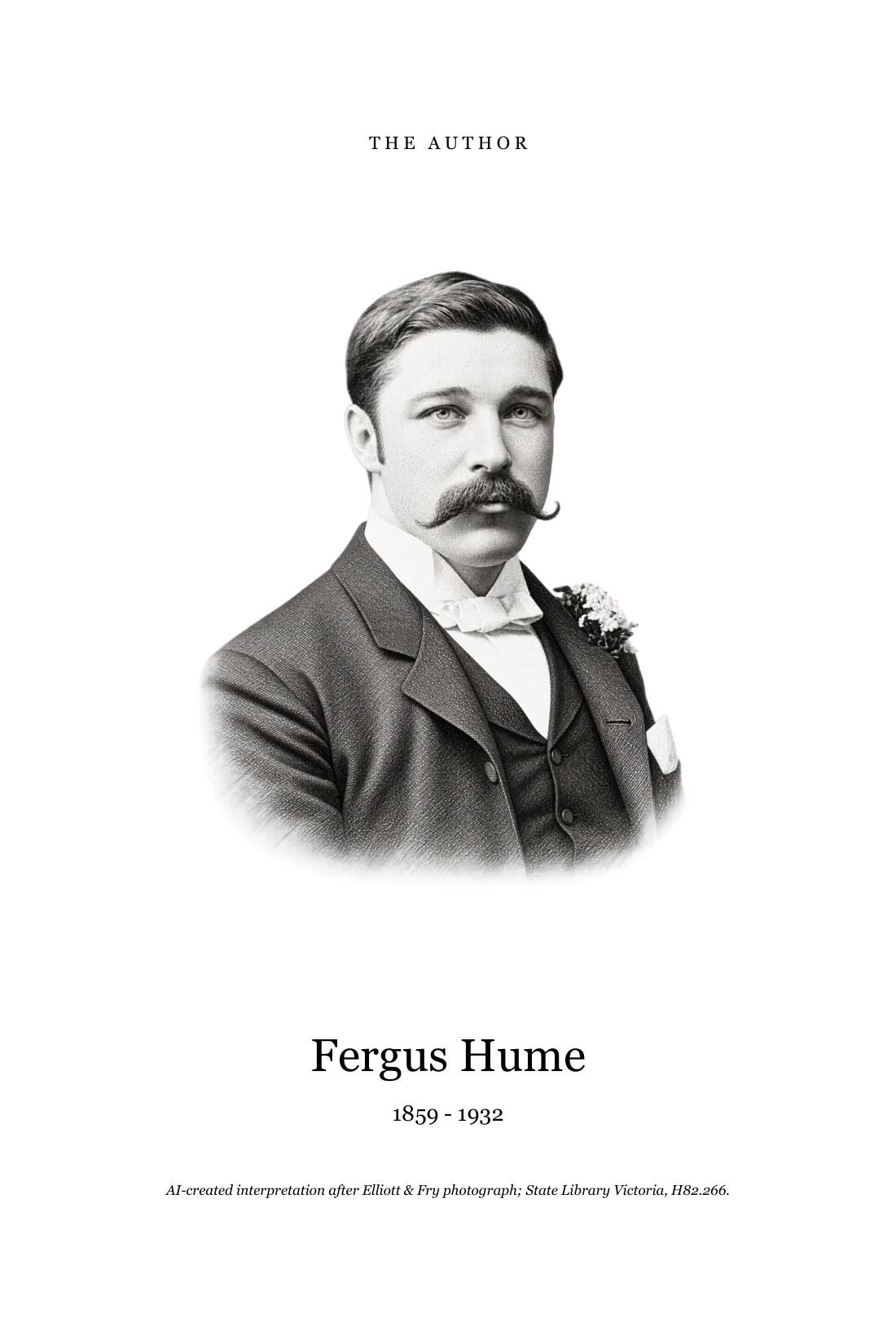
Fifty pounds. That, Fergus Hume said, was all he ever received for the English and American rights to The Mystery of a Hansom Cab, the novel that sold in hundreds of thousands and has been called the best-selling detective novel of the nineteenth century. He wrote it in Melbourne, published it there himself in 1886, and watched other people make the fortune.
So one of the best-selling mysteries of the Victorian age came out of Australia — with one correction its author insisted on. Fergus Hume was born in England in 1859 and grew up in Dunedin, New Zealand, before moving to Melbourne as a young barrister in 1885. “I belong to New Zealand, and not to Australia,” he wrote. The book, though, is Melbourne to its bones.
How did The Mystery of a Hansom Cab begin?
Hume told the story himself in the preface to a revised edition. He wanted to be a playwright, but no Melbourne theatre manager would read his plays, so he decided to write a novel to make a name locally. He asked a leading Melbourne bookseller what sold best, and was told the detective stories of Émile Gaboriau, the French author of the Lecoq novels. Hume had never heard of him. He bought all of Gaboriau’s books, read them carefully, and set out to write something of the same kind: a mystery, a murder, and a picture of low life in Melbourne.
The central idea i.e. the murder in a cab—came to me while driving at a late hour to St. Kilda, a suburb of Melbourne.
Fergus Hume, preface to The Mystery of a Hansom Cab
Publishers turned it down without reading it, he said, on the grounds that no colonial could write anything worth reading. So he paid for an edition himself, of some five thousand copies by his own recollection. It sold out in three weeks. A second edition sold almost as fast, and a group of speculators bought the rights from Hume, formed what they called the Hansom Cab Publishing Company and took the book to London, where it was published in 1887 and became a sensation.

What is The Mystery of a Hansom Cab about?
It opens with a newspaper report. In the small hours of a July night, a hansom cab pulls up at the police station in St Kilda, and the driver explains that the man in the back is dead. He had picked him up drunk in Collins Street; a gentleman in a light coat had climbed in to see him home, then got out on the way. There is no obvious motive, no witness who saw the stranger clearly, and soon a respectable young man is under arrest.
What follows takes the reader from the drawing rooms of wealthy squatters to the slums off Little Bourke Street, where Hume says he spent many nights gathering material. The lawyer Calton and two of the lodging-house keepers were drawn from people he knew, by his account, and his portrait of a city divided between new money and old poverty is the book’s lasting strength. We won’t give away who was in the cab.
The Mystery of a Hansom Cab
1886. A dead man in a cab, a city of gold-rush fortunes and slum lanes, and a trial that grips Melbourne. The Australian best-seller that beat Sherlock Holmes to the shelves.
A Study in Scarlet
1887. Sherlock Holmes’s debut, published in London the same year Hume’s novel was taking it by storm. It sold far fewer copies at first.


Did The Mystery of a Hansom Cab outsell Sherlock Holmes?
At first, yes, by a long way. A Study in Scarlet, the first Holmes story, appeared in Beeton’s Christmas Annual in 1887, the year Hume’s book reached London, and scholars of Australian literature note that the Hansom Cab outsold it. Holmes, of course, had the longer career. Hume’s book was soon parodied, as The Mystery of a Wheelbarrow in 1888, but today it is far less famous than the detective it once outsold. See Did you know Sherlock Holmes first appeared in a Christmas annual? for that side of the story.
- 1859
Fergus Hume is born in England; he grows up in Dunedin, New Zealand
- 1885
Hume moves to Melbourne
- 1886
The Mystery of a Hansom Cab is self-published in Melbourne
- 1887
Published in London, where it becomes a sensation; A Study in Scarlet appears the same year
- 1888
Hume moves to England; a parody, The Mystery of a Wheelbarrow, appears
- 1925
An Australian silent film version
- 1932
Hume dies in Essex, having written more than 130 novels
- 2012
An ABC television film revives the story

Is The Mystery of a Hansom Cab worth reading now?
Yes, for the city as much as the puzzle. Hume was a first-time novelist and it shows in places: the plot leans on coincidence and the dialogue can be stagey. But the book has pace and real atmosphere, and it is a fascinating snapshot of 1880s Melbourne. Readers who know Wilkie Collins will recognise its sensation-novel bones; see What was the sensation novel? for the family resemblance.
Hume went on to write a great many more mysteries, including The Green Mummy, though none matched his first. For other detectives who followed in Holmes’s era, try Books like Sherlock Holmes.
Start with the report in the Argus, as the cabman knocks on the station door in Grey Street. By the inquest, you will be as hooked as Melbourne was.
Questions readers ask
Who wrote The Mystery of a Hansom Cab?
Fergus Hume, an English-born writer raised in New Zealand, who wrote it while working as a barrister in Melbourne. He self-published it there in 1886.
Was The Mystery of a Hansom Cab a best-seller?
Yes. After its London publication in 1887 it sold hundreds of thousands of copies and has been called the best-selling detective novel of the nineteenth century, though Hume sold his rights for £50.
Did The Mystery of a Hansom Cab come before Sherlock Holmes?
Yes. It was published in Melbourne in 1886, a year before A Study in Scarlet, and it outsold Holmes’s debut at first.
 The Green Mummy252 pages · $15.99