Jean Marie Latour never existed. The quiet, scholarly French bishop who rides lost through the red hills of New Mexico in the opening pages of Death Comes for the Archbishop is a portrait of a real man, Jean-Baptiste Lamy, who arrived in Santa Fe in 1851 and died there, as Archbishop, in 1888. His restless friend and vicar, Father Joseph Vaillant, is drawn from an equally real priest, Joseph Projectus Machebeuf, who ended his days as the first Bishop of Denver.
Willa Cather changed the names, rearranged events and invented freely, but the outline of the novel is history: two seminary friends from the Auvergne, missionaries in Ohio, sent to a vast territory that the United States had just taken from Mexico, where they spend the rest of their lives.
Who was the real archbishop in Death Comes for the Archbishop?
Lamy was born in 1814 at Lempdes, near Clermont-Ferrand, and trained for the priesthood at the seminary of Montferrand. In 1839 he answered a call for missionaries from the Bishop of Cincinnati and spent the next decade as a parish priest in rural Ohio. Machebeuf, two years older, from nearby Riom and the same seminary, made the same journey the same year.
When the Mexican–American War brought New Mexico under American rule, Rome created a new vicariate there and, in 1850, named Lamy its bishop. He reached Santa Fe in the summer of 1851 to find that the local clergy did not recognise him; they answered to the Bishop of Durango, in Mexico, and Lamy had to ride there himself to settle the matter. Machebeuf came with him as vicar-general.
- 1814
Jean-Baptiste Lamy is born at Lempdes in the Auvergne, France
- 1839
Lamy and Joseph Machebeuf leave France to serve as missionary priests in Ohio
- 1850
Lamy is appointed to the new Vicariate Apostolic of New Mexico
- 1851
He enters Santa Fe, then rides to Durango in Mexico to establish his authority
- 1875
Santa Fe becomes an archdiocese, with Lamy as its first archbishop
- 1887
Machebeuf becomes the first Bishop of Denver
- 1888
Lamy dies in Santa Fe and is buried beneath the floor of his cathedral
- 1927
Willa Cather publishes Death Comes for the Archbishop
Cather’s novel follows that map closely. Its first book is set in the autumn of 1851; its bishop must ride to Durango to prove that he is who he says he is; his priests are from the seminary at Montferrand; and his friend, like Machebeuf, is eventually sent north to the Colorado gold fields, in a section Cather called “Gold under Pike’s Peak”.
The cathedral on the hill
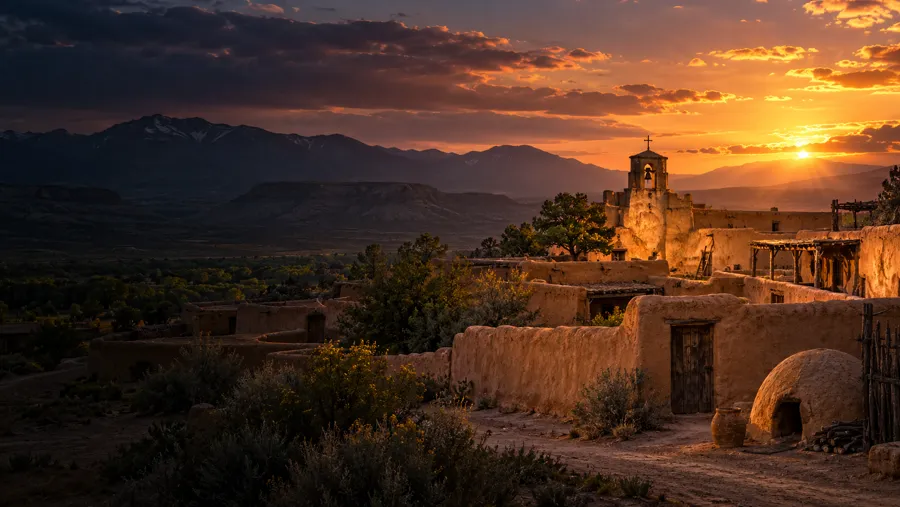
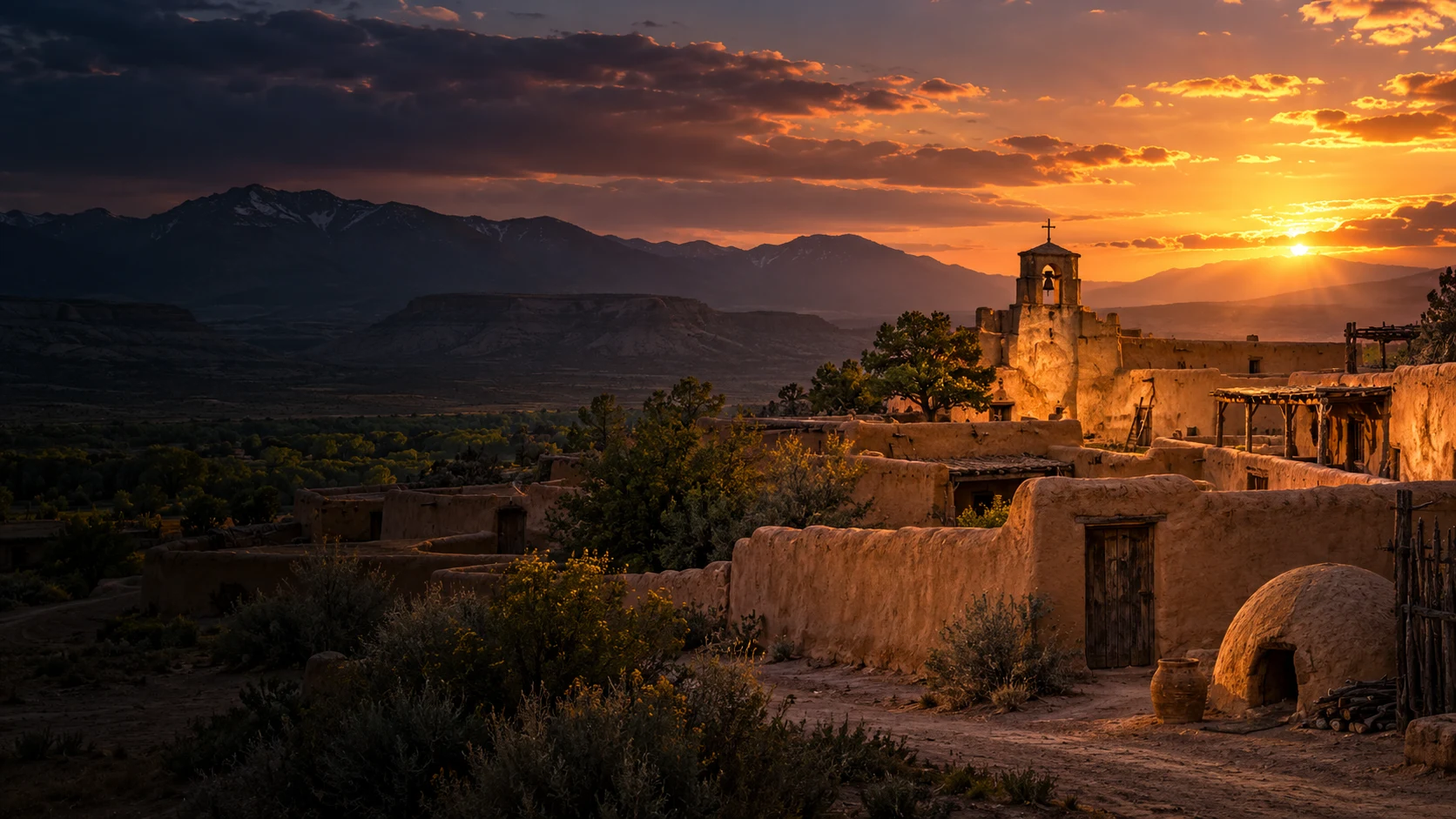
Lamy’s most visible legacy is the Cathedral Basilica of St Francis of Assisi in Santa Fe, built in a Romanesque Revival style that recalled the churches of his native France. A bronze statue of Lamy has stood in front of it since 1915. In the novel the cathedral becomes Latour’s great hope, and its stone a discovery. Out riding, he has found a single hill of golden rock among green ones, and one afternoon he takes Father Joseph to see it: “That hill, Blanchet, is my Cathedral.”
But the Cathedral is not for us, Father Joseph. We build for the future—better not lay a stone unless we can do that.
Bishop Latour, in Willa Cather’s *Death Comes for the Archbishop* (1927)
How did Cather know the story?
Mostly from a book. In 1908 a priest named William Joseph Howlett, who had once taught in Machebeuf’s school in Denver, published a Life of the Right Reverend Joseph P. Machebeuf, drawing on the private letters that Machebeuf’s brother and sister had kept and handed over to him. Cather later said that she relied on Howlett for her understanding of her “two priests”, and Vaillant’s motto, “Rest in action”, is a phrase that recurs in Howlett’s pages. Howlett himself remarked, a little drily, that anyone who read both books would see she had taken a good deal more from his than inspiration.
The rest came from her own travels in the Southwest, from local legend and from her imagination. The book is less a plot than a sequence of journeys and tales: a priest at Acoma, a miraculous apparition, an escape from a murderer’s house in a snowstorm, a long friendship growing old. Cather gives the Navajo and Pueblo peoples a dignity uncommon in fiction of the time, and has the dying Latour count the forced removal of the Navajo among the great wrongs he has seen.
How true to life is it?
True in outline, free in detail. Cather compresses decades, gives Latour an inner life no archive could supply, and tells the story from the side of the French newcomers: most of the Mexican priests Latour displaces appear as greedy, worldly or corrupt, which is only one side of a contested story. Read it as a legend told in clear, quiet prose rather than as a history of the New Mexican church.
It was a success at once, selling some 86,500 copies in its first two years, and it has stayed on the lists of the twentieth century’s best novels, including the Modern Library’s hundred. Cather’s first novel, oddly, was about an engineer building a bridge in Canada; her reputation as the great novelist of the American West was made on the Nebraska prairie, which our guide to the Prairie Trilogy explores, and in Willa Cather’s novels in order you can follow the road from one to the other.
If you have never read Cather, Death Comes for the Archbishop is a fine place to begin. Open it at the red hills, with the lost bishop and his compass, and let the journey take its time.
Questions readers ask
Who is Death Comes for the Archbishop based on?
Bishop Jean Marie Latour is based on Jean-Baptiste Lamy (1814–1888), the first Archbishop of Santa Fe. Father Joseph Vaillant is based on Joseph Projectus Machebeuf, who became the first Bishop of Denver.
Is Death Comes for the Archbishop a true story?
It is a novel, but it follows the real careers of Lamy and Machebeuf closely in outline. Cather changed names, invented scenes and retold local legends.
When was Death Comes for the Archbishop published?
It was published in 1927 by Alfred A. Knopf and sold strongly from the start.
Where did Willa Cather get the story?
She drew heavily on William Joseph Howlett’s 1908 biography of Machebeuf, which quotes many of his letters home, as well as on her own travels in New Mexico.
 O Pioneers!156 pages · $12.99
 My Ántonia222 pages · $14.99
 The Song of the Lark444 pages · $20.99
 Alexander's Bridge78 pages · $10.99