
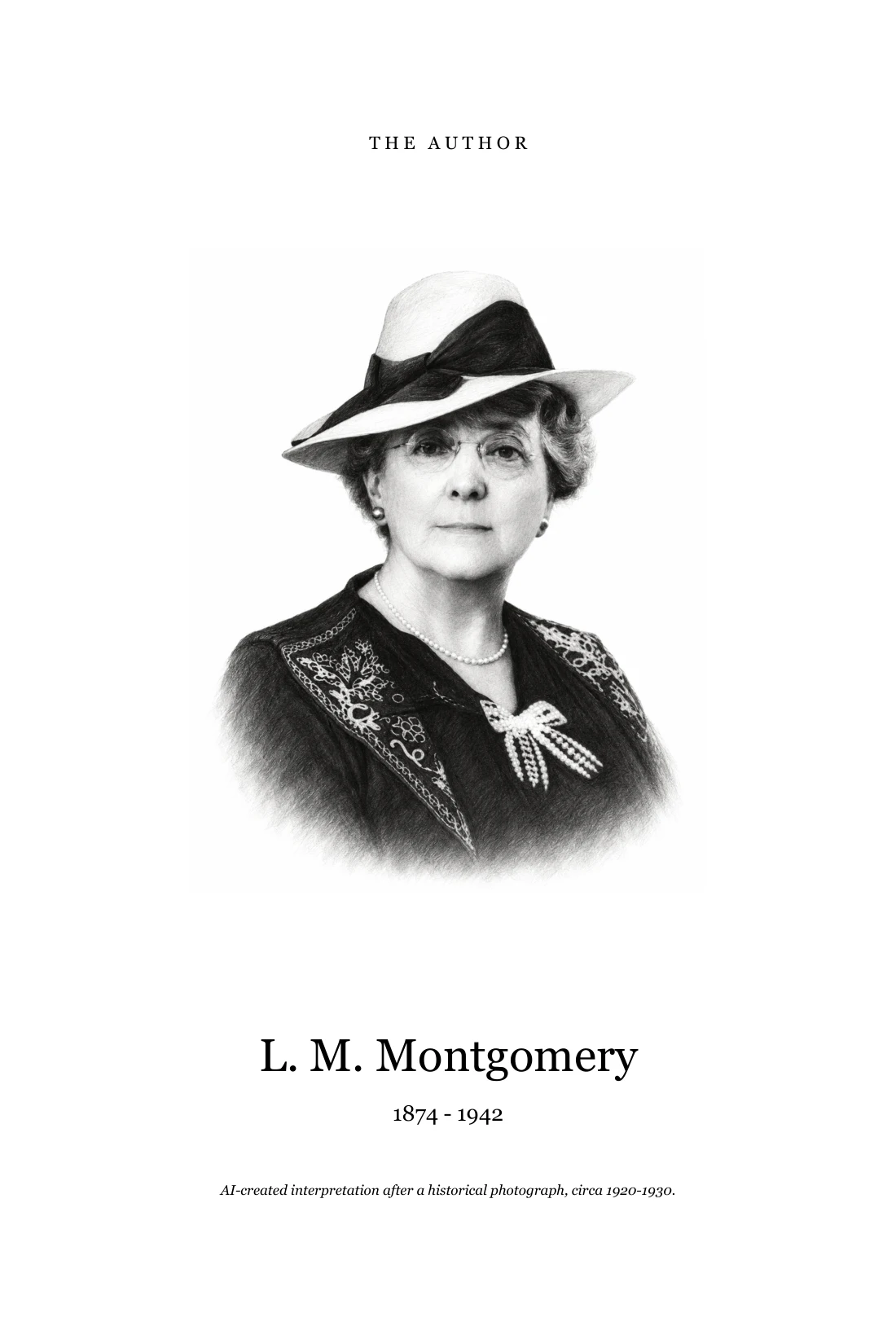
It took L. M. Montgomery the best part of a decade in court to get Further Chronicles of Avonlea off the market. The book was hers, in the sense that she had written every word of it. She simply had not agreed to its publication, at least not in the form her old publisher chose to print.
That is the odd history behind the second of two story collections set in Anne Shirley’s world. Chronicles of Avonlea (1912) and Further Chronicles of Avonlea (1920) together hold twenty-seven stories about the farmers, spinsters, feuding lovers and stubborn old men of Avonlea and the villages around it. Anne herself is a visitor rather than a resident: she stars in just two of them.
Is Anne in Chronicles of Avonlea?
A little. The first story, “The Hurrying of Ludovic”, finds Anne on holiday at Echo Lodge, the house she knows from Anne of Avonlea, deciding to help a middle-aged courtship that has been moving at walking pace for fifteen years. She also has a small part in “The Courting of Prissy Strong” and is mentioned in passing elsewhere, along with Marilla, Mrs Rachel Lynde and Diana Barry.
“When a man has been coming to see you straight along, twice a week for fifteen years, you get rather talked out by spells.”
Theodora Dix, “The Hurrying of Ludovic”, Chronicles of Avonlea (1912)
The rest of the cast is new, and that is a clue to how the book was made. With no novel ready for 1912, Montgomery agreed to her publisher’s suggestion that she revise some of her earlier magazine stories, many written before Anne existed, to add references to Anne and to Avonlea. Twelve were chosen. Some, inevitably, wear their Avonlea addresses a little loosely.

The best stories in Chronicles of Avonlea
- “The Quarantine at Alexander Abraham’s”: a woman who dislikes men climbs into the house of a man who will not have a woman over his doorstep, not knowing it has just been put under smallpox quarantine. Neither is allowed to leave. The funniest story in either book.
- “Pa Sloane’s Purchase”: an old farmer with a weakness for auctions, much to his wife’s despair, comes home from one with a baby.
- “Old Lady Lloyd”: a proud, impoverished old woman, thought by the village to be rich, secretly helps the daughter of the man she once loved.
- “The Miracle at Carmody”: a fierce unbeliever, her lame and gentle sister and a small boy who sets out to prove that prayer works.
- “Each in His Own Tongue”: a minister’s grandson with a gift for the violin, and a grandfather who believes the gift is a sin.
Chronicles of Avonlea
1912. Twelve stories of courtship, pride and reconciliation, mostly comic, sometimes tearful. Anne opens the book and then steps quietly aside.
Further Chronicles of Avonlea
1920. Fifteen more stories, darker in places, including one narrated by Anne and a ghostly tale of a grieving mother by the sea. Published without Montgomery’s consent.


Why was Further Chronicles of Avonlea published without permission?
By 1919 Montgomery had left L. C. Page, whom she believed had underpaid her for years, and the two were already fighting in court. As part of a settlement she reluctantly sold Page her remaining rights in her early books. The condition, according to L. M. Montgomery Online, was that a new collection drawn from leftover stories should not feature Anne Shirley in the book or on its cover.
Montgomery had revised the leftover stories accordingly. Page then announced that he would print the old 1912 versions he still held. Further Chronicles of Avonlea appeared in 1920, and Montgomery sued again. The case was not settled until 1928, when she won and the book was withdrawn. It returned to print decades later and has stayed there.

What is in Further Chronicles of Avonlea?
Anne narrates “The Little Brown Book of Miss Emily”, in which she and Diana, spending time at Echo Lodge, come to know a tiresome old spinster who leaves Anne her secret when she dies. Elsewhere the mood ranges from farce, in “Aunt Cynthia’s Persian Cat”, where two sisters lose a rich aunt’s precious pet, and “The Materializing of Cecil”, where a spinster’s invented suitor turns up in person, to the unsettling “The Dream-Child”. The last story, “Tannis of the Flats”, moves far from the Island to a trading post in the Canadian Northwest, and its treatment of a Métis heroine reflects the attitudes of its time.
Road to Avonlea and the stories on screen
If these stories feel familiar, it may be because of Road to Avonlea, the Canadian series that ran from 1990 to 1996. Many of its early episodes were drawn from both Chronicles books, stitched together with the King family from The Story Girl and The Golden Road.
Read the Anne of Green Gables books in order first if you can, so that Echo Lodge and Mrs Lynde mean something. Then, for an evening of short, satisfying pieces by L. M. Montgomery at her most playful, open Chronicles of Avonlea and let Anne introduce you to the neighbours. Fans of the Island will find more in books like Anne of Green Gables.
Questions readers ask
Is Anne in Chronicles of Avonlea?
Only briefly. She is the central figure in the first story, “The Hurrying of Ludovic”, has a small role in one other and is mentioned in a few more. The other stories are about Avonlea’s neighbours.
Is Chronicles of Avonlea part of the Anne series?
It is a companion volume rather than one of the eight Anne novels. It shares the setting and a few characters but can be read at any point.
Why did L. M. Montgomery sue over Further Chronicles of Avonlea?
Her former publisher, L. C. Page, printed old versions of stories she had revised under an agreement not to feature Anne. Montgomery sued, and the case was settled in her favour in 1928.
 Anne of Green Gables258 pages · $15.99
 The Blue Castle212 pages · $14.99
 Anne of Avonlea244 pages · $15.99
 Anne of the Island228 pages · $14.99