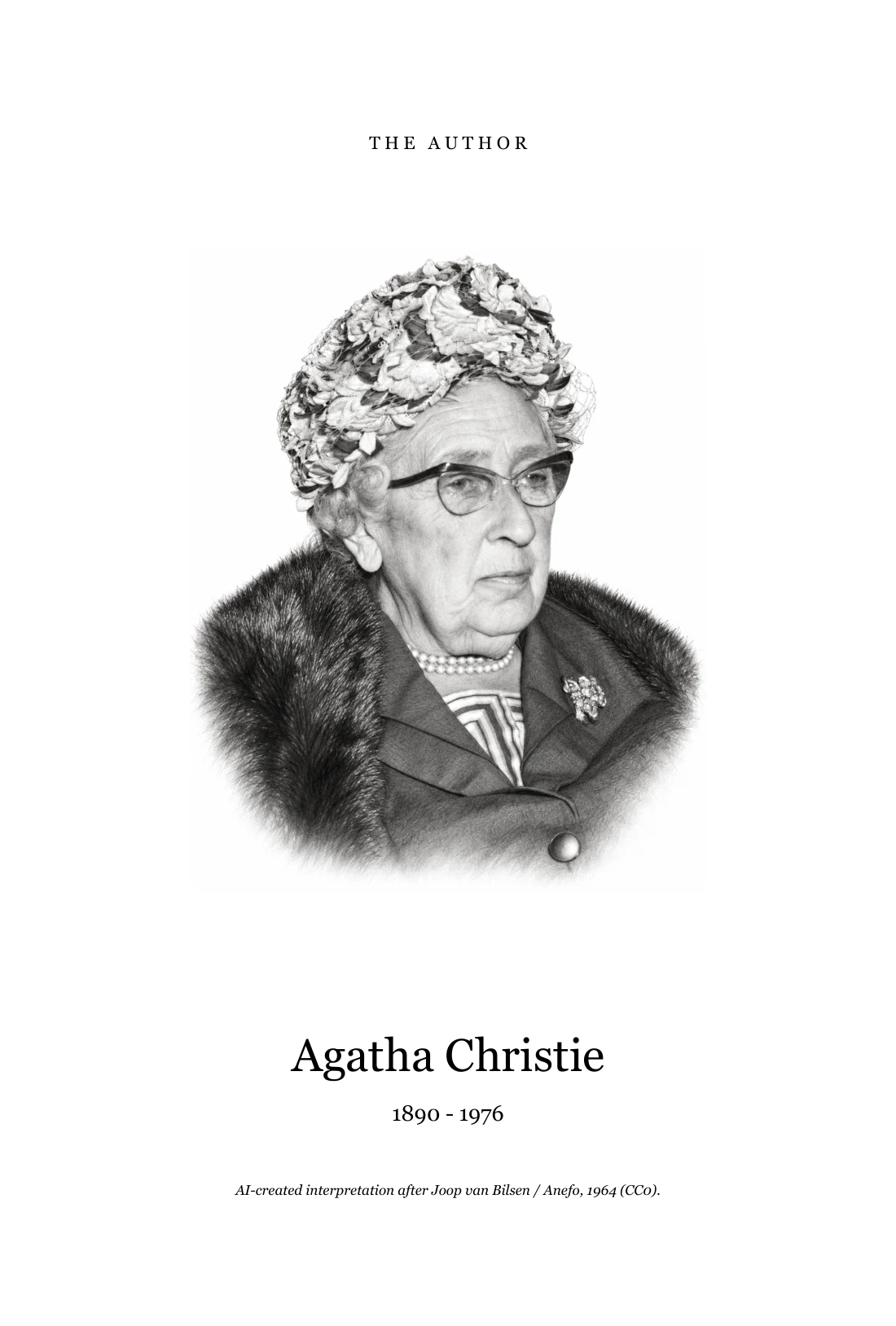
Twenty-five pounds. That, according to the Christie estate, is what Agatha Christie earned from her first detective novel, The Mysterious Affair at Styles, and it reportedly came from her share of the serial rights rather than from the book. She had to fight her way even to that modest sum, because Agatha Christie’s first novel was rejected by every publisher who saw it, and her second attempt fared little better.
There are, in fact, two first novels in this story. One was never published at all. The other is The Mysterious Affair at Styles, which introduced Hercule Poirot and was turned down at least twice before anyone would take it on.
The novel nobody wanted
As a young woman Christie wrote a novel called Snow Upon the Desert, drawing on a season she had spent in Cairo, and sent it out under the pen name Monosyllaba. Six publishers declined it. Her mother suggested she ask for advice from Eden Phillpotts, a successful novelist and family friend, who encouraged her and introduced her to his literary agent, Hughes Massie. Massie turned the book down as well, but told her to try writing another.
A dare, a dispensary and a Belgian
The other came out of the First World War. Christie served as a Voluntary Aid Detachment nurse at the Red Cross hospital in Torquay Town Hall, and from 1917 worked as a paid dispenser after qualifying as an apothecary’s assistant. The job gave her a working knowledge of poisons that she would draw on for the rest of her career.
According to the Christie estate, the push to try a mystery came from her sister Madge, who bet her she could not write a detective story. Christie started in 1916 and wrote much of it on Dartmoor. For her detective she borrowed from the Belgian refugees then living in Torquay, and produced a retired Belgian policeman with an egg-shaped head:
Poirot was an extraordinary looking little man. He was hardly more than five feet, four inches, but carried himself with great dignity. His head was exactly the shape of an egg, and he always perched it a little on one side.
Agatha Christie, The Mysterious Affair at Styles (1920)
Why was The Mysterious Affair at Styles rejected?
Publishers do not usually explain themselves, and these did not. Hodder and Stoughton returned the manuscript, and so did Methuen. Christie then sent it to John Lane at The Bodley Head, where it disappeared into a drawer. The war ended, her husband Archie came home, and by the estate’s account she had more or less forgotten about it when, after a long silence, Lane asked to see her.
He would publish, he said, if she changed the ending. In her draft the solution was revealed in a courtroom. Lane wanted it moved, and Christie rewrote the scene so that Poirot explains everything in the library at Styles instead. The original courtroom chapter survived, and has since been published.

How the first Poirot novel was received
Before it appeared as a book, Styles ran as a serial in The Times Weekly Edition in 1920. It was published in the United States in October 1920, by John Lane’s New York house, and by The Bodley Head in Britain on 21 January 1921. The Times Literary Supplement said its only fault was that it was almost too ingenious, which is the kind of complaint a new writer can live with.
It was not an overnight sensation, but it set everything in motion. Poirot, Captain Hastings and Inspector Japp all make their first appearances here, along with Christie’s gift for making every member of a household look guilty. In 1935 it was among the first ten paperbacks published by Penguin Books.
The Mysterious Affair at Styles
1920. A wealthy woman, newly married to a much younger man, dies of strychnine poisoning at an Essex country house, and a Belgian refugee in the village is asked to help. Christie’s first published novel, and Poirot’s first case.
The Secret Adversary
1922. Christie’s second novel swaps Poirot for Tommy and Tuppence, two cheerful young adventurers who blunder into a post-war conspiracy.
The Murder on the Links
1923. Poirot returns, this time on the French coast, facing a murdered millionaire and a rival detective from Paris.


For other writers whose careers began with a single book that changed everything, see Debut novels by famous authors. Poirot’s next steps are traced in Hercule Poirot’s first cases, in the order they were published, and the book that made her truly famous gets its own investigation in Did The Murder of Roger Ackroyd really cause a scandal?.
It is a long road from six rejection slips and a forgotten manuscript to the most famous detective in fiction. Begin it where Christie did: The Mysterious Affair at Styles, with a death by strychnine, a houseful of suspects and a small man who considers “a man of method” the highest praise there is.
Questions readers ask
What was Agatha Christie’s first novel?
Her first completed novel was Snow Upon the Desert, set in Cairo, which was rejected and never published. Her first published novel was The Mysterious Affair at Styles, published in 1920 in the United States and 1921 in Britain.
How many times was The Mysterious Affair at Styles rejected?
At least twice, by Hodder and Stoughton and by Methuen, before John Lane of The Bodley Head agreed to publish it on condition that Christie rewrote the final revelation scene.
How much did Agatha Christie earn from her first book?
About £25, reportedly from her share of the serial rights. Her contract with The Bodley Head also tied up her next five books, terms she later regretted.
 The Murder of Roger Ackroyd212 pages · $14.99
 The Murder at the Vicarage216 pages · $14.99
 The Man in the Brown Suit234 pages · $14.99
 The Secret of Chimneys248 pages · $15.99